


Page 2374 - Hematology_ Basic Principles and Practice ( PDFDrive )
P. 2374
2116   Part XII  Hemostasis and Thrombosis


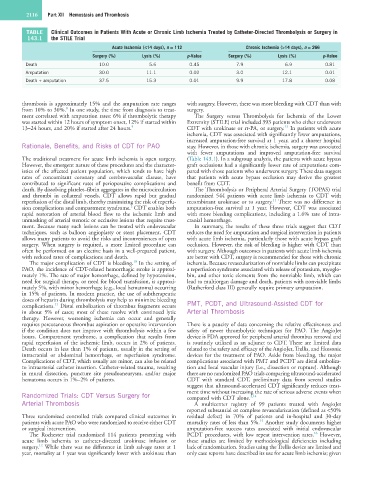
          TABLE   Clinical Outcomes in Patients With Acute or Chronic Limb Ischemia Treated by Catheter-Directed Thrombolysis or Surgery in
          143.1   the STILE Trial
                                      Acute Ischemia (≤14 days), n = 112         Chronic Ischemia (>14 days), n = 266
                               Surgery (%)      Lysis (%)     p-Value       Surgery (%)     Lysis (%)      p-Value
         Death                   10.0             5.6          0.45           7.9             6.9          0.81
         Amputation              30.0            11.1          0.02           3.0            12.1          0.01
         Death + amputation      37.5            15.3          0.01           9.9            17.8          0.08


        thrombosis  is  approximately  15%  and  the  amputation  rate  ranges   with surgery. However, there was more bleeding with CDT than with
                       8
        from 10% to 30%.  In one study, the time from diagnosis to treat-  surgery.
        ment correlated with amputation rates: 6% if thrombolytic therapy   The  Surgery  versus  Thrombolysis  for  Ischemia  of  the  Lower
        was started within 12 hours of symptom onset, 12% if started within   Extremity (STILE) trial included 393 patients who either underwent
                                                                                              13
        13–24 hours, and 20% if started after 24 hours. 9     CDT with urokinase or rt-PA, or surgery.  In patients with acute
                                                              ischemia, CDT was associated with significantly fewer amputations,
                                                              increased amputation-free survival at 1 year, and a shorter hospital
        Rationale, Benefits, and Risks of CDT for PAO         stay. However, in those with chronic ischemia, surgery was associated
                                                              with  fewer  amputations  and  improved  amputation-free  survival
        The traditional treatment for acute limb ischemia is open surgery.   (Table 143.1). In a subgroup analysis, the patients with acute bypass
        However, the emergent nature of these procedures and the character-  graft occlusions had a significantly lower rate of amputations com-
        istics of the affected patient population, which tends to have high   pared with those patients who underwent surgery. These data suggest
        rates  of  concomitant  coronary  and  cerebrovascular  disease,  have   that  patients  with  acute  bypass  occlusion  may  derive  the  greatest
        contributed  to  significant  rates  of  perioperative  complications  and   benefit from CDT.
        death. By dissolving platelet–fibrin aggregates in the microcirculation   The Thrombolysis or Peripheral Arterial Surgery (TOPAS) trial
        and  thrombi  in  collateral  vessels,  CDT  allows  rapid  but  gradual   randomized  544  patients  with  acute  limb  ischemia  to  CDT  with
                                                                                          11
        reperfusion of the distal limb, thereby minimizing the risk of reperfu-  recombinant urokinase or to surgery.  There was no difference in
                                            2
        sion complications and compartment syndrome.  CDT enables both   amputation-free  survival  at  1  year.  However,  CDT  was  associated
        rapid  restoration  of  arterial  blood  flow  to  the  ischemic  limb  and   with more bleeding complications, including a 1.6% rate of intra-
        unmasking of arterial stenotic or occlusive lesions that require treat-  cranial hemorrhage.
        ment. Because many such lesions can be treated with endovascular   In  summary,  the  results  of  these  three  trials  suggest  that  CDT
        techniques,  such  as  balloon  angioplasty  or  stent  placement,  CDT   reduces the need for amputation and surgical intervention in patients
        allows many patients to avoid the risks and inconveniences of open   with acute limb ischemia, particularly those with acute bypass graft
        surgery.  When  surgery  is  required,  a  more  limited  procedure  can   occlusion. However, the risk of bleeding is higher with CDT than
        often be performed on an elective basis in a well-prepared patient,   with surgery. Although outcomes in patients with acute limb ischemia
        with reduced rates of complications and death.        are better with CDT, surgery is recommended for those with chronic
                                             10
           The major complication of CDT is bleeding.  In the setting of   ischemia. Because revascularization of nonviable limbs can precipitate
        PAO, the incidence of CDT-related hemorrhagic stroke is approxi-  a reperfusion syndrome associated with release of potassium, myoglo-
        mately 1%. The rate of major hemorrhage, defined by hypotension,   bin, and other toxic elements from the nonviable limb, which can
        need for surgical therapy, or need for blood transfusion, is approxi-  lead to multiorgan damage and death, patients with nonviable limbs
        mately 5%, with minor hemorrhage (e.g., local hematoma) occurring   (Rutherford class III) generally require primary amputation.
        in 15% of patients. In modern practice, the use of subtherapeutic
        doses of heparin during thrombolysis may help to minimize bleeding
                   11
        complications.  Distal embolization of thrombus fragments occurs   PMT, PCDT, and Ultrasound-Assisted CDT for
        in  about  5%  of  cases;  most  of  these  resolve  with  continued  lytic   Arterial Thrombosis
        therapy.  However,  worsening  ischemia  can  occur  and  generally
        requires percutaneous thrombus aspiration or operative intervention   There is a paucity of data concerning the relative effectiveness and
        if the condition does not improve with thrombolysis within a few   safety  of  newer  thrombolytic  techniques  for  PAO.  The  AngioJet
        hours.  Compartment  syndrome,  a  complication  that  results  from   device is FDA approved for peripheral arterial thrombus removal and
        rapid  reperfusion  of  the  ischemic  limb,  occurs  in  2%  of  patients.   is routinely utilized as an adjunct to CDT. There are limited data
        Death occurs in less than 1% of patients, usually in the setting of   related to the safety and efficacy of the AngioJet, Trellis, and Ekosonic
        intracranial  or  abdominal  hemorrhage,  or  reperfusion  syndrome.   devices for the treatment of PAO. Aside from bleeding, the major
        Complications of CDT, which usually are minor, can also be related   complications associated with PMT and PCDT are distal emboliza-
        to intraarterial catheter insertion. Catheter-related trauma, resulting   tion and local vascular injury (i.e., dissection or rupture). Although
        in  mural  dissection,  puncture  site  pseudoaneurysm,  and/or  major   there are no randomized PAO trials comparing ultrasound-accelerated
        hematoma occurs in 1%–2% of patients.                 CDT  with  standard  CDT,  preliminary  data  from  several  studies
                                                              suggest that ultrasound-accelerated CDT significantly reduces treat-
        Randomized Trials: CDT Versus Surgery for             ment time without increasing the rate of serious adverse events when
                                                                                   3,14
                                                              compared with CDT alone.
        Arterial Thrombosis                                      A  multicenter  registry  of  99  patients  treated  with  AngioJet
                                                              reported substantial or complete revascularization (defined as <50%
        Three  randomized  controlled  trials  compared  clinical  outcomes  in   residual  defect)  in  70%  of  patients  and  in-hospital  and  30-day
                                                                                      15
        patients with acute PAO who were randomized to receive either CDT   mortality rates of less than 5%.  Another study documents higher
        or surgical intervention.                             amputation-free  success  rates  associated  with  initial  endovascular
                                                                                                        16
           The  Rochester  trial  randomized  114  patients  presenting  with   PCDT  procedures,  with  low  repeat  intervention  rates.   However,
        acute  limb  ischemia  to  catheter-directed  urokinase  infusion  or   these  studies  are  limited  by  methodological  deficiencies  including
              12
        surgery.  While there was no difference in limb salvage rates at 1   lack of randomization. Studies using the Trellis device are limited and
        year, mortality at 1 year was significantly lower with urokinase than   only case reports have described its use for acute limb ischemia; given

