


Page 2377 - Hematology_ Basic Principles and Practice ( PDFDrive )
P. 2377
Chapter 143  Mechanical Interventions in Arterial and Venous Thrombosis  2119


            shown that organized thrombus is not susceptible to thrombolytic   extensive proximal lower extremity DVT, such as those with acute
            drugs). 22                                            iliofemoral DVT, who have a low risk of bleeding and a long life-
              The most important safety factor to consider in a patient being   expectancy. 1,25–27   However,  the  2016  guidelines  update  from  the
            evaluated for DVT thrombolysis is the risk of major bleeding. Factors   American  College  of  Chest  Physicians  recommends  against  the
            associated  with  an  increased  risk  of  bleeding  include  ongoing  or   routine use of CDT, with the caveat that patients who attach a high
            recent bleeding; recent major surgery, trauma, pregnancy, obstetrical   value  to  PTS  prevention  relative  to  bleeding  risks  and  procedural
            delivery, or cardiopulmonary resuscitation; or the presence of lesions   inconvenience may choose CDT. 18
            in critical areas such as the central nervous system, which may bleed.
            Because CDT involves the administration of iodinated contrast mate-
            rial for venography, renal function is also an important consideration   Treatment of Established PTS
            as are life expectancy, baseline ambulatory capacity, and comorbidi-
            ties. 1,25  Patients with limited long-term mobility or those with a life   Patients  with  established  PTS  suffer  major  symptoms  that  signifi-
            expectancy of less than 6 months are unlikely to benefit from aggres-  cantly  impair  their  ability  to  conduct  their  daily  activities  and  to
            sive therapy to prevent PTS. Comorbidities that increase procedure   enjoy a normal QOL. Unfortunately once PTS has developed, there
            risks, such as respiratory compromise that limits the use of sedation,   are no treatments that have consistently been shown to be effective.
            may also render CDT less attractive.                  Despite limited evidence of benefit, elastic compression stockings are
              Urgent  endovascular  thrombolysis  is  indicated  to  prevent  life-,   often utilized because of their low risk and ready availability. Low-
            limb-, or organ-threatening complications of acute DVT in situations   dose diuretics may be useful to reduce edema. Patients with venous
            such  as  phlegmasia  cerulea  dolens  or  extensive  IVC  thrombosis   ulcers can be given pentoxifylline, dedicated wound care with topical
            (especially with suprarenal extension, which may lead to fatal PE or   antibiotics, exfoliants, and growth factors, and multilayer compres-
                                                                             28
            acute renal failure). The use of endovascular thrombolysis in these   sion bandaging.  Despite these measures, PTS symptoms and venous
            situations is justifiable when other treatment options are lacking. In   ulcers often resist improvement and cause long-term hardships.
            contrast,  there  is  significant  uncertainty  regarding  the  appropriate   Because the severity of PTS symptoms often parallels the degree
            indications for nonurgent CDT for the treatment of DVT. At present,   of ambulatory venous hypertension, endovascular interventions that
            guidelines  of  the  American  Heart  Association  (2011),  Society  of   eliminate venous obstruction and valvular reflux have been used for
            Interventional  Radiology  (2014),  American  Venous  Forum  and   treatment  of  patients  with  severe  PTS.  Studies  suggest  that  stent
            Society  for  Vascular  Surgery  (2012),  and  the  United  Kingdom’s   recanalization  of  chronically  occluded  iliac  veins  in  patients  with
            National Institute of Clinical Excellence (2012) suggest the use of   advanced  PTS  can  be  achieved  in  over  80%  of  patients  and  can
            CDT/PCDT  as  an  adjunct  to  anticoagulant  therapy  for  carefully   reduce  PTS  symptoms,  improve  QOL,  and  enhance  healing  of
                                                                            29
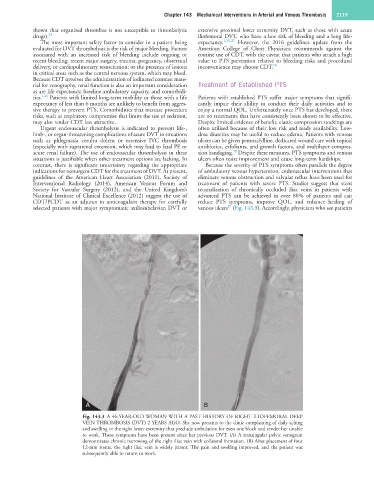
            selected patients with major symptomatic axillosubclavian DVT or   venous ulcers  (Fig. 143.3). Accordingly, physicians who see patients


                             A                                      B
                            Fig. 143.3  A 46-YEAR-OLD WOMAN WITH A PAST HISTORY OF RIGHT ILIOFEMORAL DEEP
                            VEIN THROMBOSIS (DVT) 2 YEARS AGO. She now presents to the clinic complaining of daily aching
                            and swelling in the right lower extremity that preclude ambulation for even one block and render her unable
                            to work. These symptoms have been present since her previous DVT. (A) A transjugular pelvic venogram
                            demonstrates chronic narrowing of the right iliac vein with collateral formation. (B) After placement of four
                            12-mm stents, the right iliac vein is widely patent. The pain and swelling improved, and the patient was
                            subsequently able to return to work.

