


Page 2378 - Hematology_ Basic Principles and Practice ( PDFDrive )
P. 2378
2120   Part XII  Hemostasis and Thrombosis


        with severe PTS, with or without ulcers, should consider consulting
        a venous endovascular specialist.

        Inferior Vena Cava Filters

        IVC filters are indicated for patients with proximal DVT or PE who
        have contraindications to or complications of anticoagulation, who
        develop  symptomatic  PE  despite  therapeutic-level  anticoagulation,
        and/or who have severe cardiorespiratory compromise. In other cir-
        cumstances, caution should be used when placing IVC filters because
        of ongoing uncertainty about their long-term risk–benefit ratio. Two
        randomized trials evaluating IVC filters are worthy of note. In the
        PREPIC  Study,  which  was  carried  out  in  patients  concomitantly
        receiving  anticoagulant  therapy  and  which  was  underpowered  to
        detect an effect on  fatal PE, filters  appeared to  provide additional
                                                         30
        protection  against  symptomatic  PE  but  did  not  alter  mortality.
        Symptomatic recurrent DVT was increased in the filter group, but
        the  overall  rates  of  PTS  and  symptomatic  recurrent VTE  did  not
        differ  significantly.  Because  fatal  PE  rarely  occurs  in  patients  with
        DVT  who  are  properly  anticoagulated,  IVC  filters  should  not  be
        routinely  placed  in  patients  with  DVT.  Patients  who  experience
        clinical failure of first-line anticoagulation can usually be switched to
        an  effective  alternative  regimen,  such  as  LMWH  or  another  oral
        anticoagulant.
           Retrievable IVC filters have the intended advantages of allowing
        PE prophylaxis during the period of highest risk, with subsequent
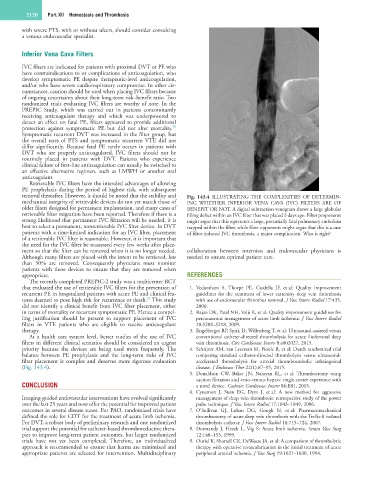
        removal thereafter. However, it should be noted that the stability and   Fig.  143.4  ILLUSTRATING THE  COMPLEXITIES  OF  DETERMIN-
        mechanical integrity of retrievable devices do not yet match those of   ING  WHETHER  INFERIOR  VENA  CAVA  (IVC)  FILTERS  ARE  OF
        older filters designed for permanent implantation, and many cases of   BENEFIT OR NOT. A digital subtraction venogram shows a large globular
        retrievable filter migration have been reported. Therefore if there is a   filling defect within an IVC filter that was placed 3 days ago. Filter proponents
        strong likelihood that permanent IVC filtration will be needed, it is   might argue that this represents a large, potentially fatal pulmonary embolism
        best to select a permanent, nonretrievable IVC filter device. In DVT   trapped within the filter, while filter opponents might argue that this is a case
        patients with a time-limited indication for an IVC filter, placement   of filter-induced IVC thrombosis, a major complication. Who is right?
        of a retrievable IVC filter is reasonable. However, it is important that
        the need for the IVC filter be reassessed every few weeks after place-
        ment so that the filter can be removed when it is no longer needed.   collaboration  between  internists  and  endovascular  physicians  is
        Although many filters are placed with the intent to be retrieved, less   needed to ensure optimal patient care.
        than  50%  are  removed.  Consequently  physicians  must  monitor
        patients  with  these  devices  to  ensure  that  they  are  removed  when
        appropriate.                                          REFERENCES
           The recently completed PREPIC-2 study was a multicenter RCT
        that evaluated the use of retrievable IVC filters for the prevention of   1.  Vedantham  S,  Thorpe  PE,  Cardella  JF,  et al:  Quality  improvement
        recurrent PE in hospitalized patients with acute PE and clinical fea-  guidelines  for  the  treatment  of  lower  extremity  deep  vein  thrombosis
                                                 31
        tures deemed to pose high risk for recurrence or death.  This study   with use of endovascular thrombus removal. J Vasc Interv Radiol 17:435,
        did not identify a clinical benefit from IVC filter placement, either   2006.
        in terms of mortality or recurrent symptomatic PE. Hence a compel-  2.  Rajan DK, Patel NH, Valji K, et al: Quality improvement guidelines for
        ling  justification  should  be  present  to  support  placement  of  IVC   percutaneous management of acute limb ischemia. J Vasc Interv Radiol
        filters  in  VTE  patients  who  are  eligible  to  receive  anticoagulant   20:S208–S218, 2009.
        therapy.                                               3.  Engelberger RP, Spirk D, Willenberg T, et al: Ultrasound-assisted versus
           At  a  health  care  system  level,  better  studies  of  the  use  of  IVC   conventional catheter-directed thrombolysis for acute iliofemoral deep
        filters in different clinical scenarios should be considered an urgent   vein thrombosis. Circ Cardiovasc Interv 8:e002027, 2015.
        priority  because  the  devices  are  being  used  more  frequently.  The   4.  Schrijver AM, van Leersum M, Fioole B, et al: Dutch randomized trial
        balance  between  PE  prophylaxis  and  the  long-term  risks  of  IVC   comparing  standard  catheter-directed  thrombolysis  versus  ultrasound-
        filter  placement  is  complex  and  deserves  more  rigorous  evaluation     accelerated  thrombolysis  for  arterial  thromboembolic  infrainguinal
        (Fig. 143.4).                                            disease. J Endovasc Ther 22(1):87–95, 2015.
                                                               5.  Donaldson  CW,  Baker  JN,  Narayan  RL,  et al: Thrombectomy  using
                                                                 suction filtration and veno-venous bypass: single-center experience with
        CONCLUSION                                               a novel device. Catheter Cardiovasc Interv 86:E81, 2015.
                                                               6.  Cynamon  J,  Stein  EG,  Dym  J,  et al:  A  new  method  for  aggressive
        Imaging-guided endovascular interventions have evolved significantly   management of deep vein thrombosis: retrospective study of the power
        over the last 25 years and now offer the potential for improved patient   pulse technique. J Vasc Interv Radiol 17:1043–1049, 2006.
        outcomes in several disease states. For PAO, randomized trials have   7.  O’Sullivan  GJ,  Lohan  DG,  Gough  N,  et al:  Pharmacomechanical
        defined the role for CDT for the treatment of acute limb ischemia.   thrombectomy of acute deep vein thrombosis with the Trellis-8 isolated
        For DVT, a robust body of preliminary research and one randomized   thrombolysis catheter. J Vasc Interv Radiol 18:715–724, 2007.
        trial support the potential for catheter-based thromboreductive thera-  8.  Dormandy  J,  Heeck  L,  Vig  S:  Acute  limb  ischemia.  Semin Vasc  Surg
        pies to improve long-term patient outcomes, but larger randomized   12:148–153, 1999.
        trials  have  not  yet  been  completed.  Therefore,  an  individualized   9.  Ouriel K, Shortell CK, DeWeese JA, et al: A comparison of thrombolytic
        approach is recommended to ensure that harms are minimized and   therapy with operative revascularization in the initial treatment of acute
        appropriate patients are selected for intervention. Multidisciplinary   peripheral arterial ischemia. J Vasc Surg 19:1021–1030, 1994.

