


Page 2420 - Hematology_ Basic Principles and Practice ( PDFDrive )
P. 2420
2160   Part XII  Hemostasis and Thrombosis


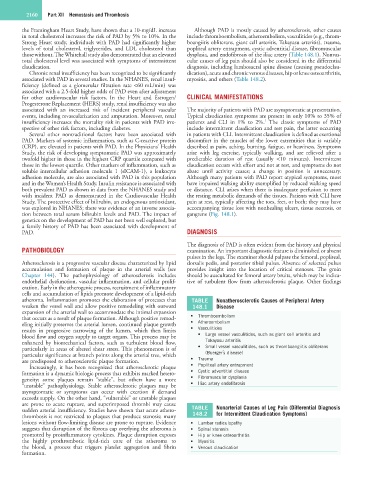
        the Framingham Heart Study, have shown that a 10-mg/dL increase   Although PAD is mostly caused by atherosclerosis, other causes
        in total cholesterol increases the risk of PAD by 5% to 10%. In the   include thromboembolism, atheroembolism, vasculitides (e.g., throm-
        Strong Heart study, individuals with PAD had significantly higher   boangiitis obliterans, giant cell arteritis, Takayasu arteritis), trauma,
        levels  of  total  cholesterol,  triglycerides,  and  LDL  cholesterol  than   popliteal artery entrapment, cystic adventitial disease, fibromuscular
        those without. The Whitehall study also demonstrated that an elevated   dysplasia, and endofibrosis of the iliac artery (Table 148.1). Nonvas-
        total cholesterol level was associated with symptoms of intermittent   cular causes of leg pain should also be considered in the differential
        claudication.                                         diagnosis, including lumbosacral spine disease (causing pseudoclau-
           Chronic renal insufficiency has been recognized to be significantly   dication), acute and chronic venous diseases, hip or knee osteoarthritis,
        associated with PAD in several studies. In the NHANES, renal insuf-  myositis, and others (Table 148.2).
        ficiency  (defined  as  a  glomerular  filtration  rate  <60 mL/min)  was
        associated with a 2.5-fold higher odds of PAD even after adjustment
        for  other  cardiovascular  risk  factors.  In  the  Heart  and  Estrogen/  CLINICAL MANIFESTATIONS
        Progesterone Replacement (HERS) study, renal insufficiency was also
        associated  with  an  increased  risk  of  incident  peripheral  vascular   The majority of patients with PAD are asymptomatic at presentation.
        events, including revascularization and amputation. Moreover, renal   Typical claudication symptoms are present in only 10% to 35% of
                                                                                        1
        insufficiency increases the mortality risk in patients with PAD irre-  patients  and  CLI  in  1%  to  2%.   The  classic  symptoms  of  PAD
        spective of other risk factors, including diabetes.   include intermittent claudication and rest pain, the latter occurring
           Several  other  nontraditional  factors  have  been  associated  with   in patients with CLI. Intermittent claudication is defined as exertional
        PAD. Markers of systemic inflammation, such as C-reactive protein   discomfort in the muscles of the lower extremities that is variably
        (CRP), are elevated in patients with PAD. In the Physicians’ Health   described as pain, aching, burning, fatigue, or heaviness. Symptoms
        Study, the risk of developing symptomatic PAD was approximately   arise  with  leg  exercise,  typically  walking,  and  are  relieved  after  a
        twofold higher in those in the highest CRP quartile compared with   predictable  duration  of  rest  (usually  <10  minutes).  Intermittent
        those in the lowest quartile. Other markers of inflammation, such as   claudication occurs with effort and not at rest, and symptoms do not
        soluble  intercellular  adhesion  molecule  1  (sICAM-1),  a  leukocyte   abate  until  activity  ceases;  a  change  in  position  is  unnecessary.
        adhesion molecule, are also associated with PAD in this population   Although many patients with PAD report atypical symptoms, most
        and in the Women’s Health Study. Insulin resistance is associated with   have impaired walking ability exemplified by reduced walking speed
        both prevalent PAD as shown in data from the NHANES study and   or distance. CLI arises when there is inadequate perfusion to meet
        with  incident  PAD  as  demonstrated  in  the  Cardiovascular  Health   the resting metabolic demands of the tissues. Patients with CLI have
        Study. The protective effect of bilirubin, an endogenous antioxidant,   pain at rest, typically affecting the toes, feet, or both; they may have
        was explored in NHANES; there was evidence of an inverse associa-  accompanying tissue loss with nonhealing ulcers, tissue necrosis, or
        tion between total serum bilirubin levels and PAD. The impact of   gangrene (Fig. 148.1).
        genetics on the development of PAD has not been well explored, but
        a family history of PAD has been associated with development of
        PAD.                                                  DIAGNOSIS
                                                              The diagnosis of PAD is often evident from the history and physical
        PATHOBIOLOGY                                          examination. An important diagnostic feature is diminished or absent
                                                              pulses in the legs. The examiner should palpate the femoral, popliteal,
        Atherosclerosis is a progressive vascular disease characterized by lipid   dorsalis pedis, and posterior tibial pulses. Absence of selected pulses
        accumulation  and  formation  of  plaque  in  the  arterial  walls  (see   provides  insight  into  the  location  of  critical  stenoses.  The  groin
        Chapter  144).  The  pathophysiology  of  atherosclerosis  includes   should be auscultated for femoral artery bruits, which may be indica-
        endothelial dysfunction, vascular inflammation, and cellular prolif-  tive  of  turbulent  flow  from  atherosclerotic  plaque.  Other  findings
        eration. Early in the atherogenic process, recruitment of inflammatory
        cells and accumulation of lipids promote development of a lipid-rich
        atheroma. Inflammation promotes the elaboration of proteases that   TABLE   Nonatherosclerotic Causes of Peripheral Artery
        weaken the vessel wall and allow positive remodeling with outward   148.1  Disease
        expansion of the arterial wall to accommodate the intimal expansion
        that occurs as a result of plaque formation. Although positive remod-  •  Thromboembolism
        eling initially preserves the arterial lumen, continued plaque growth   •  Atheroembolism
        results  in  progressive  narrowing  of  the  lumen,  which  then  limits   •  Vasculitides
        blood flow and oxygen supply to target organs. This process may be   •  Large vessel vasculitides, such as giant cell arteritis and
        enhanced  by  biomechanical  factors,  such  as  turbulent  blood  flow,   Takayasu arteritis
        particularly in areas of altered shear stress. This phenomenon is of   •  Small vessel vasculitides, such as thromboangiitis obliterans
        particular significance at branch points along the arterial tree, which   (Buerger’s disease)
        are predisposed to atherosclerotic plaque formation.   •  Trauma
           Increasingly,  it  has  been  recognized  that  atherosclerotic  plaque   •  Popliteal artery entrapment
        formation is a dynamic biologic process that exhibits marked hetero-  •  Cystic adventitial disease
        geneity;  some  plaques  remain  “stable”,  but  others  have  a  more   •  Fibromuscular dysplasia
        “unstable”  pathophysiology.  Stable  atherosclerotic  plaques  may  be   •  Iliac artery endofibrosis
        asymptomatic  or  symptoms  can  occur  with  exertion  if  demand
        exceeds supply. On the other hand, “vulnerable” or unstable plaques
        are prone to acute rupture, and superimposed thrombi may cause   TABLE   Nonarterial Causes of Leg Pain (Differential Diagnosis
        sudden arterial insufficiency. Studies have shown that acute athero-  148.2  for Intermittent Claudication Symptoms)
        thrombosis is not restricted to plaques that produce stenosis; many
        lesions without flow-limiting disease are prone to rupture. Evidence   •  Lumbar radiculopathy
        suggests that disruption of the fibrous cap overlying the atheroma is   •  Spinal stenosis
        promoted by proinflammatory cytokines. Plaque disruption exposes   •  Hip or knee osteoarthritis
        the  highly  prothrombotic  lipid-rich  core  of  the  atheroma  to     •  Myositis
        the  blood,  a  process  that  triggers  platelet  aggregation  and  fibrin   •  Venous claudication
        formation.

