


Page 2422 - Hematology_ Basic Principles and Practice ( PDFDrive )
P. 2422
2162   Part XII  Hemostasis and Thrombosis


                                                          Brachial
                                                       RIGHT LEFT
                                                        114    76


                     PVR 63 mm Hg 441 cc  RIGHT High  Thigh            PVR 66 mm Hg 591 cc  LEFT  High  Thigh
                     Gain:  .75 mm Hg/20 mm Spd: 25  Amp: 30           Gain:  .75 mm Hg/20 mm Spd: 25  Amp: 20

                                                   1.15  131  116  1.02


                                                   1.14  130  116 1.02

                                                   1.08  123   89 0.78
                     PVR 61 mm Hg 277 cc  RIGHT Above Knee             PVR 65 mm Hg 404 cc  LEFT  Above Knee
                     Gain:  .75 mm Hg/20 mm Spd: 25  Amp: 27  RIGHT  LEFT Gain:  .75 mm Hg/20 mm Spd: 25  Amp: 13

                                                   0.90  103 DP  83 0.73
                                                   0.89  101 PT  83 0.73


                     PVR 62 mm Hg 109 cc  RIGHT Below Knee             PVR 64 mm Hg 159 cc  LEFT  Below Knee
                     Gain:  .75 mm Hg/20 mm Spd: 25  Amp: 33  ABI: 0.90  ABI: 0.73 Gain:  .75 mm Hg/20 mm Spd: 25  Amp: 17


                     PVR 61 mm Hg 129 cc  RIGHT Ankle                  PVR 44 mm Hg 129 cc  LEFT  Ankle
                     Gain:  .75 mm Hg/20 mm Spd: 25  Amp: 29           Gain:  .75 mm Hg/20 mm Spd: 25  Amp: 07


                     PVR 63 mm Hg 79 cc  RIGHT Metatarsal              PVR 57 mm Hg 75 cc  LEFT  Metatarsal
                     Gain:  .75 mm Hg/20 mm Spd: 25  Amp: 10           Gain:  .75 mm Hg/20 mm Spd: 25  Amp: 05

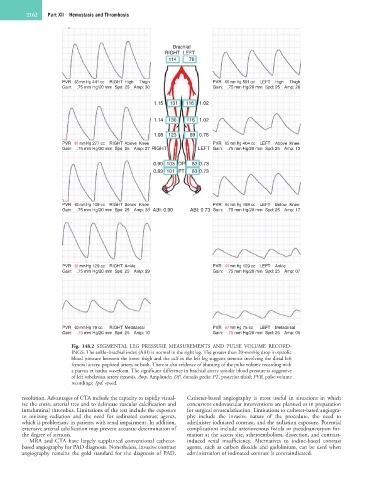
                        Fig.  148.2  SEGMENTAL  LEG  PRESSURE  MEASUREMENTS  AND  PULSE  VOLUME  RECORD-
                        INGS. The ankle–brachial index (ABI) is normal in the right leg. The greater than 20-mmHg drop in systolic
                        blood pressure between the lower thigh and the calf in the left leg suggests stenosis involving the distal left
                        femoral artery, popliteal artery, or both. There is also evidence of blunting of the pulse volume recording with
                        a parvus et tardus waveform. The significant difference in brachial artery systolic blood pressure is suggestive
                        of left subclavian artery stenosis. Amp, Amplitude; DP, dorsalis pedis; PT, posterior tibial; PVR, pulse volume
                        recordings; Spd, speed.
        resolution. Advantages of CTA include the capacity to rapidly visual-  Catheter-based  angiography  is  most  useful  in  situations  in  which
        ize the entire arterial tree and to delineate vascular calcification and   concurrent endovascular interventions are planned or in preparation
        intraluminal thrombus. Limitations of the test include the exposure   for surgical revascularization. Limitations to catheter-based angiogra-
        to  ionizing  radiation  and  the  need  for  iodinated  contrast  agents,   phy  include  the  invasive  nature  of  the  procedure,  the  need  to
        which is problematic in patients with renal impairment. In addition,   administer iodinated contrast, and the radiation exposure. Potential
        extensive arterial calcification may prevent accurate determination of   complications include arteriovenous fistula or pseudoaneurysm for-
        the degree of stenosis.                               mation at the access site, atheroembolism, dissection, and contrast-
           MRA  and  CTA  have  largely  supplanted  conventional  catheter-  induced  renal  insufficiency.  Alternatives  to  iodine-based  contrast
        based angiography for PAD diagnosis. Nonetheless, invasive contrast   agents, such as carbon dioxide and gadolinium, can be used when
        angiography  remains  the  gold  standard  for  the  diagnosis  of  PAD.   administration of iodinated contrast is contraindicated.

