


Page 2423 - Hematology_ Basic Principles and Practice ( PDFDrive )
P. 2423
Chapter 148  Peripheral Artery Disease  2163


                                                                  Reduction  of  Atherothrombosis  for  Continued  Health  (REACH)
                                                                  registry, which enrolled patients with established PAD on the basis
                                                                  of  clinical  symptoms,  abnormal  ABI,  and  prior  revascularization,
                                                                  demonstrated a 23.6% rate of new adverse limb events over 4 years
                                                                  including new revascularization procedures as well as ischemic ampu-
                                                                       12
                                                                  tations.  These data are consistent with findings from the TRA2°P-
                                                                  TIMI  50  trial,  which  evaluated  the  impact  of  the  novel  agent
                                                                  vorapaxar in patients with PAD, where the rate of peripheral artery
                                                                                                              13
                                                                  revascularization  in  the  placebo  treated  group  was  22.2%   over  a
                                                                  median period of three years. Prognosis is worst for those with CLI,
                                                                  where mean amputation-free survival at 1 year is only 50%. Out-
                                                                  comes are worse for patients with PAD who continue to smoke or
                                                                  have  coexisting  diabetes;  such  patients  have  even  higher  rates  of
                                                                  ischemic ulceration and amputation.
                                                                    Given the high risk of concomitant coronary and cerebral artery
                                                                  disease, individuals with PAD are also at increased risk of MI, stroke,
                                                                  and  cardiovascular  death.  The  mortality  rate  is  increased  two-  to
                                                                  fourfold in patients with PAD compared with those without PAD,
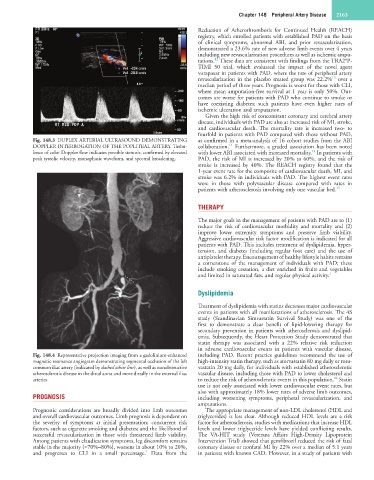
            Fig. 148.3  DUPLEX ARTERIAL ULTRASOUND DEMONSTRATING   as confirmed in a meta-analysis of 16 cohort studies from the ABI
                                                                            14
            DOPPLER INTERROGATION OF THE POPLITEAL ARTERY. Turbu-  collaboration.   Furthermore,  a  graded  association  has  been  noted
                                                                                                       14
            lence of color Doppler flow indicates possible stenosis, confirmed by elevated   with lower ABI associated with increased mortality.  In patients with
            peak systolic velocity, monophasic waveform, and spectral broadening.   PAD, the risk of MI is increased by 20% to 60%, and the risk of
                                                                  stroke  is  increased  by  40%. The  REACH  registry  found  that  the
                                                                  1-year event rate for the composite of cardiovascular death, MI, and
                                                                  stroke was 6.2% in individuals with PAD. The highest event rates
                                                                  were  in  those  with  polyvascular  disease  compared  with  rates  in
                                                                  patients with atherosclerosis involving only one vascular bed. 15

                                                                  THERAPY

                                                                  The major goals in the management of patients with PAD are to (1)
                                                                  reduce  the  risk  of  cardiovascular  morbidity  and  mortality  and  (2)
                                                                  improve  lower  extremity  symptoms  and  preserve  limb  viability.
                                                                  Aggressive cardiovascular risk factor modification is indicated for all
                                                                  patients with PAD. This includes treatment of dyslipidemia, hyper-
                                                                  tension,  and  diabetes  (including  regular  foot  care)  and  the  use  of
                                                                  antiplatelet therapy. Encouragement of healthy lifestyle habits remains
                                                                  a  cornerstone  of  the  management  of  individuals  with  PAD;  these
                                                                  include smoking cessation, a diet enriched in fruits and vegetables
                                                                  and limited in saturated fats, and regular physical activity. 1

                                                                  Dyslipidemia

                                                                  Treatment of dyslipidemia with statins decreases major cardiovascular
                                                                  events in patients with all manifestations of atherosclerosis. The 4S
                                                                  study  (Scandinavian  Simvastatin  Survival  Study)  was  one  of  the
                                                                  first  to  demonstrate  a  clear  benefit  of  lipid-lowering  therapy  for
                                                                  secondary prevention in patients with atherosclerosis and dyslipid-
                                                                  emia. Subsequently, the Heart Protection Study demonstrated that
                                                                  statin  therapy  was  associated  with  a  22%  relative  risk  reduction
                                                                  in  adverse  cardiovascular  events  in  patients  with  vascular  disease,
            Fig. 148.4  Representative projection imaging from a gadolinium-enhanced   including  PAD.  Recent  practice  guidelines  recommend  the  use  of
            magnetic resonance angiogram demonstrating segmental occlusion of the left   high-intensity statin therapy, such as atorvastatin 80 mg daily or rosu-
            common iliac artery (indicated by dashed white line), as well as nonobstructive   vastatin 20 mg daily, for individuals with established atherosclerotic
            atherosclerotic disease in the distal aorta and more distally in the external iliac   vascular disease, including those with PAD to lower cholesterol and
                                                                                                              16
            arteries.                                             to reduce the risk of atherosclerotic events in this population.  Statin
                                                                  use is not only associated with lower cardiovascular event rates, but
                                                                  also with approximately 18% lower rates of adverse limb outcomes,
            PROGNOSIS                                             including  worsening  symptoms,  peripheral  revascularization,  and
                                                                  amputations.
            Prognostic  considerations  are  broadly  divided  into  limb  outcomes   The appropriate management of non-LDL cholesterol (HDL and
            and overall cardiovascular outcomes. Limb prognosis is dependent on   triglycerides) is less clear. Although reduced HDL levels are a risk
            the  severity  of  symptoms  at  initial  presentation;  concurrent  risk   factor for atherosclerosis, studies with medications that increase HDL
            factors, such as cigarette smoking and diabetes; and the likelihood of   levels  and  lower  triglyceride  levels  have  yielded  conflicting  results.
            successful revascularization in those with threatened limb viability.   The  VA-HIT  study  (Veterans  Affairs  High-Density  Lipoprotein
            Among patients with claudication symptoms, leg discomfort remains   Intervention Trial) showed that gemfibrozil reduced the risk of fatal
            stable in the majority (≈70%–80%), worsens in about 10% to 20%,   coronary disease or nonfatal MI by 22% over a median of 5.1 years
                                                 1
            and  progresses  to  CLI  in  a  small  percentage.   Data  from  the   in patients with known CAD. However, in a study of patients with

