


Page 2437 - Hematology_ Basic Principles and Practice ( PDFDrive )
P. 2437
Chapter 149  Antithrombotic Drugs  2175


                                                                  testing  can  influence  the  results.  Consequently,  laboratories  must
                                                                  establish a therapeutic aPTT range with each reagent–coagulometer
               Reactive                                           combination  by  measuring  the  aPTT  and  anti–factor  Xa  level  in
             center loop                                          plasma samples collected from heparin-treated patients. For most of
                               HCII
                                                                  the  aPTT  reagents  and  coagulometers  in  current  use,  therapeutic
                                                                  heparin levels are achieved with a two- to threefold prolongation of
                                +++          Anionic              the aPTT.
                                ---          N-terminal             Anti–factor Xa levels also can be used to monitor heparin therapy.
                                                                  With this test, therapeutic heparin levels range from 0.3 to 0.7 U/
                                                                  mL. Although this test is gaining in popularity, anti–factor Xa assays
                  Exosite 2
                                                                  have  yet  to  be  standardized,  and  results  can  vary  widely  between
                    +++                                           laboratories.
                                                                    The ACT is used to monitor heparin when high doses are given
                                         Glycosaminoglycan        (>100 U/kg)  to  patients  undergoing  PCI  or  cardiac  surgery  with
                  IIa                    (Heparin or dermatan sulfate)  cardiopulmonary  bypass  (CPB)  and  those  requiring  extracorporeal
                                                                  membrane  oxygenation  (ECMO). The  ACT  varies  depending  on
                    +++                                           which test kit is used. For PCI, the target ACT is 250 to 300 seconds
                                                                  in  patients  not  receiving  GPIIb/IIIa  inhibitors  and  200  to  250
                  Exosite 1                                       seconds if a GPIIb/IIIa inhibitor is given. For CPB, a target ACT
                                                                  longer than 480 seconds is desirable, whereas for ECMO, the target
                                                                  ACT ranges from 140 to 240 seconds.
                      +++                                           Up to 25% of heparin-treated patients with venous thromboem-
                                                                  bolism  require  more  than  35,000 U/day  to  achieve  a  therapeutic
                                                                  aPTT. These patients are considered heparin resistant. It is useful to
                    IIa           HCII       Glycosaminoglycan    measure anti–factor Xa levels in these patients because many will have
                                                                  a therapeutic anti–factor Xa level despite a subtherapeutic aPTT. This
                      +++         +++                             dissociation in test results occurs because elevated plasma levels of
                      ---                                         fibrinogen and factor VIII, both of which are acute-phase proteins,
             Anionic                                              shorten the aPTT but have no effect on anti–factor Xa levels. Heparin
            N-terminal                                            therapy in patients who exhibit this phenomenon is best monitored
                                                                  using anti–factor Xa levels instead of the aPTT. Patients with con-
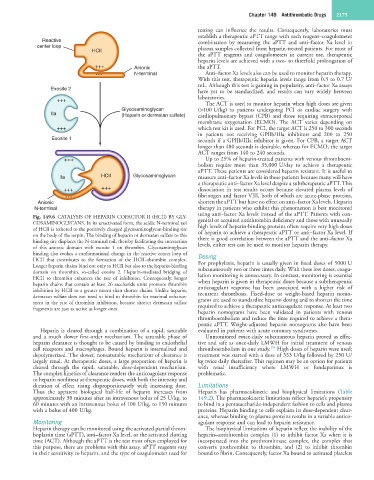
            Fig. 149.6  CATALYSIS OF HEPARIN COFACTOR II (HCII) BY GLY-  genital or acquired antithrombin deficiency and those with unusually
            COSAMINOGLYCANS. In its unactivated form, the acidic N-terminal tail   high levels of heparin-binding proteins often require very high doses
            of HCII is tethered to the positively charged glycosaminoglycan-binding site   of heparin to achieve a therapeutic aPTT or anti–factor Xa level. If
            on the body of the serpin. The binding of heparin or dermatan sulfate to this   there is good correlation between the aPTT and the anti–factor Xa
            binding site displaces the N-terminal tail, thereby facilitating the interaction   levels, either test can be used to monitor heparin therapy.
            of  this  anionic  domain  with  exosite  1  on  thrombin.  Glycosaminoglycan
            binding also evokes a conformational change in the reactive center loop of   Dosing
            HCII  that  contributes  to  the  formation  of  the  HCII–thrombin  complex.   For prophylaxis, heparin is usually given in fixed doses of 5000 U
            Longer heparin chains bind not only to HCII but also to the heparin-binding   subcutaneously two or three times daily. With these low doses, coagu-
            domain  on  thrombin,  so-called  exosite  2.  Heparin-mediated  bridging  of   lation monitoring is unnecessary. In contrast, monitoring is essential
            HCII  to  thrombin  enhances  the  rate  of  inhibition.  Consequently,  longer   when heparin is given in therapeutic doses because a subtherapeutic
            heparin chains that contain at least 26 saccharide units promote thrombin   anticoagulant  response  has  been  associated  with  a  higher  risk  of
            inhibition by HCII to a greater extent than shorter chains. Unlike heparin,   recurrent  thrombosis.  Fixed-dose  or  weight-based  heparin  nomo-
            dermatan sulfate does not need to bind to thrombin for maximal enhance-  grams are used to standardize heparin dosing and to shorten the time
            ment in the rate of thrombin inhibition, because shorter dermatan sulfate   required to achieve a therapeutic anticoagulant response. At least two
            fragments are just as active as longer ones.
                                                                  heparin  nomograms  have  been  validated  in  patients  with  venous
                                                                  thromboembolism and reduce the time required to achieve a thera-
                                                                  peutic  aPTT. Weight-adjusted  heparin  nomograms  also  have  been
              Heparin is cleared through a combination of a rapid, saturable   evaluated in patients with acute coronary syndromes.
            and  a  much  slower  first-order  mechanism. The  saturable  phase  of   Unmonitored twice-daily subcutaneous heparin proved as effec-
            heparin clearance is thought to be caused by binding to endothelial   tive and safe as once-daily LMWH for initial treatment of venous
                                                                                          15a
            cell receptors and macrophages. Bound heparin is internalized and   thromboembolism in one study.  High doses of heparin were used;
            depolymerized. The slower, nonsaturable mechanism of clearance is   treatment was started with a dose of 333 U/kg followed by 250 U/
            largely renal. At therapeutic doses, a large proportion of heparin is   kg twice daily thereafter. This regimen may be an option for patients
            cleared  through  the  rapid,  saturable,  dose-dependent  mechanism.   with  renal  insufficiency  where  LMWH  or  fondaparinux  is
            The complex kinetics of clearance renders the anticoagulant response   problematic.
            to heparin nonlinear at therapeutic doses, with both the intensity and
            duration  of  effect  rising  disproportionately  with  increasing  dose.   Limitations
            Thus  the  apparent  biological  half-life  of  heparin  increases  from   Heparin  has  pharmacokinetic  and  biophysical  limitations  (Table
            approximately 30 minutes after an intravenous bolus of 25 U/kg, to   149.2). The pharmacokinetic limitations reflect heparin’s propensity
            60 minutes with an intravenous bolus of 100 U/kg, to 150 minutes   to bind in a pentasaccharide-independent fashion to cells and plasma
            with a bolus of 400 U/kg.                             proteins. Heparin binding to cells explains its dose-dependent clear-
                                                                  ance, whereas binding to plasma proteins results in a variable antico-
            Monitoring                                            agulant response and can lead to heparin resistance.
            Heparin therapy can be monitored using the activated partial throm-  The biophysical limitations of heparin reflect the inability of the
            boplastin time (aPTT), anti–factor Xa level, or the activated clotting   heparin–antithrombin complex (1) to inhibit factor Xa when it is
            time (ACT). Although the aPTT is the test most often employed for   incorporated  into  the  prothrombinase  complex,  the  complex  that
            this purpose, there are problems with this assay. aPTT reagents vary   converts  prothrombin  to  thrombin,  and  (2)  to  inhibit  thrombin
            in their sensitivity to heparin, and the type of coagulometer used for   bound to fibrin. Consequently, factor Xa bound to activated platelets

