


Page 2438 - Hematology_ Basic Principles and Practice ( PDFDrive )
P. 2438
2176   Part XII  Hemostasis and Thrombosis


          TABLE   Pharmacokinetic and Biophysical Limitations of   TABLE   Features of Heparin-Induced Thrombocytopenia
          149.2   Heparin                                       149.3
                                 Limitations Mechanism         Features       Details
         Poor bioavailability at low   Limited absorption of long heparin   Thrombocytopenia  Platelet count of 100,000/µL or less or a
           doses                   chains                                       decrease in platelet count of 50% or more
         Dose-dependent clearance  Binds to endothelial cells  Timing         Platelet count falls 5–10 days after starting
         Variable anticoagulant   Binds to plasma proteins whose                heparin
           response                levels vary from patient to patient  Type of heparin  More common with unfractionated heparin than
         Reduced activity in the vicinity   Neutralized by platelet factor 4    LMWH
           of platelet-rich thrombi  released from activated platelets  Type of patient  More common in surgical patients than medical
         Limited activity against factor   Reduced capacity of heparin–         patients; more common in women than in men
           Xa incorporated in the   antithrombin complex to inhibit   Thrombosis  Venous thrombosis more common than arterial
           prothrombinase complex   factor Xa bound to activated                thrombosis
           and thrombin bound to   platelets and thrombin bound to   LMWH, Low-molecular-weight heparin.
           fibrin                  fibrin


        within platelet-rich thrombi has the potential to generate thrombin,   TABLE   Management of Heparin-Induced Thrombocytopenia
        even in the face of heparin. Once this thrombin binds to fibrin, it   149.4
        too  is  protected  from  inhibition  by  the  heparin–antithrombin   Stop all heparin
        complex. Clot-associated thrombin can then trigger thrombus growth   Give an alternative anticoagulant, such as lepirudin, argatroban,
        by  locally  activating  platelets  and  amplifying  its  own  generation   bivalirudin, danaparoid, or fondaparinux.
        through  feedback  activation  of  factors  V,  VIII,  and  XI.  Further   Do not give platelet transfusions.
        compounding the problem is the potential for heparin neutralization   Do not give warfarin until the platelet count returns to its baseline
        by the high concentrations of PF4 released from activated platelets   level. If warfarin is administered, give vitamin K to restore the INR
        within the platelet-rich thrombus.                        to normal.
                                                               Evaluate for thrombosis, particularly deep vein thrombosis.
        Side Effects                                           INR, International normalized ratio.
        The most common side effect of heparin is bleeding. Other complica-
        tions include thrombocytopenia, osteoporosis, and elevated levels of
        transaminases.
                                                              performed  by  quantifying  serotonin  release  when  washed  platelets
        Bleeding.  The  risk  of  heparin-induced  bleeding  increases  with   loaded with labeled serotonin are exposed to patient serum in the
        higher  heparin  doses.  Concomitant  administration  of  drugs  that   absence  or  presence  of  varying  concentrations  of  heparin.  If  the
        affect hemostasis, such as antiplatelet or fibrinolytic agents, increases   patient serum contains the HIT antibody, heparin addition induces
        the risk of bleeding, as does recent surgery or trauma. Heparin-treated   platelet activation and subsequent serotonin release.
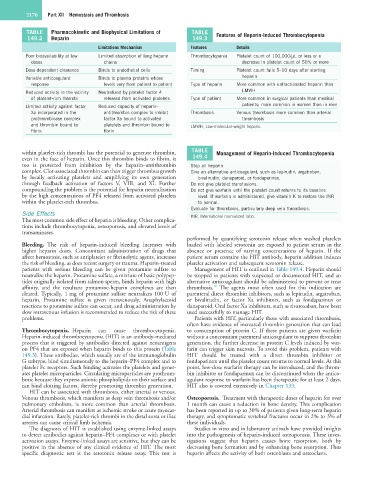
        patients  with  serious  bleeding  can  be  given  protamine  sulfate  to   Management of HIT is outlined in Table 149.4. Heparin should
        neutralize the heparin. Protamine sulfate, a mixture of basic polypep-  be stopped in patients with suspected or documented HIT, and an
        tides originally isolated from salmon sperm, binds heparin with high   alternative anticoagulant should be administered to prevent or treat
                                                                       16
        affinity,  and  the  resultant  protamine-heparin  complexes  are  then   thrombosis.   The  agents  most  often  used  for  this  indication  are
        cleared. Typically,  1 mg  of  protamine  sulfate  neutralizes  100 U  of   parenteral direct thrombin inhibitors, such as lepirudin, argatroban,
        heparin.  Protamine  sulfate  is  given  intravenously.  Anaphylactoid   or  bivalirudin,  or  factor  Xa  inhibitors,  such  as  fondaparinux  or
        reactions to protamine sulfate can occur, and drug administration by   danaparoid. Oral factor Xa inhibitors, such as rivaroxaban, have been
        slow intravenous infusion is recommended to reduce the risk of these   used successfully to manage HIT.
        problems.                                                Patients with HIT, particularly those with associated thrombosis,
                                                              often have evidence of increased thrombin generation that can lead
        Thrombocytopenia.  Heparin   can   cause   thrombocytopenia.   to  consumption  of  protein  C.  If  these  patients  are  given  warfarin
        Heparin-induced thrombocytopenia (HIT) is an antibody-mediated   without a concomitant parenteral anticoagulant to suppress thrombin
        process that is triggered by antibodies directed against neoantigens   generation, the further decrease in protein C levels induced by war-
        on PF4 that are exposed when heparin binds to this protein (Table   farin can trigger skin necrosis. To avoid this problem, patients with
        149.3). These antibodies, which usually are of the immunoglobulin   HIT  should  be  treated  with  a  direct  thrombin  inhibitor  or
        G subtype, bind simultaneously to the heparin–PF4 complex and to   fondaparinux until the platelet count returns to normal levels. At this
        platelet Fc receptors. Such binding activates the platelets and gener-  point, low-dose warfarin therapy can be introduced, and the throm-
        ates platelet microparticles. Circulating microparticles are prothrom-  bin inhibitor or fondaparinux can be discontinued when the antico-
        botic because they express anionic phospholipids on their surface and   agulant response to warfarin has been therapeutic for at least 2 days.
        can bind clotting factors, thereby promoting thrombin generation.  HIT also is covered extensively in Chapter 133.
           HIT can be associated with thrombosis, either arterial or venous.
        Venous thrombosis, which manifests as deep vein thrombosis and/or   Osteoporosis.  Treatment with therapeutic doses of heparin for over
        pulmonary  embolism,  is  more  common  than  arterial  thrombosis.   1 month can cause a reduction in bone density. This complication
        Arterial thrombosis can manifest as ischemic stroke or acute myocar-  has been reported in up to 30% of patients given long-term heparin
        dial infarction. Rarely, platelet-rich thrombi in the distal aorta or iliac   therapy, and symptomatic vertebral fractures occur in 2% to 3% of
        arteries can cause critical limb ischemia.            these individuals.
           The diagnosis of HIT is established using enzyme-linked assays   Studies in vitro and in laboratory animals have provided insights
        to detect antibodies against heparin–PF4 complexes or with platelet   into the pathogenesis of heparin-induced osteoporosis. These inves-
        activation assays. Enzyme-linked assays are sensitive, but they can be   tigations  suggest  that  heparin  causes  bone  resorption,  both  by
        positive in the absence of any clinical evidence of HIT. The most   decreasing bone formation and by enhancing bone resorption. Thus
        specific  diagnostic  test  is  the  serotonin  release  assay.  This  test  is   heparin affects the activity of both osteoblasts and osteoclasts.

