


Page 2446 - Hematology_ Basic Principles and Practice ( PDFDrive )
P. 2446
2184   Part XII  Hemostasis and Thrombosis


        When compared with warfarin in patients with atrial fibrillation, the   Plasminogen
        higher-dose edoxaban regimen (60 mg once daily with dose reduc-       activators
        tion to 30 mg once daily for the indications listed earlier) was non-
        inferior for prevention of stroke and systemic embolism, but it was               Plasmin activator
                                                         38
        associated with less intracranial bleeding and less major bleeding.                  inhibitors
        In patients with venous thromboembolism who had received at least   Plasminogen  Plasmin
        5 days of heparin, edoxaban was noninferior to warfarin for preven-
        tion of recurrent venous thromboembolism and was associated with                        α -Antiplasmin
                                                                                                 2
        less bleeding. 39
                                                                                Fibrin      Fibrin degradation
                                                                                               products
        Dosing
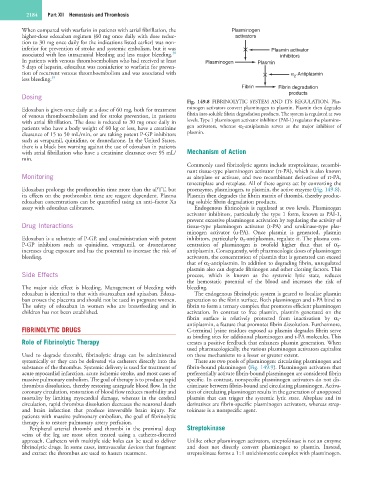
                                                              Fig.  149.8  FIBRINOLYTIC  SYSTEM  AND  ITS  REGULATION.  Plas-
        Edoxaban is given once daily at a dose of 60 mg, both for treatment   minogen activators convert plasminogen to plasmin. Plasmin then degrades
        of venous thromboembolism and for stroke prevention, in patients   fibrin into soluble fibrin degradation products. The system is regulated at two
        with atrial fibrillation. The dose is reduced to 30 mg once daily in   levels. Type 1 plasminogen activator inhibitor (PAI-1) regulates the plasmino-
        patients who have a body weight of 60 kg or less, have a creatinine   gen  activators,  whereas  α 2 -antiplasmin  serves  as  the  major  inhibitor  of
        clearance of 15 to 50 mL/min, or are taking potent P-GP inhibitors   plasmin.
        such as verapamil, quinidine, or dronedarone. In the United States,
        there is a black box warning against the use of edoxaban in patients
        with atrial fibrillation who have a creatinine clearance over 95 mL/  Mechanism of Action
        min.
                                                              Commonly used fibrinolytic agents include streptokinase, recombi-
                                                              nant tissue-type plasminogen activator (rt-PA), which is also known
        Monitoring                                            as  alteplase  or  activase,  and  two  recombinant  derivatives  of  rt-PA,
                                                              tenecteplase and reteplase. All of these agents act by converting the
        Edoxaban prolongs the prothrombin time more than the aPTT, but   proenzyme, plasminogen, to plasmin, the active enzyme (Fig. 149.8).
        its effects on the prothrombin time are reagent dependent. Plasma   Plasmin then degrades the fibrin matrix of thrombi, thereby produc-
        edoxaban concentrations can be quantified using an anti–factor Xa   ing soluble fibrin degradation products.
        assay with edoxaban calibrators.                         Endogenous fibrinolysis is regulated at two levels. Plasminogen
                                                              activator inhibitors, particularly the type 1 form, known as PAI-1,
                                                              prevent excessive plasminogen activation by regulating the activity of
        Drug Interactions                                     tissue-type  plasminogen  activator  (t-PA)  and  urokinase-type  plas-
                                                              minogen  activator  (u-PA).  Once  plasmin  is  generated,  plasmin
        Edoxaban is a substrate of P-GP, and coadministration with potent   inhibitors, particularly α 2 -antiplasmin, regulate it. The plasma con-
        P-GP  inhibitors  such  as  quinidine,  verapamil,  or  dronedarone   centration  of  plasminogen  is  twofold  higher  than  that  of  α 2 -
        increases drug exposure and has the potential to increase the risk of   antiplasmin. Consequently, with pharmacologic doses of plasminogen
        bleeding.                                             activators, the concentration of plasmin that is generated can exceed
                                                              that of α 2 -antiplasmin. In addition to degrading fibrin, unregulated
                                                              plasmin also can degrade fibrinogen and other clotting factors. This
        Side Effects                                          process,  which  is  known  as  the  systemic  lytic  state,  reduces
                                                              the  hemostatic  potential  of  the  blood  and  increases  the  risk  of
        The  major  side  effect  is  bleeding.  Management  of  bleeding  with   bleeding.
        edoxaban is identical to that with rivaroxaban and apixaban. Edoxa-  The endogenous fibrinolytic system is geared to localize plasmin
        ban crosses the placenta and should not be used in pregnant women.   generation to the fibrin surface. Both plasminogen and t-PA bind to
        The  safety  of  edoxaban  in  women  who  are  breastfeeding  and  in   fibrin to form a ternary complex that promotes efficient plasminogen
        children has not been established.                    activation.  In  contrast  to  free  plasmin,  plasmin  generated  on  the
                                                              fibrin  surface  is  relatively  protected  from  inactivation  by  α 2 -
                                                              antiplasmin, a feature that promotes fibrin dissolution. Furthermore,
        FIBRINOLYTIC DRUGS                                    C-terminal lysine residues exposed as plasmin degrades fibrin serve
                                                              as binding sites for additional plasminogen and t-PA molecules. This
        Role of Fibrinolytic Therapy                          creates a positive feedback that enhances plasmin generation. When
                                                              used pharmacologically, the various plasminogen activators capitalize
        Used  to  degrade  thrombi,  fibrinolytic  drugs  can  be  administered   on these mechanisms to a lesser or greater extent.
        systemically or they can be delivered via catheters directly into the   There are two pools of plasminogen: circulating plasminogen and
        substance of the thrombus. Systemic delivery is used for treatment of   fibrin-bound plasminogen (Fig. 149.9). Plasminogen activators that
        acute myocardial infarction, acute ischemic stroke, and most cases of   preferentially activate fibrin-bound plasminogen are considered fibrin
        massive pulmonary embolism. The goal of therapy is to produce rapid   specific. In contrast, nonspecific plasminogen activators do not dis-
        thrombus dissolution, thereby restoring antegrade blood flow. In the   criminate between fibrin-bound and circulating plasminogen. Activa-
        coronary circulation, restoration of blood flow reduces morbidity and   tion of circulating plasminogen results in the generation of unopposed
        mortality  by  limiting  myocardial  damage,  whereas  in  the  cerebral   plasmin  that  can  trigger  the  systemic  lytic  state.  Alteplase  and  its
        circulation, rapid thrombus dissolution decreases the neuronal death   derivatives are fibrin-specific plasminogen activators, whereas strep-
        and  brain  infarction  that  produce  irreversible  brain  injury.  For   tokinase is a nonspecific agent.
        patients with massive pulmonary embolism, the goal of fibrinolytic
        therapy is to restore pulmonary artery perfusion.
           Peripheral  arterial  thrombi  and  thrombi  in  the  proximal  deep   Streptokinase
        veins  of  the  leg  are  most  often  treated  using  a  catheter-directed
        approach. Catheters with multiple side holes can be used to deliver   Unlike other plasminogen activators, streptokinase is not an enzyme
        fibrinolytic drugs. In some cases, intravascular devices that fragment   and  does  not  directly  convert  plasminogen  to  plasmin.  Instead,
        and extract the thrombus are used to hasten treatment.  streptokinase forms a 1 : 1 stoichiometric complex with plasminogen.

