


Page 2441 - Hematology_ Basic Principles and Practice ( PDFDrive )
P. 2441
Chapter 149  Antithrombotic Drugs  2179


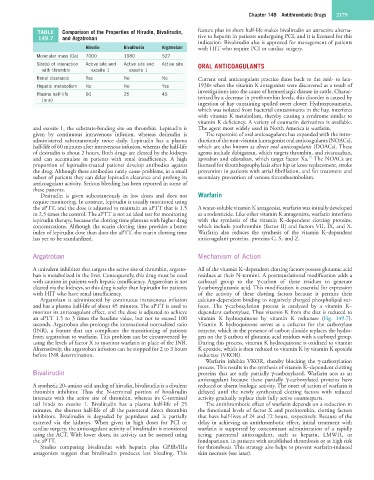
             TABLE   Comparison of the Properties of Hirudin, Bivalirudin,   feature plus its short half-life makes bivalirudin an attractive alterna-
              149.7  and Argatroban                               tive to heparin in patients undergoing PCI, and it is licensed for this
                                                                  indication. Bivalirudin also is approved for management of patients
                             Hirudin      Bivalirudin  Argatroban  with HIT who require PCI or cardiac surgery.
             Molecular mass (Da)  7000    1980        527
             Site(s) of interaction   Active site and   Active site and   Active site  ORAL ANTICOAGULANTS
               with thrombin   exosite 1   exosite 1
             Renal clearance  Yes         No          No          Current oral anticoagulant practice dates back to the mid- to late-
             Hepatic metabolism  No       No          Yes         1930s when the vitamin K antagonists were discovered as a result of
                                                                  investigations into the cause of hemorrhagic disease in cattle. Charac-
             Plasma half-life   60        25          45          terized by a decrease in prothrombin levels, this disorder is caused by
               (min)
                                                                  ingestion of hay containing spoiled sweet clover. Hydroxycoumarin,
                                                                  which was isolated from bacterial contaminants in the hay, interferes
                                                                  with vitamin K metabolism, thereby causing a syndrome similar to
                                                                  vitamin K deficiency. A variety of coumarin derivatives is available.
            and exosite 1, the substrate-binding site on thrombin. Lepirudin is   The agent most widely used in North America is warfarin.
            given  by  continuous  intravenous  infusion,  whereas  desirudin  is   The repertoire of oral anticoagulants has expanded with the intro-
            administered  subcutaneously  twice  daily.  Lepirudin  has  a  plasma   duction of the non-vitamin k antagonist oral anticoagulants (NOACs),
            half-life of 60 minutes after intravenous infusion, whereas the half-life   which are also known as direct oral anticoagulants (DOACs). These
            of desirudin is about 2 hours. Both drugs are cleared by the kidneys   agents include dabigatran, which targets thrombin, and rivaroxaban,
                                                                                                      14
            and  can  accumulate  in  patients  with  renal  insufficiency.  A  high   apixaban and edoxaban, which target factor Xa.  The NOACs are
            proportion of lepirudin-treated patients develop antibodies against   licensed for thromboprophylaxis after hip or knee replacement, stroke
            the drug. Although these antibodies rarely cause problems, in a small   prevention in patients with atrial fibrillation, and for treatment and
            subset of patients they can delay lepirudin clearance and prolong its   secondary prevention of venous thromboembolism.
            anticoagulant activity. Serious bleeding has been reported in some of
            these patients.
              Desirudin  is  given  subcutaneously  in  low  doses  and  does  not   Warfarin
            require monitoring. In contrast, lepirudin is usually monitored using
            the aPTT, and the dose is adjusted to maintain an aPTT that is 1.5   A water-soluble vitamin K antagonist, warfarin was initially developed
            to 2.5 times the control. The aPTT is not an ideal test for monitoring   as a rodenticide. Like other vitamin K antagonists, warfarin interferes
            lepirudin therapy, because the clotting time plateaus with higher drug   with  the  synthesis  of  the  vitamin  K–dependent  clotting  proteins,
            concentrations. Although the ecarin clotting time provides a better   which include prothrombin (factor II) and factors VII, IX, and X.
            index of lepirudin dose than does the aPTT, the ecarin clotting time   Warfarin  also  reduces  the  synthesis  of  the  vitamin  K–dependent
            has yet to be standardized.                           anticoagulant proteins, proteins C, S, and Z.

            Argatroban                                            Mechanism of Action

            A univalent inhibitor that targets the active site of thrombin, argatro-  All of the vitamin K–dependent clotting factors possess glutamic acid
            ban is metabolized in the liver. Consequently, this drug must be used   residues at their N-termini. A posttranslational modification adds a
            with caution in patients with hepatic insufficiency. Argatroban is not   carboxyl  group  to  the  γ-carbon  of  these  residues  to  generate
            cleared via the kidneys, so this drug is safer than lepirudin for patients   γ-carboxyglutamic acid. This modification is essential for expression
            with HIT who have renal insufficiency.                of  the  activity  of  these  clotting  factors  because  it  permits  their
              Argatroban  is  administered  by  continuous  intravenous  infusion   calcium-dependent binding to negatively charged phospholipid sur-
            and has a plasma half-life of about 45 minutes. The aPTT is used to   faces.  The  γ-carboxylation  process  is  catalyzed  by  a  vitamin  K–
            monitor its anticoagulant effect, and the dose is adjusted to achieve   dependent carboxylase. Thus vitamin K from the diet is reduced to
            an aPTT 1.5 to 3 times the baseline value, but not to exceed 100   vitamin  K  hydroquinone  by  vitamin  K  reductase  (Fig.  149.7).
            seconds. Argatroban also prolongs the international normalized ratio   Vitamin  K  hydroquinone  serves  as  a  cofactor  for  the  carboxylase
            (INR),  a  feature  that  can  complicate  the  transitioning  of  patients   enzyme, which in the presence of carbon dioxide replaces the hydro-
            from argatroban to warfarin. This problem can be circumvented by   gen on the γ-carbon of glutamic acid residues with a carboxyl group.
            using the levels of factor X to monitor warfarin in place of the INR.   During this process, vitamin K hydroquinone is oxidized to vitamin
            Alternatively, the argatroban infusion can be stopped for 2 to 3 hours   K epoxide, which is then reduced to vitamin K by vitamin K epoxide
            before INR determination.                             reductase (VKOR).
                                                                    Warfarin  inhibits  VKOR,  thereby  blocking  the  γ-carboxylation
                                                                  process. This results in the synthesis of vitamin K–dependent clotting
            Bivalirudin                                           proteins that are only partially γ-carboxylated. Warfarin acts as an
                                                                  anticoagulant  because  these  partially  γ-carboxylated  proteins  have
            A synthetic 20–amino acid analog of hirudin, bivalirudin is a divalent   reduced or absent biologic activity. The onset of action of warfarin is
            thrombin  inhibitor.  Thus  the  N-terminal  portion  of  bivalirudin   delayed  until  the  newly  synthesized  clotting  factors  with  reduced
            interacts  with  the  active  site  of  thrombin,  whereas  its  C-terminal   activity gradually replace their fully active counterparts.
            tail  binds  to  exosite  1.  Bivalirudin  has  a  plasma  half-life  of  25   The antithrombotic effect of warfarin depends on a reduction in
            minutes, the shortest half-life of all the parenteral direct thrombin   the functional levels of factor X and prothrombin, clotting factors
            inhibitors.  Bivalirudin  is  degraded  by  peptidases  and  is  partially   that have half-lives of 24 and 72 hours, respectively. Because of the
            excreted  via  the  kidneys.  When  given  in  high  doses  for  PCI  or   delay  in  achieving  an  antithrombotic  effect,  initial  treatment  with
            cardiac surgery, the anticoagulant activity of bivalirudin is monitored   warfarin  is  supported  by  concomitant  administration  of  a  rapidly
            using the ACT. With lower doses, its activity can be assessed using     acting  parenteral  anticoagulant,  such  as  heparin,  LMWH,  or
            the aPTT.                                             fondaparinux, in patients with established thrombosis or at high risk
              Studies  comparing  bivalirudin  with  heparin  plus  GPIIb/IIIa   for thrombosis. This strategy also helps to prevent warfarin-induced
            antagonists  suggest  that  bivalirudin  produces  less  bleeding.  This   skin necrosis (see later).

