


Page 2442 - Hematology_ Basic Principles and Practice ( PDFDrive )
P. 2442
2180   Part XII  Hemostasis and Thrombosis

                                                                                 19
           Ca 2+                                              factor VII, and factor X.  The test is performed by adding throm-
                                     Ca 2+                    boplastin,  a  reagent  that  contains  tissue  factor,  phospholipid,  and
                                    YYYY                      calcium, to citrated plasma and determining the time to clot forma-
           Glu                       Gla                      tion. Thromboplastins vary in their sensitivity to reductions in the
          Precursor     O 2                     γ-carboxylated  levels of the vitamin K–dependent clotting factors. Consequently, less
                                                clotting factor  sensitive thromboplastins will prompt the administration of higher
                              Vitamin K-                      doses  of  warfarin  to  achieve  a  target  prothrombin  time.  This  is
                              dependent                       problematic  because  higher  doses  of  warfarin  increase  the  risk  of
                              carboxylase                     bleeding.
              Vitamin K                      Vitamin K           The  INR  was  developed  to  circumvent  many  of  the  problems
             hydroquinone                     epoxide         associated with the prothrombin time assay. To calculate the INR,
                                                              the patient’s prothrombin time is divided by the mean normal pro-
                                                              thrombin time, and this ratio is then multiplied by the international
        Warfarin                                    Warfarin  sensitivity index (ISI), an index of the sensitivity of the thromboplas-
                                                              tin used for prothrombin time determination to reductions in the
              Vitamin K                       Vitamin K       levels of the vitamin K–dependent clotting factors. Highly sensitive
                                                              thromboplastins have an ISI of 1.0. Most current thromboplastins
                                               epoxide
              reductase       Vitamin K       reductase       have ISI values that range from 1.0 to 1.4.
                                                                 Although the INR has helped to standardize anticoagulant prac-
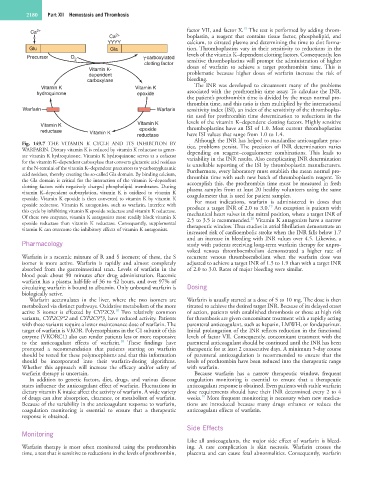
        Fig.  149.7  THE  VITAMIN  K  CYCLE  AND  ITS  INHIBITION  BY   tice,  problems  persist. The  precision  of  INR  determination  varies
        WARFARIN. Dietary vitamin K is reduced by vitamin K reductase to gener-  depending  on  reagent–coagulometer  combinations.  This  leads  to
        ate vitamin K hydroquinone. Vitamin K hydroquinone serves as a cofactor   variability in the INR results. Also complicating INR determination
        for the vitamin K–dependent carboxylase that converts glutamic acid residues   is unreliable reporting of the ISI by thromboplastin manufacturers.
        at the N-termini of the vitamin K–dependent precursors to γ-carboxyglutamic   Furthermore, every laboratory must establish the mean normal pro-
        acid residues, thereby creating the so-called Gla domain. By binding calcium,   thrombin time with each new batch of thromboplastin reagent. To
        the Gla domain is critical for the interaction of the vitamin K–dependent   accomplish this, the prothrombin time must be measured in fresh
        clotting  factors  with  negatively  charged  phospholipid  membranes.  During   plasma samples from at least 20 healthy volunteers using the same
        vitamin  K–dependent  carboxylation,  vitamin  K  is  oxidized  to  vitamin  K   coagulometer that is used for patient samples.
        epoxide. Vitamin K epoxide is then converted to vitamin K by vitamin K   For  most  indications,  warfarin  is  administered  in  doses  that
        epoxide reductase. Vitamin K antagonists, such as warfarin, interfere with   produce a target INR of 2.0 to 3.0.  An exception is patients with
                                                                                         19
        this cycle by inhibiting vitamin K epoxide reductase and vitamin K reductase.   mechanical heart valves in the mitral position, where a target INR of
        Of these two enzymes, vitamin K antagonists more readily block vitamin K   2.5 to 3.5 is recommended.  Vitamin K antagonists have a narrow
                                                                                   20
        epoxide  reductase  than  vitamin  K  reductase.  Consequently,  supplemental   therapeutic window. Thus studies in atrial fibrillation demonstrate an
        vitamin K can overcome the inhibitory effects of vitamin K antagonists.
                                                              increased risk of cardioembolic stroke when the INR falls below 1.7
                                                              and an increase in bleeding with INR values over 4.5. Likewise, a
        Pharmacology                                          study with patients receiving long-term warfarin therapy for unpro-
                                                              voked  venous  thromboembolism  demonstrated  a  higher  rate  of
        Warfarin is a racemic mixture of R and S isomers; of these, the S   recurrent  venous  thromboembolism  when  the  warfarin  dose  was
        isomer  is  more  active.  Warfarin  is  rapidly  and  almost  completely   adjusted to achieve a target INR of 1.5 to 1.9 than with a target INR
        absorbed  from  the  gastrointestinal  tract.  Levels  of  warfarin  in  the   of 2.0 to 3.0. Rates of major bleeding were similar.
        blood  peak  about  90  minutes  after  drug  administration.  Racemic
        warfarin has a plasma half-life of 36 to 42 hours, and over 97% of
        circulating warfarin is bound to albumin. Only unbound warfarin is   Dosing
        biologically active.
           Warfarin  accumulates  in  the  liver,  where  the  two  isomers  are   Warfarin is usually started at a dose of 5 to 10 mg. The dose is then
        metabolized via distinct pathways. Oxidative metabolism of the more   titrated to achieve the desired target INR. Because of its delayed onset
                                       18
        active  S  isomer  is  effected  by  CYP2C9.  Two  relatively  common   of action, patients with established thrombosis or those at high risk
        variants, CYP2C9*2 and CYP2C9*3, have reduced activity. Patients   for thrombosis are given concomitant treatment with a rapidly acting
        with these variants require a lower maintenance dose of warfarin. The   parenteral anticoagulant, such as heparin, LMWH, or fondaparinux.
        target of warfarin is VKOR. Polymorphisms in the C1 subunit of this   Initial prolongation of the INR reflects reduction in the functional
        enzyme (VKORC1) also can render patients less or more responsive   levels of factor VII. Consequently, concomitant treatment with the
                                        18
        to  the  anticoagulant  effects  of  warfarin.   These  findings  have   parenteral anticoagulant should be continued until the INR has been
        prompted  a  recommendation  that  patients  starting  on  warfarin   therapeutic for at least 2 consecutive days. A minimum 5-day course
        should be tested for these polymorphisms and that this information   of  parenteral  anticoagulation  is  recommended  to  ensure  that  the
        should  be  incorporated  into  their  warfarin-dosing  algorithms.   levels of prothrombin have been reduced into the therapeutic range
        Whether  this  approach  will  increase  the  efficacy  and/or  safety  of   with warfarin.
        warfarin therapy is uncertain.                           Because  warfarin  has  a  narrow  therapeutic  window,  frequent
           In  addition  to  genetic  factors,  diet,  drugs,  and  various  disease   coagulation  monitoring  is  essential  to  ensure  that  a  therapeutic
        states influence the anticoagulant effect of warfarin. Fluctuations in   anticoagulant response is obtained. Even patients with stable warfarin
        dietary vitamin K intake affect the activity of warfarin. A wide variety   dose requirements should have their INR determined every 2 to 4
                                                                   19
        of drugs can alter absorption, clearance, or metabolism of warfarin.   weeks.  More frequent monitoring is necessary when new medica-
        Because of the variability in the anticoagulant response to warfarin,   tions  are  introduced  because  many  drugs  enhance  or  reduce  the
        coagulation  monitoring  is  essential  to  ensure  that  a  therapeutic   anticoagulant effects of warfarin.
        response is obtained.
                                                              Side Effects
        Monitoring
                                                              Like  all  anticoagulants,  the  major  side  effect  of  warfarin  is  bleed-
        Warfarin  therapy  is  most  often  monitored  using  the  prothrombin   ing.  A  rare  complication  is  skin  necrosis.  Warfarin  crosses  the
        time, a test that is sensitive to reductions in the levels of prothrombin,   placenta and can cause fetal abnormalities. Consequently, warfarin

