


Page 2447 - Hematology_ Basic Principles and Practice ( PDFDrive )
P. 2447
Chapter 149  Antithrombotic Drugs  2185


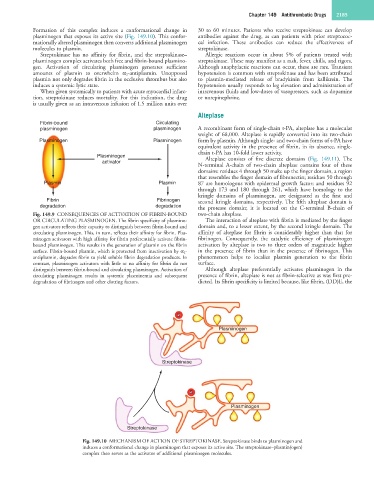
            Formation  of  this  complex  induces  a  conformational  change  in   30  to  60  minutes.  Patients  who  receive  streptokinase  can  develop
            plasminogen that exposes its active site (Fig. 149.10). This confor-  antibodies  against  the  drug,  as  can  patients  with  prior  streptococ-
            mationally altered plasminogen then converts additional plasminogen   cal  infection.  These  antibodies  can  reduce  the  effectiveness  of
            molecules to plasmin.                                 streptokinase.
              Streptokinase  has  no  affinity  for  fibrin,  and  the  streptokinase–  Allergic  reactions  occur  in  about  5%  of  patients  treated  with
            plasminogen complex activates both free and fibrin-bound plasmino-  streptokinase. These may manifest as a rash, fever, chills, and rigors.
            gen.  Activation  of  circulating  plasminogen  generates  sufficient   Although anaphylactic reactions can occur, these are rare. Transient
            amounts  of  plasmin  to  overwhelm  α 2-antiplasmin.  Unopposed   hypotension is common with streptokinase and has been attributed
            plasmin not only degrades fibrin in the occlusive thrombus but also   to  plasmin-mediated  release  of  bradykinin  from  kallikrein.  The
            induces a systemic lytic state.                       hypotension usually responds to leg elevation and administration of
              When given systemically to patients with acute myocardial infarc-  intravenous fluids and low-doses of vasopressors, such as dopamine
            tion, streptokinase reduces mortality. For this indication, the drug   or norepinephrine.
            is usually given as an intravenous infusion of 1.5 million units over

                                                                  Alteplase
              Fibrin-bound                          Circulating
              plasminogen                          plasminogen    A recombinant form of single-chain t-PA, alteplase has a molecular
                                                                  weight of 68,000. Alteplase is rapidly converted into its two-chain
              Plasminogen                          Plasminogen    form by plasmin. Although single- and two-chain forms of t-PA have
                                                                  equivalent activity in the presence of fibrin, in its absence, single-
                                                                  chain t-PA has 10-fold lower activity.
                                 Plasminogen                        Alteplase  consists  of  five  discrete  domains  (Fig.  149.11).  The
                                  activator
                                                                  N-terminal  A-chain  of  two-chain  alteplase  contains  four  of  these
                                                                  domains: residues 4 through 50 make up the finger domain, a region
                                                                  that resembles the finger domain of fibronectin; residues 50 through
               Plasmin                               Plasmin      87 are homologous with epidermal growth factor; and residues 92
                                                                  through  173  and  180  through  261,  which  have  homology  to  the
                                                                  kringle  domains  of  plasminogen,  are  designated  as  the  first  and
                Fibrin                              Fibrinogen    second kringle domains, respectively. The fifth alteplase domain is
              degradation                           degradation   the  protease  domain;  it  is  located  on  the  C-terminal  B-chain  of
            Fig. 149.9  CONSEQUENCES OF ACTIVATION OF FIBRIN-BOUND   two-chain alteplase.
            OR CIRCULATING PLASMINOGEN. The fibrin specificity of plasmino-  The interaction of alteplase with fibrin is mediated by the finger
            gen activators reflects their capacity to distinguish between fibrin-bound and   domain and, to a lesser extent, by the second kringle domain. The
            circulating plasminogen. This, in turn, reflects their affinity for fibrin. Plas-  affinity  of  alteplase  for  fibrin  is  considerably  higher  than  that  for
            minogen activators with high affinity for fibrin preferentially activate fibrin-  fibrinogen.  Consequently,  the  catalytic  efficiency  of  plasminogen
            bound plasminogen. This results in the generation of plasmin on the fibrin   activation  by  alteplase  is  two  to  three  orders  of  magnitude  higher
            surface. Fibrin-bound plasmin, which is protected from inactivation by α 2 -  in  the  presence  of  fibrin  than  in  the  presence  of  fibrinogen. This
            antiplasmin, degrades fibrin to yield soluble fibrin degradation products. In   phenomenon  helps  to  localize  plasmin  generation  to  the  fibrin
            contrast, plasminogen activators with little or no affinity for fibrin do not   surface.
            distinguish between fibrin-bound and circulating plasminogen. Activation of   Although  alteplase  preferentially  activates  plasminogen  in  the
            circulating  plasminogen  results  in  systemic  plasminemia  and  subsequent   presence of fibrin, alteplase is not as fibrin-selective as was first pre-
            degradation of fibrinogen and other clotting factors.   dicted. Its fibrin specificity is limited because, like fibrin, (DD)E, the


                                                           S
                                                                         Plasminogen


                                                      Streptokinase


                                                               S

                                                                             Plasminogen


                                           Streptokinase
                            Fig. 149.10  MECHANISM OF ACTION OF STREPTOKINASE. Streptokinase binds to plasminogen and
                            induces a conformational change in plasminogen that exposes its active site. The streptokinase–plasmin(ogen)
                            complex then serves as the activator of additional plasminogen molecules.

