


Page 2448 - Hematology_ Basic Principles and Practice ( PDFDrive )
P. 2448
2186   Part XII  Hemostasis and Thrombosis


                                                                                  Alteplase
                              F        EGF      K1      K2           P


                                                                     K H R R
                                                                   296
                                                                             299
                                                                      A A A A

                                                                                  Tenecteplase
                              F        EGF      K1      K2           P


                                                                                  Desmoteplase
                                      F       EGF       K1            P


                                                                                  Reteplase
                                                        K2           P
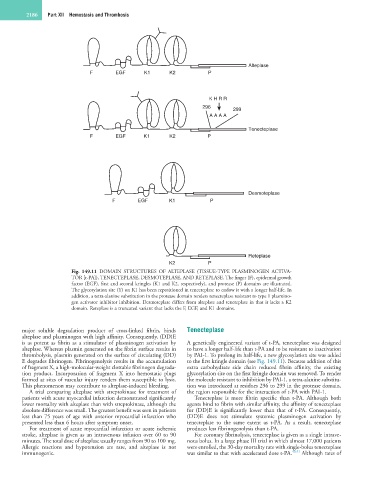
                        Fig.  149.11  DOMAIN  STRUCTURES  OF  ALTEPLASE  (TISSUE-TYPE  PLASMINOGEN  ACTIVA-
                        TOR [t-PA]), TENECTEPLASE, DESMOTEPLASE, AND RETEPLASE. The finger (F), epidermal growth
                        factor (EGF), first and second kringles (K1 and K2, respectively), and protease (P) domains are illustrated.
                        The glycosylation site (Y) on K1 has been repositioned in tenecteplase to endow it with a longer half-life. In
                        addition, a tetra-alanine substitution in the protease domain renders tenecteplase resistant to type 1 plasmino-
                        gen activator inhibitor inhibition. Desmoteplase differs from alteplase and teneteplase in that it lacks a K2
                        domain. Reteplase is a truncated variant that lacks the F, EGF, and K1 domains.


        major  soluble  degradation  product  of  cross-linked  fibrin,  binds   Tenecteplase
        alteplase and plasminogen with high affinity. Consequently, (DD)E
        is as potent as fibrin as a stimulator of plasminogen activation by   A genetically engineered variant of t-PA, tenecteplase was designed
        alteplase. Whereas plasmin generated on the fibrin surface results in   to have a longer half-life than t-PA and to be resistant to inactivation
        thrombolysis, plasmin generated on the surface of circulating (DD)  by PAI-1. To prolong its half-life, a new glycosylation site was added
        E degrades fibrinogen. Fibrinogenolysis results in the accumulation   to the first kringle domain (see Fig. 149.11). Because addition of this
        of fragment X, a high-molecular-weight clottable fibrinogen degrada-  extra  carbohydrate  side  chain  reduced  fibrin  affinity,  the  existing
        tion  product.  Incorporation  of  fragment  X  into  hemostatic  plugs   glycosylation site on the first kringle domain was removed. To render
        formed at sites of vascular injury renders them susceptible to lysis.   the molecule resistant to inhibition by PAI-1, a tetra-alanine substitu-
        This phenomenon may contribute to alteplase-induced bleeding.  tion was introduced at residues 296 to 299 in the protease domain,
           A  trial  comparing  alteplase  with  streptokinase  for  treatment  of   the region responsible for the interaction of t-PA with PAI-1.
        patients with acute myocardial infarction demonstrated significantly   Tenecteplase  is  more  fibrin  specific  than  t-PA.  Although  both
        lower mortality with alteplase than with streptokinase, although the   agents bind to fibrin with similar affinity, the affinity of tenecteplase
        absolute difference was small. The greatest benefit was seen in patients   for  (DD)E  is  significantly  lower  than  that  of  t-PA.  Consequently,
        less  than  75  years  of  age  with  anterior  myocardial  infarction  who   (DD)E  does  not  stimulate  systemic  plasminogen  activation  by
        presented less than 6 hours after symptom onset.      tenecteplase  to  the  same  extent  as  t-PA.  As  a  result,  tenecteplase
           For treatment of  acute  myocardial  infarction  or  acute  ischemic   produces less fibrinogenolysis than t-PA.
        stroke, alteplase is given as an intravenous infusion over 60 to 90   For coronary fibrinolysis, tenecteplase is given as a single intrave-
        minutes. The total dose of alteplase usually ranges from 90 to 100 mg.   nous bolus. In a large phase III trial in which almost 17,000 patients
        Allergic  reactions  and  hypotension  are  rare,  and  alteplase  is  not   were enrolled, the 30-day mortality rate with single-bolus tenecteplase
        immunogenic.                                          was similar to that with accelerated dose t-PA. 40,41  Although rates of

