


Page 2452 - Hematology_ Basic Principles and Practice ( PDFDrive )
P. 2452
2190   Part XII  Hemostasis and Thrombosis


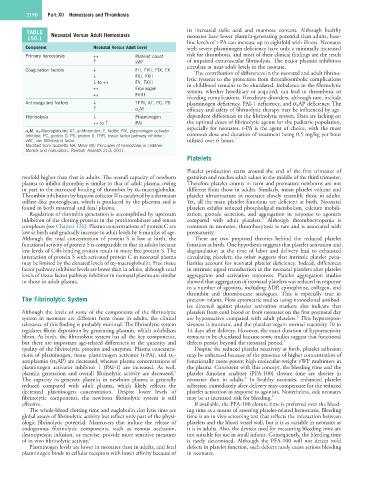
          TABLE   Neonatal Versus Adult Hemostasis            its  increased  sialic  acid  and  mannose  content.  Although  healthy
          150.1                                               neonates have lower plasmin-generating potential than adults, base-
                                                              line levels of t-PA can increase up to eightfold with illness. Neonates
         Component              Neonatal Versus Adult Level   with severe plasminogen deficiency have only a minimally increased
         Primary hemostasis     ↔            Platelet count   risk for thrombosis, and most of their clinical findings are the result
                                ↑            vWF              of impaired extravascular fibrinolysis. The major plasmin inhibitors
         Coagulation factors    ↓            FII, FVII, FIX, FX  circulate at near-adult levels in the neonate.
                                                                 The contribution of differences in the neonatal and adult fibrino-
                                ↓            FXI, FXII        lytic systems to the protection from thromboembolic complications
                                ↓ to ↔       FV, FXIII        in childhood remains to be elucidated. Imbalance in the fibrinolytic
                                ↔            Fibrinogen       system, whether hereditary or acquired, can lead to thrombotic or
                                ↔            FVIII
                                                              bleeding complications. Hereditary disorders, although rare, include
         Anticoagulant factors  ↓            TFPI, AT, PC, PS  plasminogen deficiency, PAI-1 deficiency, and α 2AP deficiency. The
                                ↑            α 2 M            efficacy and safety of fibrinolytic therapy may be influenced by age-
         Fibrinolysis           ↓            Plasminogen      dependent differences in the fibrinolytic system. Data are lacking on
                                ↔ to ↑       PAI              the optimal doses of fibrinolytic agents for the pediatric population,
                                                              especially for neonates. t-PA is the agent of choice, with the most
         α 2M, α 2-Macroglobulin; AT, antithrombin; F, factor; PAI, plasminogen activator
         inhibitor; PC, protein C; PS, protein S; TFPI, tissue factor pathway inhibitor;   common dose and duration of treatment being 0.5 mg/kg per hour
                                                                              7
         vWF, von Willebrand factor.                          infused over 6 hours.
         Modified from Guzzetta NA, Miller BE: Principles of hemostasis in children:
         Models and maturation. Paediatr Anaesth 21:3, 2011.
                                                              Platelets
                                                              Platelet  production  starts  around  the  end  of  the  first  trimester  of
        twofold higher than that in adults. The overall capacity of newborn   gestation and reaches adult values in the middle of the third trimester.
        plasma to inhibit thrombin is similar to that of adult plasma, owing   Therefore platelet counts in term and premature newborns are not
        in part to the increased binding of thrombin by α 2 -macroglobulin.   different from those in adults. Similarly, mean platelet volume and
        Thrombin inhibition by heparin cofactor II is catalyzed by a dermatan   platelet ultrastructure in neonates closely resemble those in adults.
        sulfate–like proteoglycan, which is produced by the placenta and is   Yet, all the main platelet functions are deficient at birth. Neonatal
        found in both maternal and fetal plasma.              platelets exhibit reduced phospholipid metabolism, calcium mobili-
           Regulation of thrombin generation is accomplished by upstream   zation,  granule  secretion,  and  aggregation  in  response  to  agonists
                                                                                       8
        inhibition of the clotting proteins in the prothrombinase and tenase   compared  with  adult  platelets.   Although  thrombocytopenia  is
        complexes (see Chapter 126). Plasma concentrations of protein C are   common in neonates, thrombocytosis is rare and is associated with
        low at birth and gradually increase to adult levels by 6 months of age.   prematurity.
        Although  the  total  concentration  of  protein  S  is  low  at  birth,  the   There  are  two  proposed  theories  behind  the  reduced  platelet
        functional activity of protein S is comparable to that in adults because   function at birth. One hypothesis suggests that platelet activation and
        low levels of C4b-binding protein result in more free protein S. The   degranulation  at  the  time  of  labor  and  delivery  lead  to  exhausted
        interaction of protein S with activated protein C in neonatal plasma   circulating platelets; the other suggests that intrinsic platelet pecu-
        may be limited by the elevated levels of α 2 -macroglobulin. Free tissue   liarities account for neonatal platelet deficiency. Indeed, differences
        factor pathway inhibitor levels are lower than in adults, although total   in intrinsic signal transduction in the neonatal platelets alter platelet
        levels of tissue factor pathway inhibitor in neonatal plasma are similar   aggregation  and  activation  responses.  Platelet  aggregation  studies
        to those in adult plasma.                             showed that aggregation of neonatal platelets was reduced in response
                                                              to a number of agonists, including ADP, epinephrine, collagen, and
                                                              thrombin  and  thromboxane  analogues.  This  is  especially  true  in
        The Fibrinolytic System                               preterm infants. Flow cytometric studies using monoclonal antibod-
                                                              ies  directed  against  platelet  activation  markers  also  indicate  that
        Although the levels of some of the components of the fibrinolytic   platelets from cord blood or from neonates on the first postnatal day
                                                                                                  8
        system  in  neonates  are  different  from  those  in  adults,  the  clinical   are  hyporeactive  compared  with  adult  platelets.  This hyporespon-
        relevance of this finding is probably minimal. The fibrinolytic system   siveness is transient, and the platelets regain normal reactivity 10 to
        regulates fibrin deposition by generating plasmin, which solubilizes   14 days after delivery. However, the exact duration of hyporeactivity
        fibrin. At birth, the fibrinolytic system has all the key components,   remains to be elucidated because some studies suggest that functional
        but there are important age-related differences in the quantity and   defects persist beyond the neonatal period. 9
        quality of the fibrinolytic proteins and enzymes. Plasma concentra-  Despite the reduced platelet reactivity at birth, platelet adhesion
        tions of plasminogen, tissue plasminogen activator (t-PA), and α 2 -  may be enhanced because of the presence of higher concentration of
        antiplasmin (α 2 AP) are decreased, whereas plasma concentrations of   functionally more potent high-molecular-weight vWF multimers in
        plasminogen  activator  inhibitor  1  (PAI-1)  are  increased.  As  well,   the plasma. Consistent with this concept, the bleeding time and the
                                                          6
        plasmin  generation  and  overall  fibrinolytic  activity  are  decreased.    platelet  function  analyzer  (PFA-100)  closure  time  are  shorter  in
                                                                                 8
        The  capacity  to  generate  plasmin  in  newborn  plasma  is  generally   neonates  than  in  adults.   In  healthy  neonates,  enhanced  platelet
        reduced  compared  with  adult  plasma,  which  likely  reflects  the   adhesion immediately after delivery may compensate for the reduced
        decreased  plasminogen  concentration.  Despite  lower  levels  of     platelet activation in response to agonists. Nonetheless, sick neonates
        fibrinolytic  components,  the  newborn  fibrinolytic  system  is  still   may be at increased risk for bleeding. 8
        effective.                                               If available, the PFA-100 closure time is preferred over the bleed-
           The whole-blood clotting time and euglobulin clot lysis time are   ing time as a means of assessing platelet-related hemostasis. Bleeding
        global assays of fibrinolytic activity but reflect only part of the physi-  time is an in vivo screening test that reflects the interaction between
        ologic  fibrinolytic  potential.  Maneuvers  that  induce  the  release  of   platelets and the blood vessel wall, but it is as variable in neonates as
        endogenous  fibrinolytic  components,  such  as  venous  occlusion,   it is in adults. Also, the devices used for measuring bleeding time are
        desmopressin infusion, or exercise, provide more sensitive measures   not suitable for use in small infants. Consequently, the bleeding time
        of in vivo fibrinolytic activity. 6                   is  rarely  determined.  Although  the  PFA-100  will  not  detect  mild
           Plasminogen levels are lower in neonates than in adults, and fetal   defects in platelet function, such defects rarely cause serious bleeding
        plasminogen binds to cellular receptors with lower affinity because of   in neonates.

