


Page 2453 - Hematology_ Basic Principles and Practice ( PDFDrive )
P. 2453
Chapter 150  Disorders of Coagulation in the Neonate  2191


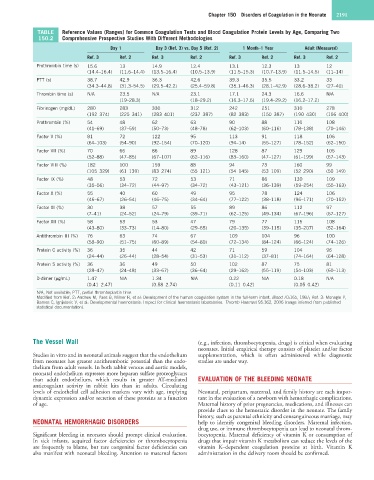
             TABLE   Reference Values (Ranges) for Common Coagulation Tests and Blood Coagulation Protein Levels by Age, Comparing Two
              150.2  Comprehensive Prospective Studies With Different Methodologies
                                     Day 1          Day 3 (Ref. 3) vs. Day 5 (Ref. 2)  1 Month–1 Year  Adult (Measured)
                              Ref. 3    Ref. 2     Ref. 3      Ref. 2       Ref. 3     Ref. 2    Ref. 3     Ref. 2
             Prothrombin time (s)  15.6  13        14.9        12.4         13.1       12.3      13         12
                              (14.4–16.4)  (11.6–14.4)  (13.5–16.4)  (10.5–13.9)  (11.5–15.3)  (10.7–13.9)  (11.5–14.5)  (11–14)
             PTT (s)          38.7      42.9       36.3        42.6         39.3       35.5      33.2       33
                              (34.3–44.8)  (31.3–54.5)  (29.5–42.2)  (25.4–59.8)  (35.1–46.3)  (28.1–42.9)  (28.6–38.2)  (27–40)
             Thrombin time (s)  N/A     23.5       N/A         23.1         17.1       24.3      16.6       N/A
                                        (19–28.3)              (18–29.2)    (16.3–17.6)  (19.4–29.2)  (16.2–17.2)
             Fibrinogen (mg/dL)  280    283        330         312          242        251       310        278
                              (192–374)  (225–341)  (283–401)  (237–387)    (82–383)   (150–387)  (190–430)  (156–400)
             Prothrombin (%)  54        48         62          63           90         88        110        108
                              (41–69)   (37–59)    (50–73)     (48–78)      (62–103)   (60–116)  (78–138)   (70–146)
             Factor V (%)     81        72         122         95           113        91        118        106
                              (64–103)  (54–90)    (92–154)    (70–120)     (94–14)    (55–127)  (78–152)   (62–150)
             Factor VII (%)   70        66         86          89           128        87        129        105
                              (52–88)   (47–85)    (67–107)    (62–116)     (83–160)   (47–127)  (61–199)   (67–143)
             Factor VIII (%)  182       100        159         88           94         73        160        99
                              (105–329)  (61–139)  (83–274)    (55–121)     (54–145)   (53–109)  (52–290)   (50–149)
             Factor IX (%)    48        53         72          53           71         86        130        109
                              (35–56)   (34–72)    (44–97)     (34–72)      (43–121)   (36–139)  (59–254)   (55–163)
             Factor X (%)     55        40         60          49           95         78        124        106
                              (46–67)   (26–54)    (46–75)     (34–64)      (77–122)   (38–118)  (96–171)   (70–152)
             Factor XI (%)    30        38         57          55           89         86        112        97
                              (7–41)    (24–52)    (24–79)     (39–71)      (62–125)   (49–134)  (67–196)   (67–127)
             Factor XII (%)   58        53         53          47           79         77        115        108
                              (43–80)   (33–73)    (14–80)     (29–65)      (20–135)   (39–115)  (35–207)   (52–164)
             Antithrombin III (%)  76   63         74          67           109        104       96         100
                              (58–90)   (51–75)    (60–89)     (54–80)      (72–134)   (84–124)  (66–124)   (74–126)
             Protein C activity (%)  36  35        44          42           71         59        104        96
                              (24–44)   (26–44)    (28–54)     (31–53)      (31–112)   (37–81)   (74–164)   (64–128)
             Protein S activity (%)  36  36        49          50           102        87        75         81
                              (28–47)   (24–48)    (33–67)     (36–64)      (29–162)   (55–119)  (54–103)   (60–113)
             D-dimer (µg/mL)  1.47      N/A        1.34        N/A          0.22       N/A       0.18       N/A
                              (0.41–2.47)          (0.58–2.74)              (0.11–0.42)          (0.05–0.42)
             N/A, Not available; PTT, partial thromboplastin time.
             Modified from Ref. 2: Andrew M, Paes B, Milner R, et al: Development of the human coagulation system in the full-term infant. Blood 70:165, 1987; Ref. 3: Monagle P,
             Barnes C, Ignjatovic V, et al: Developmental haemostasis: Impact for clinical haemostasis laboratories. Thromb Haemost 95:362, 2006 (range inferred from published
             statistical documentation).


            The Vessel Wall                                       (e.g., infection, thrombocytopenia, drugs) is critical when evaluating
                                                                  neonates. Initial empirical therapy consists of platelet and/or factor
            Studies in vitro and in neonatal animals suggest that the endothelium   supplementation,  which  is  often  administered  while  diagnostic
            from neonates has greater antithrombotic potential than the endo-  studies are under way.
            thelium from adult vessels. In both rabbit venous and aortic models,
            neonatal endothelium expresses more heparan sulfate proteoglycans
            than  adult  endothelium,  which  results  in  greater  AT-mediated   EVALUATION OF THE BLEEDING NEONATE
            anticoagulant  activity  in  rabbit  kits  than  in  adults.  Circulating
            levels of endothelial cell adhesion markers vary with age, implying   Neonatal, peripartum, maternal, and family history are each impor-
            dynamic expression and/or secretion of these proteins as a function    tant in the evaluation of a newborn with hemorrhagic complications.
            of age.                                               Maternal history of prior pregnancies, medications, and illnesses can
                                                                  provide clues to the hemostatic disorder in the neonate. The family
                                                                  history, such as parental ethnicity and consanguineous marriage, may
            NEONATAL HEMORRHAGIC DISORDERS                        help  to  identify  congenital  bleeding  disorders.  Maternal  infection,
                                                                  drug use, or immune thrombocytopenia can lead to neonatal throm-
            Significant bleeding in neonates should prompt clinical evaluation.   bocytopenia. Maternal deficiency of vitamin K or consumption of
            In  sick  infants,  acquired  factor  deficiencies  or  thrombocytopenia     drugs that impair vitamin K metabolism can reduce the levels of the
            are frequently to blame, but rare congenital factor deficiencies can   vitamin  K–dependent  coagulation  proteins  at  birth.  Vitamin  K
            also manifest with neonatal bleeding. Attention to maternal factors   administration in the delivery room should be confirmed.

