


Page 2455 - Hematology_ Basic Principles and Practice ( PDFDrive )
P. 2455
Chapter 150  Disorders of Coagulation in the Neonate  2193


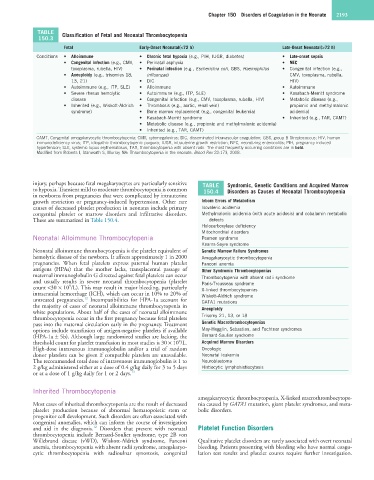
             TABLE   Classification of Fetal and Neonatal Thrombocytopenia
              150.3
                      Fetal                    Early-Onset Neonatal(<72 h)                   Late-Onset Neonatal(>72 h)
             Conditions  •  Alloimmune         •  Chronic fetal hypoxia (e.g., PIH, IUGR, diabetes)  •  Late-onset sepsis
                      •  Congenital infection (e.g., CMV,  •  Perinatal asphyxia             •  NEC
                        toxoplasma, rubella, HIV)  •  Perinatal infection (e.g., Escherichia coli, GBS, Haemophilus   •  Congenital infection (e.g.,
                      •  Aneuploidy (e.g., trisomies 18,   influenzae)                          CMV, toxoplasma, rubella,
                        13, 21)                •  DIC                                           HIV)
                      •  Autoimmune (e.g., ITP, SLE)  •  Alloimmune                          •  Autoimmune
                      •  Severe rhesus hemolytic   •  Autoimmune (e.g., ITP, SLE)            •  Kasabach-Merritt syndrome
                        disease                •  Congenital infection (e.g., CMV, toxoplasma, rubella, HIV)  •  Metabolic disease (e.g.,
                      •  Inherited (e.g., Wiskott-Aldrich  •  Thrombosis (e.g., aortic, renal vein)  propionic and methylmalonic
                        syndrome)              •  Bone marrow replacement (e.g., congenital leukemia)  acidemia)
                                               •  Kasabach-Merritt syndrome                  •  Inherited (e.g., TAR, CAMT)
                                               •  Metabolic disease (e.g., propionic and methylmalonic acidemia)
                                               •  Inherited (e.g., TAR, CAMT)
             CAMT, Congenital amegakaryocytic thrombocytopenia; CMV, cytomegalovirus; DIC, disseminated intravascular coagulation; GBS, group B Streptococcus; HIV, human
             immunodeficiency virus; ITP, idiopathic thrombocytopenic purpura; IUGR, intrauterine growth restriction; NEC, necrotizing enterocolitis; PIH, pregnancy-induced
             hypertension; SLE, systemic lupus erythematosus, TAR, thrombocytopenia with absent radii. The most frequently occurring conditions are in bold.
             Modified from Roberts I, Stanworth S, Murray NA: Thrombocytopenia in the neonate. Blood Rev 22:173, 2008.


            injury, perhaps because fetal megakaryocytes are particularly sensitive   TABLE   Syndromic, Genetic Conditions and Acquired Marrow
            to hypoxia. Transient mild to moderate thrombocytopenia is common   150.4  Disorders as Causes of Neonatal Thrombocytopenia
            in newborns from pregnancies that were complicated by intrauterine
            growth  restriction  or  pregnancy-induced  hypertension.  Other  rare   Inborn Errors of Metabolism
            causes of decreased platelet production in neonates include primary   Isovaleric acidemia
            congenital  platelet  or  marrow  disorders  and  infiltrative  disorders.   Methylmalonic acidemia (with acute acidosis) and cobalamin metabolic
            These are summarized in Table 150.4.                     defects
                                                                   Holocarboxylase deficiency
                                                                   Mitochondrial disorders
            Neonatal Alloimmune Thrombocytopenia                   Pearson syndrome
                                                                   Kearns-Sayre syndrome
            Neonatal alloimmune thrombocytopenia is the platelet equivalent of   Genetic Marrow Failure Syndromes
            hemolytic disease of the newborn. It affects approximately 1 in 2000   Amegakaryocytic thrombocytopenia
            pregnancies.  When  fetal  platelets  express  paternal  human  platelet   Fanconi anemia
            antigens  (HPAs)  that  the  mother  lacks,  transplacental  passage  of   Other Syndromic Thrombocytopenias
            maternal immunoglobulin G directed against fetal platelets can occur   Thrombocytopenia with absent radii syndrome
            and  usually  results  in  severe  neonatal  thrombocytopenia  (platelet   Paris-Trousseau syndrome
                        9
            count <30 × 10 /L). This may result in major bleeding, particularly   X-linked thrombocytopenias
            intracranial hemorrhage (ICH), which can occur in 10% to 20% of   Wiskott-Aldrich syndrome
                             12
            untreated  pregnancies.   Incompatibilities  for  HPA-1a  account  for   GATA1 mutations
            the majority of cases of neonatal alloimmune thrombocytopenia in   Aneuploidy
            white populations. About half of the cases of neonatal alloimmune
            thrombocytopenia occur in the first pregnancy because fetal platelets   Trisomy 21, 13, or 18
            pass into the maternal circulation early in the pregnancy. Treatment   Genetic Macrothrombocytopenias
            options include transfusion of antigen-negative platelets if available   May-Hegglin, Sebastian, and Fechtner syndromes
            (HPA-1a ± 5b). Although large randomized studies are lacking, the   Bernard-Soulier syndrome
                                                           9
            threshold count for platelet transfusion in most studies is 30 × 10 /L.   Acquired Marrow Disorders
            High-dose  intravenous  immunoglobulin  and/or  a  trial  of  random   Oncologic
            donor platelets can be given if compatible platelets are unavailable.   Neonatal leukemia
            The recommended total dose of intravenous immunoglobulin is 1 to   Neuroblastoma
            2 g/kg administered either at a dose of 0.4 g/kg daily for 3 to 5 days   Histiocytic lymphohistiocytosis
            or at a dose of 1 g/kg daily for 1 or 2 days. 13

            Inherited Thrombocytopenia
                                                                  amegakaryocytic thrombocytopenia, X-linked macrothrombocytope-
            Most cases of inherited thrombocytopenia are the result of decreased   nia caused by GATA1 mutation, giant platelet syndromes, and meta-
            platelet  production  because  of  abnormal  hematopoietic  stem  or   bolic disorders.
            progenitor cell development. Such disorders are often associated with
            congenital anomalies, which can inform the course of investigation
                                12
            and  aid  in  the  diagnosis.   Disorders  that  present  with  neonatal   Platelet Function Disorders
            thrombocytopenia include Bernard-Soulier syndrome, type 2B von
            Willebrand  disease  (vWD),  Wiskott-Aldrich  syndrome,  Fanconi   Qualitative platelet disorders are rarely associated with overt neonatal
            anemia, thrombocytopenia with absent radii syndrome, amegakaryo-  bleeding. Patients presenting with bleeding who have normal coagu-
            cytic  thrombocytopenia  with  radioulnar  synostosis,  congenital   lation test results and platelet counts require further investigation.

