


Page 2456 - Hematology_ Basic Principles and Practice ( PDFDrive )
P. 2456
2194   Part XII  Hemostasis and Thrombosis


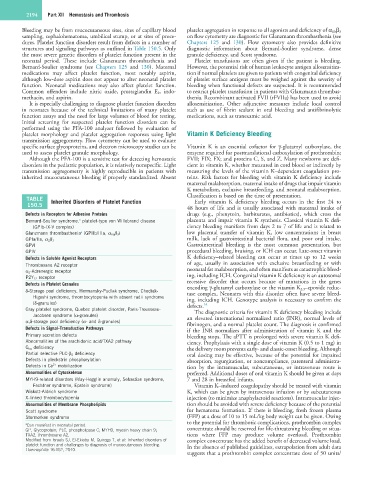
        Bleeding may be from mucocutaneous sites, sites of capillary blood   platelet aggregation in response to all agonists and deficiency of α IIbβ 3
        sampling, cephalohematoma, umbilical stump, or at sites of proce-  on flow cytometry are diagnostic for Glanzmann thrombasthenia (see
        dures. Platelet function disorders result from defects in a number of   Chapters  125  and  130).  Flow  cytometry  also  provides  definitive
        structures and signaling pathways as outlined in Table 150.5. Only   diagnostic  information  about  Bernard-Soulier  syndrome,  dense
        the most severe genetic disorders of platelet function present in the   granule deficiency, and Scott syndrome.
        neonatal  period.  These  include  Glanzmann  thrombasthenia  and   Platelet  transfusions  are  often  given  if  the  patient  is  bleeding.
        Bernard-Soulier  syndrome  (see  Chapters  125  and  130).  Maternal   However, the potential risk of human leukocyte antigen allosensitiza-
        medications  may  affect  platelet  function,  most  notably  aspirin,   tion if normal platelets are given to patients with congenital deficiency
        although low-dose aspirin does not appear to alter neonatal platelet   of platelet surface antigens must be weighed against the severity of
        function.  Neonatal  medications  may  also  affect  platelet  function.   bleeding when functional defects are suspected. It is recommended
        Common  offenders  include  nitric  oxide,  prostaglandin  E 2 ,  indo-  to restrict platelet transfusion in patients with Glanzmann thrombas-
        methacin, and aspirin.                                thenia. Recombinant activated FVII (rFVIIa) has been used to avoid
           It is especially challenging to diagnose platelet function disorders   allosensitization.  Other  adjunctive  measures  include  local  control
        in  neonates  because  of  the  technical  limitations  of  many  platelet   such  as  use  of  fibrin  sealant  in  oral  bleeding  and  antifibrinolytic
        function assays and the need for large volumes of blood for testing.   medications, such as tranexamic acid.
        Initial  screening  for  suspected  platelet  function  disorders  can  be
        performed  using  the  PFA-100  analyzer  followed  by  evaluation  of
        platelet  morphology  and  platelet  aggregation  responses  using  light   Vitamin K Deficiency Bleeding
        transmission aggregometry. Flow cytometry can be used to evaluate
        specific surface glycoproteins, and electron microscopy studies can be   Vitamin  K  is  an  essential  cofactor  for  γ-glutamyl  carboxylase,  the
        used to assess platelet granule morphology.           enzyme required for posttranslational carboxylation of prothrombin;
           Although the PFA-100 is a sensitive test for detecting hemostatic   FVII; FIX; FX; and proteins C, S, and Z. Many newborns are defi-
        disorders in the pediatric population, it is relatively nonspecific. Light   cient in vitamin K, whether measured in cord blood or indirectly by
        transmission  aggregometry  is  highly  reproducible  in  patients  with   measuring the levels of the vitamin K–dependent coagulation pro-
        inherited mucocutaneous bleeding if properly standardized. Absent   teins.  Risk  factors  for  bleeding  with  vitamin  K  deficiency  include
                                                              maternal malabsorption, maternal intake of drugs that impair vitamin
                                                              K metabolism, exclusive breastfeeding, and neonatal malabsorption.
                                                              Classification is based on the time of presentation.
          TABLE   Inherited Disorders of Platelet Function       Early  vitamin  K  deficiency  bleeding  occurs  in  the  first  24  to
          150.5
                                                              48  hours  of  life  and  is  usually  associated  with  maternal  intake  of
         Defects in Receptors for Adhesive Proteins           drugs  (e.g.,  phenytoin,  barbiturates,  antibiotics),  which  cross  the
                           a
         Bernard-Soulier syndrome,  platelet-type von Willebrand disease   placenta and impair vitamin K synthesis. Classical vitamin K defi-
            (GPIb-IX-V complex)                               ciency bleeding manifests from days 2 to 7 of life and is related to
         Glanzmann thrombasthenia  (GPIIb/IIIa, α IIb β 3 )   low  placental  transfer  of  vitamin  K,  low  concentrations  in  breast
                           a
                                                              milk,  lack  of  gastrointestinal  bacterial  flora,  and  poor  oral  intake.
         GPIa/IIa, α 2 β 1
         GPVI                                                 Gastrointestinal  bleeding  is  the  most  common  presentation,  but
         GPIV                                                 procedural bleeding, bruising, or ICH can occur. Late-onset vitamin
         Defects in Soluble Agonist Receptors                 K  deficiency–related  bleeding  can  occur  at  times  up  to  12  weeks
         Thromboxane A2 receptor                              of  age,  usually  in  association  with  exclusive  breastfeeding  or  with
         α 2 -Adrenergic receptor                             neonatal fat malabsorption, and often manifests as catastrophic bleed-
         P2Y 12  receptor                                     ing, including ICH. Congenital vitamin K deficiency is an autosomal
         Defects in Platelet Granules                         recessive  disorder  that  occurs  because  of  mutations  in  the  genes
                                                              encoding γ-glutamyl carboxylase or the vitamin K 2,3 –epoxide reduc-
         δ-Storage pool deficiency, Hermansky-Pudlak syndrome, Chediak-  tase complex. Neonates with this disorder often have severe bleed-
            Higashi syndrome, thrombocytopenia with absent radii syndrome   ing, including ICH. Genotype analysis is necessary to confirm the
            (δ-granules)                                      defects. 14
         Gray platelet syndrome, Quebec platelet disorder, Paris-Trousseau-  The diagnostic criteria for vitamin K deficiency bleeding include
            Jacobsen syndrome (α-granules)                    an  elevated  international  normalized  ratio  (INR),  normal  levels of
         α,δ-storage pool deficiency (α- and δ-granules)      fibrinogen, and a normal platelet count. The diagnosis is confirmed
         Defects in Signal-Transduction Pathways              if  the  INR  normalizes  after  administration  of  vitamin  K  and  the
         Primary secretion defects                            bleeding stops. The aPTT is prolonged with severe vitamin K defi-
         Abnormalities of the arachidonic acid/TXA2 pathway   ciency. Prophylaxis with a single dose of vitamin K (0.5 to 1 mg) in
         G αq  deficiency                                     the delivery room prevents early- and classic-onset bleeding. Although
         Partial selective PLC-β 2  deficiency                oral dosing may be effective, because of the potential for impaired
         Defects in pleckstrin phosphorylation                absorption, regurgitation, or noncompliance, parenteral administra-
                  2+
         Defects in Ca  mobilization                          tion  by  the  intramuscular,  subcutaneous,  or  intravenous  route  is
         Abnormalities of Cytoskeleton                        preferred. Additional doses of oral vitamin K should be given at days
         MYH9-related disorders (May-Hegglin anomaly, Sebastian syndrome,   7 and 28 in breastfed infants.
            Fechtner syndrome, Epstein syndrome)                 Vitamin K–induced coagulopathy should be treated with vitamin
         Wiskott-Aldrich syndrome                             K, which can be given by intravenous infusion or by subcutaneous
         X-linked thrombocytopenia                            injection (to minimize anaphylactoid reactions). Intramuscular injec-
         Abnormalities of Membrane Phospholipids              tion should be avoided with severe deficiency because of the potential
         Scott syndrome                                       for  hematoma  formation.  If  there  is  bleeding,  fresh  frozen  plasma
         Stormorken syndrome                                  (FFP) at a dose of 10 to 15 mL/kg body weight can be given. Owing
                                                              to the potential for thrombotic complications, prothrombin complex
         a Can manifest in neonatal period.
         GP, Glycoprotein; PLC, phospholipase C; MYH9, myosin heavy chain 9;    concentrate should be reserved for life-threatening bleeding or situa-
         TXA2, thromboxane A2.                                tions  where  FFP  may  produce  volume  overload.  Prothrombin
         Modified from Israels SJ, El-Ekiaby M, Quiroga T, et al: Inherited disorders of   complex concentrate has the added benefit of decreased volume load.
         platelet function and challenges to diagnosis of mucocutaneous bleeding.   In the absence of published guidelines, extrapolation from adult data
         Haemophilia 16:152, 2010.
                                                              suggests that a prothrombin complex concentrate dose of 50 units/

