


Page 248 - Hematology_ Basic Principles and Practice ( PDFDrive )
P. 248
200    Part III  Immunologic Basis of Hematology


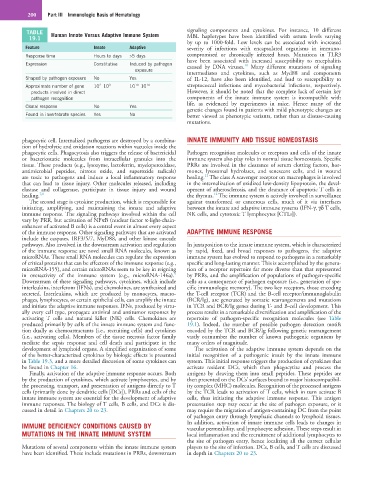
          TABLE   Human Innate Versus Adaptive Immune System  signaling  components  and  cytokines.  For  instance,  10  different
          19.1                                                MBL  haplotypes  have  been  identified  with  serum  levels  varying
                                                              by  up  to  1000-fold.  Low  levels  can  be  associated  with  increased
         Feature                Innate     Adaptive           severity  of  infections  with  encapsulated  organisms  in  immuno-
         Response time          Hours to days  >5 days        compromised  or  chronically  infected  hosts.  Mutations  in  TLR3
                                                              have  been  associated  with  increased  susceptibility  to  encephalitis
         Expression             Constitutive  Induced by pathogen   caused  by  DNA  viruses.   Many  different  mutations  of  signaling
                                                                                 10
                                             exposure
                                                              intermediates  and  cytokines,  such  as  Myd88  and  components
         Shaped by pathogen exposure  No   Yes                of  IL-12,  have  also  been  identified,  and  lead  to  susceptibility  to
         Approximate number of gene   10 –10 3  10 –10 14     streptococcal  infections  and  mycobacterial  infections,  respectively.
                                             10
                                  2
           products involved in direct                        However, it should be noted that the complete lack of certain key
           pathogen recognition                               components  of  the  innate  immune  system  is  incompatible  with
                                                              life,  as  evidenced  by  experiments  in  mice.  Hence  many  of  the
         Clonal response        No         Yes
                                                              genetic changes found in patients with mild phenotypic changes are
         Found in invertebrate species  Yes  No               better viewed as phenotypic variants, rather than as disease-causing
                                                              mutations.
        phagocytic cell. Internalized pathogens are destroyed by a combina-  INNATE IMMUNITY AND TISSUE HOMEOSTASIS
        tion of hydrolytic and oxidation reactions within vacuoles inside the
        phagocytic cells. Phagocytosis also triggers the release of bactericidal   Pathogen recognition molecules or receptors and cells of the innate
        or  bacteriostatic  molecules  from  intracellular  granules  into  the   immune system also play roles in normal tissue homeostasis. Specific
        tissue. These products (e.g., lysozyme, lactoferrin, myeloperoxidase,   PRRs are involved in the clearance of serum clotting factors, hor-
        antimicrobial  peptides,  nitrous  oxide,  and  superoxide  radicals)   mones,  lysosomal  hydrolases,  and  senescent  cells,  and  in  wound
                                                                    11
        are  toxic  to  pathogens  and  induce  a  local  inflammatory  response   healing.  The class A scavenger receptor on macrophages is involved
        that  can  lead  to  tissue  injury.  Other  molecules  released,  including   in the internalization of oxidized low-density lipoprotein, the devel-
        elastase  and  collagenase,  participate  in  tissue  injury  and  wound    opment of atherosclerosis, and the clearance of apoptotic T cells in
                                                                       12
        healing. 7,8                                          the thymus.  The immune system is actively involved in surveillance
           The second stage is cytokine production, which is responsible for   against  transformed  or  cancerous  cells,  much  of  it  via  interfaces
        initiating,  amplifying,  and  maintaining  the  innate  and  adaptive   between the innate and adaptive immune systems (IFN-γ, γδ T cells,
        immune response. The signaling pathways involved within the cell   NK cells, and cytotoxic T lymphocytes [CTLs]).
        vary by PRR, but activation of NFκB (nuclear factor κ-light-chain-
        enhancer of activated B cells) is a central event in almost every aspect
        of the immune response. Other signaling pathways that are activated   ADAPTIVE IMMUNE RESPONSE
        include the caspases, IRF3/5/7, MyD88, and other kinase cascade
        pathways. Also involved in the downstream activation and regulation   In juxtaposition to the innate immune system, which is characterized
        of the immune response are novel small RNA molecules, known as   by  rapid,  fixed,  and  broad  responses  to  pathogens,  the  adaptive
        microRNAs. These small RNA molecules can regulate the expression   immune system has evolved to respond to pathogens in a remarkably
        of critical proteins that can be effectors of the immune response (e.g.,   specific and long-lasting manner. This is accomplished by the genera-
        microRNA-155), and certain microRNAs seem to be key in reigning   tion of a receptor repertoire far more diverse than that represented
                                                          9
        in  overactivity  of  the  immune  system  (e.g.,  microRNA-146a).    by PRRs, and the amplification of populations of pathogen-specific
        Downstream of these signaling pathways, cytokines, which include   cells as a consequence of pathogen exposure (i.e., generation of spe-
        interleukins, interferons (IFNs), and chemokines, are synthesized and   cific immunologic memory). The two key receptors, those encoding
        secreted.  Interleukins,  which  are  produced  by  monocytes,  macro-  the T-cell receptor (TCR) and the B-cell receptor/immunoglobulin
        phages, lymphocytes, or certain epithelial cells, can amplify the innate   (BCR/Ig), are generated by somatic rearrangements and mutations
        and initiate the adaptive immune responses. IFNs, produced by virtu-  in TCR and BCR/Ig genes during T- and B-cell development. This
        ally every cell type, propagate antiviral and antitumor responses by   process results in a remarkable diversification and amplification of the
        activating  T  cells  and  natural  killer  (NK)  cells.  Chemokines  are   repertoire  of  pathogen-specific  recognition  molecules  (see  Table
        produced primarily by cells of the innate immune system and func-  19.1).  Indeed,  the  number  of  possible  pathogen  detection  motifs
        tion dually as chemoattractants (i.e., recruiting cells) and cytokines   encoded by the TCR and BCR/Ig following genetic rearrangement
        (i.e., activating cells). Members of the tissue necrosis factor family   vastly  outnumber  the  number  of  known  pathogenic  organisms  by
        mediate  the  sepsis  response  and  cell  death  and  participate  in  the   many orders of magnitude.
        development of lymphoid organs. A simplified organization of some   The activation of the adaptive immune system depends on the
        of the better-characterized cytokines by biologic effects is presented   initial  recognition  of  a  pathogenic  insult  by  the  innate  immune
        in Table 19.3, and a more detailed discussion of some cytokines can   system. This initial response triggers the production of cytokines that
        be found in Chapter 16.                               activate  resident  DCs,  which  then  phagocytize  and  process  the
           Finally, activation of the adaptive immune response occurs. Both   antigens  by  cleaving  them  into  small  peptides. These  peptides  are
        by the production of cytokines, which activate lymphocytes, and by   then presented on the DCs’ surfaces bound to major histocompatibil-
        the processing, transport, and presentation of antigens directly to T   ity complex (MHC) molecules. Recognition of the processed antigens
        cells (primarily done by dendritic cells [DCs]), PRRs and cells of the   by the TCR leads to activation of T cells, which in turn activate B
        innate immune system are essential for the development of adaptive   cells,  thus  initiating  the  adaptive  immune  response.  This  antigen
        immune responses. The biology of T cells, B cells, and DCs is dis-  presentation step may occur at the site of pathogen exposure, or it
        cussed in detail in Chapters 20 to 23.                may require the migration of antigen-containing DC from the point
                                                              of pathogen entry through lymphatic channels to lymphoid tissues.
        IMMUNE DEFICIENCY CONDITIONS CAUSED BY                In addition, activation of innate immune cells leads to changes in
                                                              vascular permeability, and lymphocyte adhesion. These steps result in
        MUTATIONS IN THE INNATE IMMUNE SYSTEM                 local inflammation and the recruitment of additional lymphocytes to
                                                              the  site  of  pathogen  entry,  hence  localizing  all  the  correct  cellular
        Mutations of several components within the innate immune system   players to the site of infection. DCs, B cells, and T cells are discussed
        have been identified. These include mutations in PRRs, downstream   in depth in Chapters 20 to 23.

