


Page 249 - Hematology_ Basic Principles and Practice ( PDFDrive )
P. 249
Chapter 19  Overview and Compartmentalization of the Immune System  201


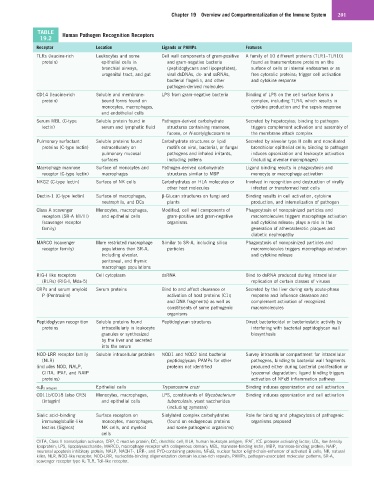
             TABLE   Human Pathogen Recognition Receptors
              19.2
             Receptor           Location              Ligands or PAMPs           Features
             TLRs (leucine-rich   Leukocytes and some   Cell wall components of gram-positive   A family of 10 different proteins (TLR1–TLR10)
               protein)           epithelial cells in   and gram-negative bacteria   found as transmembrane proteins on the
                                  bronchial airways,    (peptidoglycans and lipopeptides),   surface of cells or internal endosomes or as
                                  urogenital tract, and gut  viral dsDNAs, ds- and ssRNAs,   free cytosolic proteins; trigger cell activation
                                                        bacterial flagellin, and other   and cytokine response
                                                        pathogen-derived molecules
             CD14 (leucine-rich   Soluble and membrane-  LPS from gram-negative bacteria  Binding of LPS on the cell surface forms a
               protein)           bound forms found on                             complex, including TLR4, which results in
                                  monocytes, macrophages,                          cytokine production and the sepsis response
                                  and endothelial cells
             Serum MBL (C-type   Soluble protein found in   Pathogen-derived carbohydrate   Secreted by hepatocytes; binding to pathogen
               lectin)            serum and lymphatic fluid  structures containing mannose,   triggers complement activation and assembly of
                                                        fucose, or N-acetylglucosamine  the membrane attack complex
             Pulmonary surfactant   Soluble proteins found   Carbohydrate structures or lipid   Secreted by alveolar type II cells and nonciliated
               proteins (C-type lectin)  extracellularly on   motifs on viral, bacterial, or fungal   bronchiolar epithelial cells; binding to pathogen
                                  pulmonary mucosal     pathogens and inhaled irritants,   induces opsonization and leukocyte activation
                                  surfaces              including pollens          (including alveolar macrophages)
             Macrophage mannose   Surface of monocytes and   Pathogen-derived carbohydrate   Ligand binding results in phagocytosis and
               receptor (C-type lectin)  macrophages    structures similar to MBP  monocyte or macrophage activation
             NKG2 (C-type lectin)  Surface of NK cells  Carbohydrates on HLA molecules or   Involved in recognition and destruction of virally
                                                        other host molecules       infected or transformed host cells
             Dectin-1 (C-type lectin)  Surface of macrophages,   β-Glucan structures on fungi and   Binding results in cell activation, cytokine
                                  neutrophils, and DCs  plants                     production, and internalization of pathogen
             Class A scavenger   Monocytes, macrophages,   Modified, cell wall components of   Phagocytosis of nonopsinized particles and
               receptors (SR-A I/II/III)   and epithelial cells  gram-positive and gram-negative   macromolecules triggers macrophage activation
               (scavenger receptor                      organisms                  and cytokine release; plays a role in the
               family)                                                             generation of atherosclerotic plaques and
                                                                                   diabetic nephropathy
             MARCO (scavenger   More restricted macrophage   Similar to SR-A, including silica   Phagocytosis of nonopsinized particles and
               receptor family)   populations than SR-A,   particles               macromolecules triggers macrophage activation
                                  including alveolar,                              and cytokine release
                                  peritoneal, and thymic
                                  macrophage populations
             RIG-I like receptors   Cell cytoplasm    dsRNA                      Bind to dsRNA produced during intracellular
               (RLRs) (RIG-I, Mda-5)                                               replication of certain classes of viruses
             CRPs and serum amyloid   Serum proteins  Bind to and affect clearance or   Secreted by the liver during early acute-phase
               P (Pentraxins)                           activation of host proteins (C1q   response and influence clearance and
                                                        and DNA fragments) as well as   complement activation of recognized
                                                        constituents of some pathogenic   macromolecules
                                                        organisms
             Peptidoglycan recognition   Soluble proteins found   Peptidoglycan structures  Direct bacteriocidal or bacteriostatic activity by
               proteins           intracellularly in leukocyte                     interfering with bacterial peptidoglycan wall
                                  granules or synthesized                          biosynthesis
                                  by the liver and secreted
                                  into the serum
             NOD-LRR receptor family   Soluble intracellular proteins  NOD1 and NOD2 bind bacterial   Survey intracellular compartment for intracellular
               (NLR)                                    peptidoglycan; PAMPs for other   pathogens, binding to bacterial wall fragments
             (includes NOD, NALP,                       proteins not identified    produced either during bacterial proliferation or
               CIITA, IPAF, and NAIP                                               lysozomal degradation; ligand binding triggers
               proteins)                                                           activation of NFκB inflammation pathway
                                Epithelial cells      Trypanosome cruzi          Binding induces opsonization and cell activation
             α v β 3 (integrin)
             CD11b/CD18 (also CR3)   Monocytes, macrophages,   LPS, constituents of Mycobacterium   Binding induces opsonization and cell activation
               (integrin)         and epithelial cells  tuberculosis, yeast saccharides
                                                        (including zymosan)
             Sialic acid–binding   Surface receptors on   Sialylated complex carbohydrates   Role for binding and phagocytosis of pathogenic
               immunoglobulin-like   monocytes, macrophages,   (found on endogenous proteins   organisms proposed
               lectins (Siglecs)  NK cells, and myeloid   and some pathogenic organisms)
                                  cells
             CIITA, Class II transcription activator; CRP, C-reactive protein; DC, dendritic cell; HLA, human leukocyte antigen; IPAF, ICE-protease activating factor; LDL, low-density
             lipoprotein; LPS, lipopolysaccharide; MARCO, macrophage receptor with collagenous domain; MBL, mannose-binding lectin; MBP, mannose-binding protein; NAIP,
             neuronal apoptosis inhibitory protein; NALP, NACHT-, LRR-, and PYD-containing proteins; NFκB, nuclear factor κ-light-chain-enhancer of activated B cells; NK, natural
             killer; NLR, NOD-like receptor; NOD-LRR, nucleotide-binding oligomerization domain leucine-rich repeats; PAMPs, pathogen-associated molecular patterns; SR-A,
             scavenger receptor type A; TLR, Toll-like receptor.

