


Page 252 - Hematology_ Basic Principles and Practice ( PDFDrive )
P. 252
204    Part III  Immunologic Basis of Hematology


                                                                                   Thymocyte precursors


                                                                                                 Subcapsular
                                                         Immature                                cortex
                                                       thymocytes                                Cortex


                                                           Hassall                               Medulla
                                                        corpuscles


                                                                     Mature thymocytes
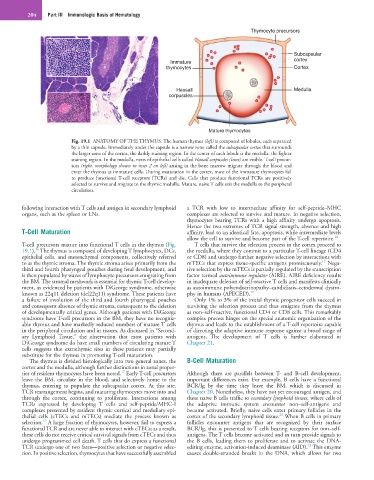
                        Fig. 19.1  ANATOMY OF THE THYMUS. The human thymus (left) is composed of lobules, each separated
                        by a thin capsule. Immediately under the capsule is a narrow zone called the subcapsular cortex that surrounds
                        the larger zone of the cortex, the darkly staining region. In the center of each lobule is the medulla, the lighter
                        staining region. In the medulla, nests of epithelial cells called Hassall corpuscles (inset) are visible. T-cell precur-
                        sors (right, morphology shown in inset 2 on left) arising in the bone marrow migrate through the blood and
                        enter the thymus as immature cells. During maturation in the cortex, most of the immature thymocytes fail
                        to produce functional T-cell receptors (TCRs) and die. Cells that produce functional TCRs are positively
                        selected to survive and migrate to the thymic medulla. Mature, naive T cells exit the medulla to the peripheral
                        circulation.


        following interaction with T cells and antigen in secondary lymphoid   a  TCR  with  low  to  intermediate  affinity  for  self-peptide–MHC
        organs, such as the spleen or LNs.                    complexes are selected to survive and mature. In negative selection,
                                                              thymocytes  bearing TCRs  with  a  high  affinity  undergo  apoptosis.
                                                              Hence the two extremes of TCR signal strength, absence and high
        T-Cell Maturation                                     affinity, lead to an identical fate, apoptosis, while intermediate levels
                                                              allow the cell to survive and become part of the T-cell repertoire. 18
        T-cell precursors mature into functional T cells in the thymus (Fig.   T cells that survive the selection process in the cortex proceed to
             16
        19.1).  The thymus is composed of developing T lymphocytes, DCs,   the medulla, where they commit to a particular T-cell lineage (CD4
        epithelial cells, and mesenchymal components, collectively referred   or CD8) and undergo further negative selection by interactions with
                                                                                                          17
        to as the thymic stroma. The thymic stroma arises primarily from the   mTECs that express tissue-specific antigens promiscuously.  Nega-
        third and fourth pharyngeal pouches during fetal development, and   tive selection by the mTECs is partially regulated by the transcription
        is then populated by waves of lymphocyte precursors emigrating from   factor termed autoimmune regulator (AIRE). AIRE deficiency results
        the BM. The stromal meshwork is essential for thymic T-cell develop-  in inadequate deletion of self-reactive T cells and manifests clinically
        ment, as evidenced by patients with DiGeorge syndrome, otherwise   as autoimmune polyendocrinopathy–candidiasis–ectodermal dystro-
        known as 22q11 deletion (del22q11) syndrome. These patients have   phy in humans (APECED). 19
        a failure of involution of the third and fourth pharyngeal pouches   Only 1% to 3% of the initial thymic progenitor cells succeed in
        and consequent absence of thymic stroma, consequent to the deletion   surviving the selection process and thus emigrate from the thymus
        of developmentally critical genes. Although patients with DiGeorge   as non–self-reactive, functional CD4 or CD8 cells. This remarkably
        syndrome have T-cell precursors in the BM, they have no recogniz-  complex process hinges on the special anatomic organization of the
        able thymus and have markedly reduced numbers of mature T cells   thymus and leads to the establishment of a T-cell repertoire capable
        in the peripheral circulation and in tissues. As discussed in “Second-  of directing the adaptive immune response against a broad range of
        ary  Lymphoid  Tissue,”  the  observation  that  most  patients  with   antigens.  The  development  of  T  cells  is  further  elaborated  in
        DiGeorge syndrome do have small numbers of circulating mature T   Chapter 21.
        cells suggests that extrathymic  sites in  these patients may  partially
        substitute for the thymus in promoting T-cell maturation.
           The thymus is divided histologically into two general zones, the   B-Cell Maturation
        cortex and the medulla, although further distinctions in zonal proper-
                                         17
        ties of resident thymocytes have been noted.  Early T-cell precursors   Although  there  are  parallels  between  T-  and  B-cell  development,
        leave  the  BM,  circulate  in  the  blood,  and  selectively  home  to  the   important differences exist. For example, B cells have a functional
        thymus,  entering  to  populate  the  subcapsular  cortex.  At  this  site,   BCR/Ig  by  the  time  they  leave  the  BM,  which  is  discussed  in
        TCR rearrangement begins, and maturing thymocytes move into and   Chapter 20. Nonetheless, they have not yet encouraged antigen, and
        through  the  cortex,  continuing  to  proliferate.  Interactions  among   these naive B cells traffic to secondary lymphoid tissues, where cells of
        TCRs  expressed  by  developing  T  cells  and  self-peptide/MHC-I   the  adaptive  immune  system  encounter  non–self-antigens  and
        complexes presented by resident thymic cortical and medullary epi-  become  activated.  Briefly,  naive  cells  enter  primary  follicles  in  the
                                                                                            20
        thelial  cells  (cTECs  and  mTECs)  mediate  the  process  known  as   cortex of the secondary lymphoid tissue.  When B cells in primary
               17
        selection.  A large fraction of thymocytes, however, fail to express a   follicles  encounter  antigens  that  are  recognized  by  their  surface
        functional TCR and are never able to interact with cTECs; as a result,   BCR/Ig, this is presented to T cells bearing receptors for non–self-
        these cells do not receive critical survival signals from cTECs and thus   antigens. The T cells become activated and in turn provide signals to
        undergo programmed cell death. T cells that do express a functional   the  B  cells,  leading  them  to  proliferate  and  to  activate  the  DNA-
                                                                                                      21
        TCR undergo one of two fates—positive selection or negative selec-  editing enzyme, activation-induced deaminase (AID).  This enzyme
        tion. In positive selection, thymocytes that have successfully assembled   causes  double-stranded  breaks  in  the  DNA,  which  allows  for  two

