


Page 253 - Hematology_ Basic Principles and Practice ( PDFDrive )
P. 253
Chapter 19  Overview and Compartmentalization of the Immune System  205


            concurrent processes: class switch recombination (CSR) and somatic   endothelial cell activation, leukocyte adhesion to endothelial cells at
            hypermutation (SHM) of immunoglobulin genes. CSR allows the B   the inflammatory site, and diapedesis of leukocytes into the tissues
            cell to express a secreted Ig with unique properties, by replacing the   (see Chapter 13). The resulting exudate fluid at the site of vasodilata-
            constant region of the BCR/Ig with a different constant region via   tion is also rich in plasma proteins that participate in innate immunity,
            DNA  recombination.  SHM  can  sometimes  lead  to  advantageous   such  as  complement  and  PRRs.  Hence  the  soluble  and  cellular
            mutations that can allow a BCR to have higher affinity for a patho-  components of the innate immune system provide the first line of
            genic antigen. These B cells, bearing a higher-affinity BCR than the   defense at the tissues where pathogens invade.
            B-cell  clone  that  they  derived  from,  are  positively  selected  to   The  epithelial  barriers  also  contain  resident  lymphocytes  and
            proliferate.                                          plasma  cells. The  lymphoid  cells  respond  to  cytokines  secreted  by
              When B-cell proliferation begins, the primary follicle becomes a   resident macrophages, such as IL-2, which stimulates T-cell prolif-
            secondary follicle. The secondary follicle has two general regions: (1)   eration. The ability of macrophages to secrete mediators that cause
            a GC filled with proliferating B cells, some T cells, macrophages, and   vasodilatation  and  recruitment  of  granulocytes,  as  well  as  initiate
            DC; and (2) the surrounding mantle zone of nonproliferating B cells   T-cell activation, illustrates the interplay between innate and adap-
            that have not encountered an antigen they recognize. The GC can   tive immunity and underscores the point that the innate and adap-
            be further divided into dark and light zones, depending on the stage   tive immune systems work in concert in host defense. Resident T
            of proliferation, as discussed later in “Systemwide Surveillance.”  cells  and  plasma  cells  in  the  tissue  can  respond  to  antigen,  with
                                                                  local  activation  of  antigen-specific  effector  T  cells  and  increased
            ENCOUNTERS WITH ANTIGEN: THE INFLAMMATORY             antibody  secretion,  respectively,  so  that  the  adaptive  immune
                                                                  response  is  stimulated  locally  after  pathogens  are  sensed  by  the
            RESPONSE                                              innate immune system.

            A  primary  function  of  the  immune  system  is  to  protect  against
            microbial pathogens. The most common sites for microbes to breach   SYSTEMWIDE SURVEILLANCE: THE ROLE OF
            the protective barriers of epithelium are the skin and the respiratory,   LYMPHATIC CIRCULATION
            gastrointestinal,  and  genitourinary  tracts.  These  tissues  directly
            encounter  the  outside  world  and  possess  complex,  multifaceted   Lymphatics are an essential component of the vascular system (Fig.
            mechanisms for dealing with antigens. It should be noted, however,   19.3). Even in the absence of inflammation, a fraction of the fluid
            that there is a vast array of nonpathogenic microbes that live in close   component of blood continually leaves the capillary bed during cir-
            proximity to these epithelial barriers, and an emerging body of sci-  culation caused by the pressure drop between the arterial and venous
            entific work points to the importance of these commensal organisms   sides. This fluid bathes the tissues of the body picking up antigens
            for maintaining immune homeostasis. 22,23             and cells and then drains into lymphatic channels that interdigitate
              To  defend  against  pathogenic  organisms,  these  barriers  contain   in every capillary bed.
            many components of the innate immune system, including macro-  At sites of inflammation, the amount of fluid and cells draining
            phages and DCs. Some tissues have specialized or unique populations   into the local lymphatics increases because of changes in the vascular
            of macrophages and DCs, although these cells have many common   tone  and  permeability  mediated  by  macrophage-  and  neutrophil-
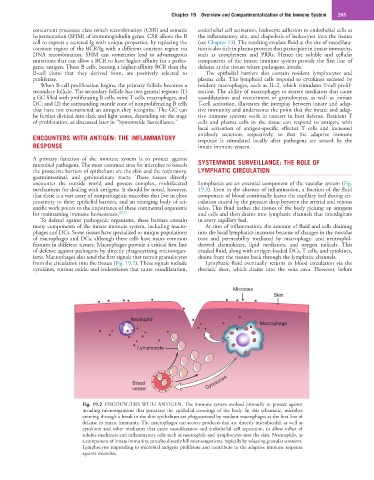
            features in different tissues. Macrophages provide a critical first line   derived  chemokines,  lipid  mediators,  and  oxygen  radicals.  This
            of defense against pathogens by directly phagocytizing microorgan-  exuded fluid, along with antigen-loaded DCs, T cells, and cytokines,
            isms. Macrophages also send the first signals that recruit granulocytes   drains from the tissues back through the lymphatic channels.
            from the circulation into the tissues (Fig. 19.2). These signals include   Lymphatic  fluid  eventually  returns  to  blood  circulation  via  the
            cytokines, nitrous oxide, and leukotrienes that cause vasodilatation,   thoracic  duct,  which  drains  into  the  vena  cava.  However,  before


                                                                             Microbes
                                                                                           Skin


                                            Neutrophil
                                                                                      Macrophage


                                              Lymphocyte


                                            Blood                   C   ytokines
                                            vessel

                            Fig. 19.2  ENCOUNTERS WITH ANTIGEN. The immune system evolved primarily to protect against
                            invading  microorganisms  that  penetrate  the  epithelial  coverings  of  the  body.  In  this  schematic,  microbes
                            entering through a break in the skin epithelium are phagocytosed by resident macrophages as the first line of
                            defense in innate immunity. The macrophages can secrete products that are directly microbicidal, as well as
                            cytokines and other mediators that cause vasodilatation and endothelial cell separation, to allow influx of
                            soluble mediators and inflammatory cells such as neutrophils and lymphocytes into the skin. Neutrophils, as
                            a component of innate immunity, can also directly kill microorganisms, typically by releasing granular contents.
                            Lymphocytes responding to microbial antigens proliferate and contribute to the adaptive immune response
                            against microbes.

