


Page 250 - Hematology_ Basic Principles and Practice ( PDFDrive )
P. 250
202    Part III  Immunologic Basis of Hematology


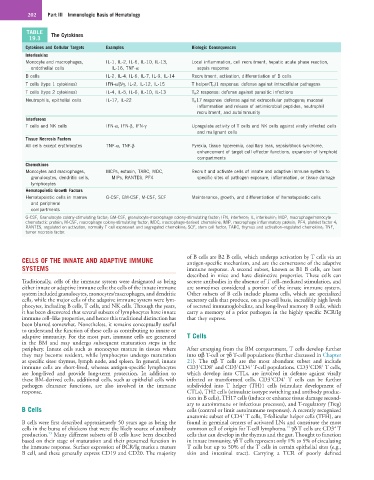
          TABLE   The Cytokines
          19.3
         Cytokines and Cellular Targets  Examples               Biologic Consequences
         Interleukins
         Monocyte and macrophages,   IL-1, IL-2, IL-6, IL-10, IL-13,   Local inflammation, cell recruitment, hepatic acute phase reaction,
           endothelial cells          IL-16, TNF-α                sepsis response
         B cells                    IL-2, IL-4, IL-6, IL-7, IL-9, IL-14  Recruitment, activation, differentiation of B cells
         T cells (type 1 cytokines)  IFN-α/β/γ, IL-2, IL-12, IL-15  T helper(T H )1 response: defense against intracellular pathogens
         T cells (type 2 cytokines)  IL-4, IL-5, IL-6, IL-10, IL-13  T H 2 response: defense against parasitic infections
         Neutrophils, epithelial cells  IL-17, IL-22            T H 17 response: defense against extracellular pathogens; mucosal
                                                                  inflammation and release of antimicrobial peptides, neutrophil
                                                                  recruitment, and autoimmunity
         Interferons
         T cells and NK cells       IFN-α, IFN-β, IFN-γ         Upregulate activity of T cells and NK cells against virally infected cells
                                                                  and malignant cells
         Tissue Necrosis Factors
         All cells except erythrocytes  TNF-α, TNF-β            Pyrexia, tissue hyperemia, capillary leak, sepsis/shock syndrome,
                                                                  enhancement of target cell effector functions, expansion of lymphoid
                                                                  compartments
         Chemokines
         Monocytes and macrophages,   MCPs, eotaxin, TARC, MDC,   Recruit and activate cells of innate and adaptive immune system to
           granulocytes, dendritic cells,   MIPs, RANTES, PF4     specific sites of pathogen exposure, inflammation, or tissue damage
           lymphocytes
         Hematopoietic Growth Factors
         Hematopoietic cells in marrow   G-CSF, GM-CSF, M-CSF, SCF  Maintenance, growth, and differentiation of hematopoietic cells
           and peripheral
           compartments
         G-CSF, Granulocyte colony-stimulating factor; GM-CSF, granulocyte-macrophage colony-stimulating factor; IFN, interferon; IL, interleukin; MCP, macrophage/monocyte
         chemotactic protein; M-CSF, macrophage colony-stimulating factor; MDC, macrophage-derived chemokine; MIP, macrophage inflammatory protein; PF4, platelet factor 4;
         RANTES, regulated on activation, normally T cell expressed and segregated chemokine; SCF, stem cell factor; TARC, thymus and activation–regulated chemokine; TNF,
         tumor necrosis factor.


        CELLS OF THE INNATE AND ADAPTIVE IMMUNE               of B cells are B2 B cells, which undergo activation by T cells via an
                                                              antigen-specific mechanism, and are the cornerstone of the adaptive
        SYSTEMS                                               immune response. A second subset, known as B1 B cells, are best
                                                              described  in  mice  and  have  distinctive  properties. These  cells  can
        Traditionally, cells of the immune system were designated as being   secrete antibodies in the absence of T cell–mediated stimulation, and
        either innate or adaptive immune cells: the cells of the innate immune   are sometimes considered a portion of the innate immune system.
        system included granulocytes, monocytes/macrophages, and dendritic   Other subsets of B cells include plasma cells, which are specialized
        cells, while the major cells of the adaptive immune system were lym-  secretory cells that produce, on a per-cell basis, incredibly high levels
        phocytes, including B cells, T cells, and NK cells. Through the years,   of secreted immunoglobulins, and long-lived memory B cells, which
        it has been discovered that several subsets of lymphocytes have innate   carry a memory of a prior pathogen in the highly specific BCR/Ig
        immune cell–like properties, and hence this traditional distinction has   that they express.
        been blurred somewhat. Nonetheless, it remains conceptually useful
        to understand the function of these cells as contributing to innate or
        adaptive immunity. For the most part, immune cells are generated   T Cells
        in  the  BM  and  may  undergo  subsequent  maturation  steps  in  the
        periphery.  Innate  cells  such  as  monocytes  mature  in  tissues  where   After emerging from the BM compartment, T cells develop further
        they may become resident, while lymphocytes undergo maturation   into αβ T-cell or γδ T-cell populations (further discussed in Chapter
        at specific sites: thymus, lymph node, and spleen. In general, innate   21).  The  αβ  T  cells  are  the  most  abundant  subset  and  include
                                                                      +
                                                                              +
                                                                                   +
                                                                                                      +
                                                                  +
                                                                                                          +
        immune cells are short-lived, whereas antigen-specific lymphocytes   CD3 CD8  and CD3 CD4  T-cell populations. CD3 CD8  T cells,
        are  long-lived  and  provide  long-term  protection.  In  addition  to   which  develop  into  CTLs,  are  involved  in  defense  against  virally
                                                                                         +
                                                                                              +
        these BM-derived cells, additional cells, such as epithelial cells with   infected  or  transformed  cells.  CD3 CD4   T  cells  can  be  further
        pathogen  clearance  functions,  are  also  involved  in  the  immune    subdivided  into  T  helper  (TH)1  cells  (stimulate  development  of
        response.                                             CTLs), TH2 cells (stimulate isotype switching and antibody produc-
                                                              tion in B cells), TH17 cells (induce or enhance tissue damage second-
                                                              ary to autoimmune or infectious processes), and T-regulatory (Treg)
        B Cells                                               cells (control or limit autoimmune responses). A recently recognized
                                                                                +
                                                              anatomic subset of CD4  T cells, T-follicular helper cells (TFH), are
        B cells were first described approximately 50 years ago as being the   found in germinal centers of activated LNs and constitute the most
                                                                                                              +
                                                                                               14
        cells in the bursa of chickens that were the likely source of antibody   common cell of origin for T-cell lymphoma.  γδ T cells are CD3  T
                 13
        production.  Many different subsets of B cells have been described   cells that can develop in the thymus and the gut. Thought to function
        based on their stage of maturation and their presumed function in   in innate immunity, γδ T cells represent only 1% to 5% of circulating
        the immune response. Surface expression of BCR/Ig marks a mature   T cells but up to 50% of the T cells in certain epithelial sites (e.g.,
        B cell, and these generally express CD19 and CD20. The majority   skin  and  intestinal  tract).  Carrying  a  TCR  of  poorly  defined

