


Page 2562 - Hematology_ Basic Principles and Practice ( PDFDrive )
P. 2562
Chapter 158  Hematologic Aspects of Parasitic Diseases  2285


              In endemic areas, laboratory staff are skilled at the examination   must  maintain  the  skills  needed  for  reliable  examination  of  thick
            of  thick  films  and  routinely  are  able  to  detect  1  parasite  in  100   films.
            high-power fields of a thick film, which corresponds to a sensitivity   A number of methods based on the fluorescent staining of parasite
            of approximately 5 to 50 parasites/µL. 107,110  Thin films are used for   deoxyribonucleic acid (DNA) and/or ribonucleic acid (RNA) and the
            determining the species of the parasites, and the circulating asexual   concentration of parasites have been devised. 112–114  However attractive
            forms  of  the  four  main  malaria  species  can  be  readily  identified,   these methods may appear, their sensitivity is limited by background
            whereas the sexual forms (gametocytes) of the species require some   staining of cellular debris, and the limit of their sensitivity is approxi-
            skill and regular practice (Figs. 158.5 and 158.6).   mately 100 parasites/µL. The time taken in preparing samples and
              Nevertheless, diagnosis of malaria by microscopy in nonendemic   the  specialized  equipment  and  skills  needed  to  use  these  methods
            countries  has  proven  problematic.  Routine  laboratories  may  only   limit their effectiveness in routine practice.
            achieve  sensitivities  of  the  order  of  500  parasites/µL  using  thick   Detection of circulating malarial antigens is another potentially
            films. 110,111   Quality  assurance  schemes  show  that  performance  of   attractive, but ultimately limited, alternative to the laborious method
            routine  hematology  laboratories  in  the  recognition  of  and  species   of screening blood films. The widely available tests detect Plasmodium
            determination of malaria parasites is poor. 109,111   histidine-rich protein 2 (BinaxNOW Malaria test) and Plasmodium-
              There has therefore been a strong drive to use nonmicroscopic   specific  lactate  dehydrogenase  (OptiMal-IT  test)  by  immunochro-
                                                                           115
            methods for malaria diagnosis. It is now apparent that these methods   matography.  The formulation of the tests using dipstick antigens
            are not sufficiently sensitive for clinical diagnosis, although they may   allows rapid testing to be performed by laboratory staff. However, the
            have a role in detecting parasites of more than 500 parasites/µL when   sensitivity is variable and may range from 100 to 1000 parasites/µL,
            experienced staff are not available and/or as part of an out-of-hours   and this is comparable to the sensitivity achieved by inexperienced
            service.  However,  it  must  be  emphasized  that  these  tests  are  no   microscopists  and  may  approach  that  achieved  by  experienced
            substitute  for  careful  microscopy.  Operationally,  this  means  that   microscopists. The current recommendations for malaria diagnosis in
            hematology laboratories need to make the diagnosis of malaria and   the  United  Kingdom  emphasize  that  the  optimum  diagnostic


             A                         B                          C                         D


             E                         F                          G                         H
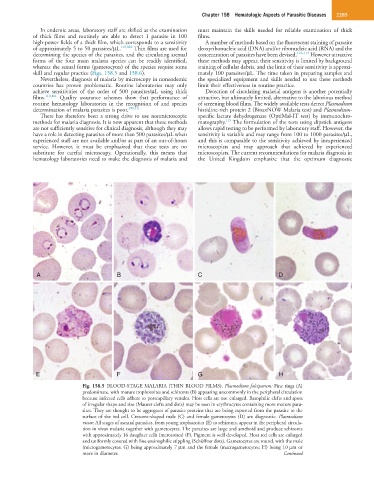
                            Fig. 158.5  BLOOD-STAGE MALARIA (THIN BLOOD FILMS). Plasmodium falciparum: Fine rings (A)
                            predominate, with mature trophozoites and schizonts (B) appearing uncommonly in the peripheral circulation
                            because infected cells adhere to postcapillary venules. Host cells are not enlarged. Basophilic clefts and spots
                            of irregular shape and size (Maurer clefts and dots) may be seen in erythrocytes containing more mature para-
                            sites. They are thought to be aggregates of parasite proteins that are being exported from the parasite to the
                            surface of the red cell. Crescent-shaped male (C) and female gametocytes (D) are diagnostic. Plasmodium
                            vivax: All stages of asexual parasites, from young trophozoites (E) to schizonts, appear in the peripheral circula-
                            tion in vivax malaria together with gametocytes. The parasites are large and ameboid and produce schizonts
                            with approximately 16 daughter cells (merozoites) (F). Pigment is well developed. Host red cells are enlarged
                            and uniformly covered with fine eosinophilic stippling (Schüffner dots). Gametocytes are round, with the male
                            (microgametocytes; G) being approximately 7 µm and the female (macrogametocytes; H) being 10 µm or
                            more in diameter.                                                 Continued

