


Page 2579 - Hematology_ Basic Principles and Practice ( PDFDrive )
P. 2579
2302   Part XIII  Consultative Hematology

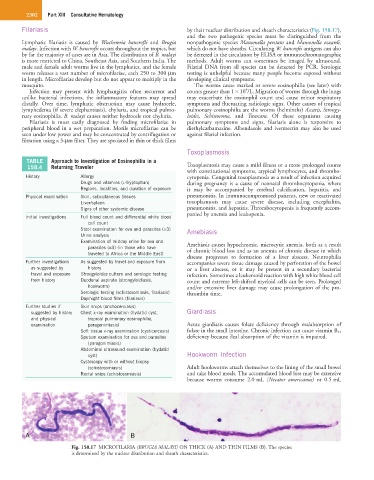
        Filariasis                                            by their nuclear distribution and sheath characteristics (Fig. 158.17),
                                                              and  the  two  pathogenic  species  must  be  distinguished  from  the
        Lymphatic  filariasis  is  caused  by  Wuchereria  bancrofti  and  Brugia   nonpathogenic species Mansonella perstans and Mansonella ozzardi,
        malayi. Infection with W. bancrofti occurs throughout the tropics, but   which do not have sheaths. Circulating W. bancrofti antigens can also
        by far the majority of cases are in Asia. The distribution of B. malayi   be detected in the circulation by ELISA or immunochromatographic
        is more restricted to China, Southeast Asia, and Southern India. The   methods.  Adult  worms  can  sometimes  be  imaged  by  ultrasound.
        male and female adult worms live in the lymphatics, and the female   Filarial  DNA  from  all  species  can  be  detected  by  PCR.  Serologic
        worm releases a vast number of microfilariae, each 250 to 300 µm   testing is unhelpful because many people become exposed without
        in length. Microfilariae develop but do not appear to multiply in the   developing clinical symptoms.
        mosquito.                                                The worms cause marked or severe eosinophilia (see later) with
                                                                                 9
           Infection  may  present  with  lymphangitis;  often  recurrent  and   counts greater than 1 × 10 /L. Migration of worms through the lungs
        unlike  bacterial  infections,  the  inflammatory  features  may  spread   may  exacerbate  the  eosinophil  count  and  cause  minor  respiratory
        distally.  Over  time,  lymphatic  obstruction  may  cause  hydrocele,   symptoms and fluctuating radiologic signs. Other causes of tropical
        lymphedema (if severe elephantiasis), chyluria, and tropical pulmo-  pulmonary eosinophilia are the worms (helminths) Ascaris, Strongy-
        nary eosinophilia. B. malayi causes neither hydrocele nor chyluria.  loides,  Schistosoma,  and  Toxocara.  Of  these  organisms  causing
           Filariasis  is  most  easily  diagnosed  by  finding  microfilariae  in   pulmonary  symptoms  and  signs,  filariasis  alone  is  responsive  to
        peripheral blood in a wet preparation. Motile microfilariae can be   diethylcarbamazine.  Albendazole  and  ivermectin  may  also  be  used
        seen under low power and may be concentrated by centrifugation or   against filarial infection.
        filtration using a 3-µm filter. They are speciated in thin or thick films
                                                              Toxoplasmosis
          TABLE   Approach to Investigation of Eosinophilia in a
          158.4   Returning Traveler                          Toxoplasmosis may cause a mild illness or a more prolonged course
                                                              with constitutional symptoms, atypical lymphocytes, and thrombo-
         History           Allergy                            cytopenia. Congenital toxoplasmosis as a result of infection acquired
                           Drugs and vitamins (L-tryptophan)  during  pregnancy  is  a  cause  of  neonatal  thrombocytopenia,  where
                           Regions, localities, and duration of exposure  it  may  be  accompanied  by  cerebral  calcification,  hepatitis,  and
         Physical examination  Skin, subcutaneous tissues     pneumonitis. In immunocompromised patients, new or reactivated
                           Liver/spleen                       toxoplasmosis  may  cause  severe  disease,  including  encephalitis,
                           Signs of other systemic disease    pneumonitis, and hepatitis. Thrombocytopenia is frequently accom-
                                                              panied by anemia and leukopenia.
         Initial investigations  Full blood count and differential white blood
                              cell count
                           Stool examination for ova and parasites (×3)  Amebiasis
                           Urine analysis
                           Examination of midday urine for ova and   Amebiasis causes hypochromic, microcytic anemia, both as a result
                              parasites (×3) (in those who have   of chronic blood loss and as an anemia of chronic disease in which
                              traveled to Africa or the Middle East)
                                                              disease  progresses  to  formation  of  a  liver  abscess.  Neutrophilia
         Further investigations   As suggested by travel and exposure from   accompanies severe tissue damage caused by perforation of the bowel
           as suggested by    history                         or  a  liver  abscess,  or  it  may  be  present  in  a  secondary  bacterial
           travel and exposure   Strongyloides culture and serologic testing  infection. Sometimes a leukemoid reaction with high white blood cell
           from history    Duodenal aspirate (strongyloidiasis,   count and extreme left-shifted myeloid cells can be seen. Prolonged
                              hookworm)                       and/or extensive liver damage may cause prolongation of the pro-
                           Serologic testing (schistosomiasis, filariasis)  thrombin time.
                           Day/night blood films (filariasis)
         Further studies if   Skin snips (onchocerciasis)
           suggested by history   Chest x-ray examination (hydatid cyst,   Giardiasis
           and physical       tropical pulmonary eosinophilia,
           examination        paragonimiasis)                 Acute  giardiasis  causes  folate  deficiency  through  malabsorption  of
                           Soft tissue x-ray examination (cysticercosis)  folate in the small intestine. Chronic infection can cause vitamin B 12
                           Sputum examination for ova and parasites   deficiency because ileal absorption of the vitamin is impaired.
                              (paragonimiasis)
                           Abdominal ultrasound examination (hydatid
                              cyst)                           Hookworm Infection
                           Cystoscopy with or without biopsy
                              (schistosomiasis)               Adult hookworms attach themselves to the lining of the small bowel
                           Rectal snips (schistosomiasis)     and take blood meals. The accumulated blood loss may be extensive
                                                              because  worms  consume  2.0 mL  (Necator  americanus)  or  0.5 mL


         A                                  B

                        Fig. 158.17  MICROFILARIA (BRUGIA MALAYI) ON THICK (A) AND THIN FILMS (B). The species
                        is determined by the nuclear distribution and sheath characteristics.

