


Page 2577 - Hematology_ Basic Principles and Practice ( PDFDrive )
P. 2577
2300   Part XIII  Consultative Hematology


        venatorum, has caused infection in a small series of older men who   intestinal  disturbances  are  common,  and  people  may  complain  of
                                                      261
        had undergone splenectomy for a lymphoproliferative disease.  The   dark urine secondary to hemoglobinuria. In some cases the disease
        same organism has been isolated in a much larger series of patients   progresses with respiratory failure secondary to ARDS, disseminated
        from China. 262                                       intravascular coagulation, and renal failure requiring the appropriate
                                                                          273
           B. microti and B. duncani have been transmitted by blood and   supportive  care.   Such  severe  cases  resemble  severe  malaria  in
                       260
        platelet transfusions.  Transplacental infection by B. microti has also   nonimmune persons, and it has been suggested that the pathophysiol-
        been reported.                                        ogy, like in malaria, includes adhesion and sequestration of infected
                                                              erythrocytes  and  the  release  of  proinflammatory  cytokines.  These
                                                              diseases may be confused with falciparum malaria, leptospirosis, or
        Parasitology                                          viral hepatitis. In pregnancy, acute babesiosis may mimic the HELLP
                                                              syndrome  (hemolysis,  elevated  liver  enzymes,  and  low  platelet
        Parasites appear to be introduced into the bloodstream, where they   count). 273
        invade erythrocytes. There they multiply by asexual fission to produce
        two to four merozoites. These infective forms are released after lysis
        of the erythrocyte and begin another cycle of invasion multiplication.   Hematologic and Laboratory Features
        Parasites are cleared by macrophages. The contribution of antibodies
        and cell-mediated immune response has not been defined, although   The hematologic features of the disease are dominated by substantial
                                                                                257
        B. bovis expresses clonally variant antigens on the surface of infected   intravascular hemolysis.  Physical examination shows pallor, jaun-
        erythrocytes. 27                                      dice, and mild hepatosplenomegaly.
                                                                 The laboratory findings are those of a compensated intravascular
                                                              hemolytic anemia and thus feature low hemoglobin and haptoglobin
        Clinical Features                                     levels, increased reticulocyte count and serum lactate dehydrogenase,
                                                              and hemoglobinuria and proteinuria. Moderate thrombocytopenia is
        The North American B. microti infections have an incubation period   common. 265,274  Electron microscopy suggests uninfected erythrocytes
        of  several  weeks,  and  after  infection  by  blood  transfusion,  clinical   are damaged during infection and so likely to be cleared more rapidly
                                                                         275
        symptoms  have  taken  from  17  days  to  many  months  to  become   than  normally.  The  white  blood  cell  count  is  usually  decreased
        manifest. 263–265  The spectrum of clinical disease is wide. B. microti   with atypical lymphocytosis and occasional evidence of hemophago-
        may  cause  asymptomatic  infection  or  present  with  a  mild  flulike   cytosis. However, leukocytosis may occur, particularly in B. divergens
        illness  in  most  cases  in  people  with  normal  immune  and  splenic   infections.
               266
        function.   The  cardinal  manifestations  are  fever  and  hemolytic   The direct Coombs test result is frequently positive for both C3
        anemia.  Splenectomy,  old  age,  and  immunosuppression,  including   components and IgG. Polyclonal hypergammaglobulinemia is seen,
        HIV, may increase the risk for more severe clinical disease. 267–269  The   and levels of C3 and C4 are reduced in acute infection. Liver function
        disease may progress to adult respiratory distress syndrome (ARDS),   tests show raised indirect bilirubin and mildly raised transaminase
                                                  262
        disseminated  intravascular  coagulation,  or  renal  failure.   Patients   levels.
        who have had a splenectomy should avoid exposure to ticks in forested
        areas where the disease is transmitted.
           B. divergens in Europe predominantly causes symptomatic infec-  Diagnosis
        tion  in  people  who  have  had  a  splenectomy. 270,271   Here,  the  case
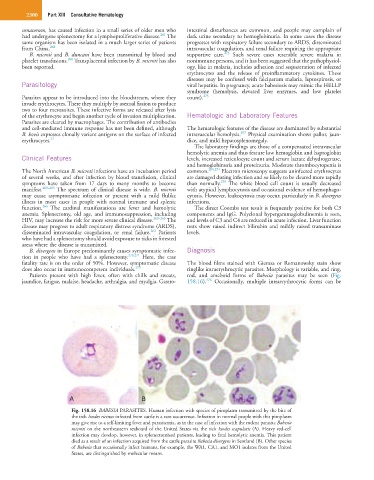
        fatality rate is on the order of 50%. However, symptomatic disease   The  blood  films  stained  with  Giemsa  or  Romanowsky  stain  show
        does also occur in immunocompetent individuals. 272   ringlike intraerythrocytic parasites. Morphology is variable, and ring,
           Patients  present  with  high  fever,  often  with  chills  and  sweats,   rod,  and  ameboid  forms  of  Babesia  parasites  may  be  seen  (Fig.
                                                                     276
        jaundice, fatigue, malaise, headache, arthralgia, and myalgia. Gastro-  158.16).   Occasionally,  multiple  intraerythrocytic  forms  can  be


                        A                      B

                        Fig. 158.16  BABESIA PARASITES. Human infection with species of piroplasm transmitted by the bite of
                        the tick Ixodes ricinus infected from cattle is a rare occurrence. Infection in normal people with this piroplasm
                        may give rise to a self-limiting fever and parasitemia, as in the case of infection with the rodent parasite Babesia
                        microti on the northeastern seaboard of the United States via the tick Ixodes scapularis (A). Heavy red-cell
                        infection may develop, however, in splenectomized patients, leading to fatal hemolytic anemia. This patient
                        died as a result of an infection acquired from the cattle parasite Babesia divergens in Scotland (B). Other species
                        of Babesia that occasionally infect humans, for example, the WA1, CA1, and MO1 isolates from the United
                        States, are distinguished by molecular means.

