


Page 2575 - Hematology_ Basic Principles and Practice ( PDFDrive )
P. 2575
2298   Part XIII  Consultative Hematology


        erythematous indurated lesions have been described during T. cruzi   preparation of needle aspirates. Parasites may occasionally be found
        recrudescence  after  solid-organ  transplant.  Here  tissue  amastigotes   in lachrymal fluid.
        can be demonstrated by fine-needle aspiration.           Sensitivity is increased by the concentration methods described
                                                              for T. brucei earlier. Organisms may also be sought in centrifuged
                                                              serum after blood has clotted or by centrifugation after lysis of RBCs
        HIV                                                   with 0.8% ammonium chloride. Trypomastigotes can also be detected
                                                              in other specimens, including CSF, bone marrow, pericardiac fluid,
        Coinfection with T. cruzi and HIV has been reported from urban   and tissue biopsy specimens. Organisms must be distinguished from
                                                          +
        centers in Brazil. T. cruzi develops in end-stage disease with CD4    the morphologically similar nonpathogenic T. rangeli (see Fig. 158.14
        T-cell counts of less than 400/µL. Patients may be severely ill, the   and earlier).
        majority with meningoencephalitis and often with a space-occupying   After the acute phase, circulating parasites are not visible, although
        lesion. Typically the CSF shows a mild lymphocytosis (<100 cells/µL).   inoculation  of  blood  into  susceptible  animals  (xenodiagnosis),  in
        Parasites may be seen in the blood and occasionally the CSF. Cardiac   vitro culture, or molecular methods may demonstrate patent infec-
        involvement and heart failure are common.             tion. Parasitemia may be obvious in immunocompromised patients
                                                              in the chronic phase of disease.
        Hematologic and Laboratory Features
                                                              Xenodiagnosis
        A mild, normocytic, normochromic anemia is typical of acute illness.
        The pathogenesis of the anemia and contributions of hemolysis and   Infection of laboratory triatomine bugs by a seropositive patient is
        bone marrow depression have not been studied in humans, but in   more sensitive than morphologic examination in chronically infected
        experimental infections in mice, uncontrolled infection and TNF-α   patients. It is also possible to infect susceptible laboratory animals.
        can be shown to contribute to depressed hematopoiesis. A modest   However, these techniques are available only in specialized centers in
        lymphocytosis  and  increases  in  liver  and  muscle  enzymes  may  be   Latin America.
        present. Nonspecific electrocardiographic changes, first-degree heart
        block, and cardiomegaly suggest early myocardial involvement.
           Hematologic abnormalities are not usually found in the late stage   In Vitro Culture
        of  disease,  in  which  cardiomyopathy  with  cardiac  failure,  rhythm
        disturbance, and angina and systemic emboli from intramural throm-  Epimastigotes can be cultured using blood agar (NNN) medium or
        bus  may  occur.  Trials  of  systemic  anticoagulation  have  not  been   other media such as Schneider insect medium. After 4 weeks or more
        conducted.                                            of culture at 26°C, epimastigotes may be detected. 222,223

        Diagnosis                                             Serology

        Microscopy                                            Serologic testing is a sensitive method of detecting infection after the
                                                              acute phase. In Latin America, a number of commercial assays are
        During the acute phase of the disease, motile trypanosomes can be   available  using  crude  epimastigote  lysates  in  a  variety  of  different
        identified in wet preparations or buffy coat preparations using con-  formats.  Serologic  tests  have  used  IFAT  and  ELISA  using  crude
        centration methods and detailed morphologic examination, including   antigen prepared from in vitro cultures of epimastigotes. These tests
        Giemsa-stained, gently prepared thick and thin films to avoid damage   must  be  carefully  controlled  with  appropriate  positive  or  negative
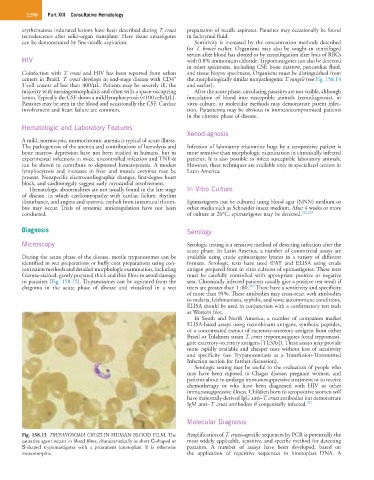
        to parasites (Fig. 158.15). Trypanosomes can be aspirated from the   sera. Chronically infected patients usually give a positive test result if
                                                                                  224
        chagoma  in  the  acute  phase  of  disease  and  visualized  in  a  wet   titers are greater than 1 : 80.  These have a sensitivity and specificity
                                                              of more than 95%. These antibodies may cross-react with antibodies
                                                              to malaria, leishmaniasis, syphilis, and some autoimmune conditions.
                                                              ELISA should be used in conjunction with a confirmatory test such
                                                              as Western blot.
                                                                 In  South  and  North  America,  a  number  of  companies  market
                                                              ELISA-based assays using recombinant antigens, synthetic peptides,
                                                              or a concentrated extract of excretory-secretory antigens from either
                                                              Brazil or Tulahuen strain T. cruzi trypomastigotes (total trypomasti-
                                                              gote excretory-secretory antigens [TESAs]). These assays may provide
                                                              more rapidly available and cheaper tests without loss of sensitivity
                                                              and  specificity  (see  Trypanosomiasis  as  a  Transfusion-Transmitted
                                                              Infection section for further discussion).
                                                                 Serologic testing may be useful in the evaluation of people who
                                                              may  have  been  exposed  to  Chagas  disease,  pregnant  women,  and
                                                              patients about to undergo immunosuppressive treatment or to receive
                                                              chemotherapy  or  who  have  been  diagnosed  with  HIV  or  other
                                                              immunosuppressive illness. Children born to seropositive women will
                                                              have maternally derived IgG anti–T. cruzi antibodies but demonstrate
                                                              IgM anti–T. cruzi antibodies if congenitally infected. 225

                                                              Molecular Diagnosis

        Fig. 158.15  TRYPANOSOMA CRUZI IN HUMAN BLOOD FILM. The   Amplification of T. cruzi–specific sequences by PCR is potentially the
        causative agent occurs in blood films, characteristically as short C-shaped or   most widely applicable, sensitive, and specific method for detecting
        S-shaped  trypomastigotes  with  a  prominent  kinetoplast.  It  is  otherwise   parasites.  A  number  of  assays  have  been  developed,  based  on
        monomorphic.                                          the  application  of  repetitive  sequences  in  kinetoplast  DNA.  A

