


Page 2574 - Hematology_ Basic Principles and Practice ( PDFDrive )
P. 2574
Chapter 158  Hematologic Aspects of Parasitic Diseases  2297


                                                                  although occasionally acute myocarditis with focal hemorrhage and
                                                                  inflammation may lead to heart failure. As the disease progresses, the
                                                                  inflammatory response is increased and is associated with increased
                                                                  tissue  damage. There  may  be  an  autoimmune  component  to  this
                                                                  inflammatory response, but the precise pathogenesis is poorly under-
                                                                      220
                                                                  stood.  In the heart, chronic myocarditis leads to a decline in cardiac
                                                                  function. In late-stage disease, amastigotes can be found in almost all
                                                                  organs. Acute myocarditis with focal hemorrhage and inflammation
                                                                  may also lead to heart failure. Involvement of the brain, meninges,
                                                                  liver, lymph nodes, and spleen is common. Damage to the muscle
                                                                  walls and intramural nerve plexus in the esophagus and colon leads
                                                                  to dilation of these structures in the later phases of the disease.


                                                                  Clinical Features

                                                                  In about half the patients, a granuloma (or chagoma) occurs where
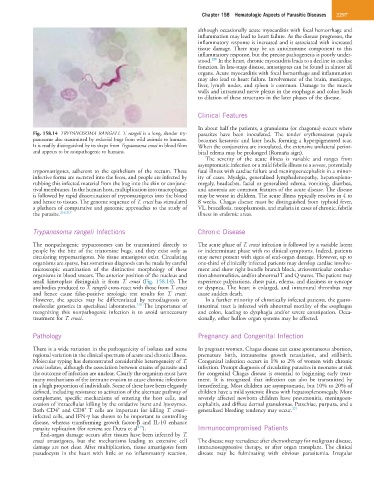
            Fig. 158.14  TRYPANOSOMA RANGELI. T. rangeli is a long, slender try-  parasites  have  been  inoculated.  The  tender  erythematous  papule
            panosome also transmitted by reduviid bugs from wild animals to humans.   becomes keratotic and later heals, forming a hyperpigmented scar.
            It is readily distinguished by its shape from Trypanosoma cruzi in blood films   When the conjunctiva are inoculated, the extensive unilateral perior-
            and appears to be nonpathogenic to humans.            bital edema may be prolonged (Romaña sign).
                                                                    The  severity  of  the  acute  illness  is  variable  and  ranges  from
                                                                  asymptomatic infection or a mild febrile illness to a severe, potentially
            trypomastigotes,  adherent  to  the  epithelium  of  the  rectum. These   fatal illness with cardiac failure and meningoencephalitis in a minor-
            infective forms are excreted into the feces, and people are infected by   ity  of  cases.  Myalgia,  generalized  lymphadenopathy,  hepatospleno-
            rubbing this infected material from the bug into the skin or conjunc-  megaly, headaches, facial or generalized edema, vomiting, diarrhea,
            tival membranes. In the human host, multiplication into macrophages   and anorexia are common features of the acute disease. The disease
            is followed by rapid dissemination of trypomastigotes into the blood   may be worse in children. The acute illness typically resolves in 4 to
            and hence to tissues. The genome sequence of T. cruzi has stimulated   8 weeks. Chagas disease must be distinguished from typhoid fever,
            a plethora of comparative and genomic approaches to the study of   VL, brucellosis, toxoplasmosis, and malaria in cases of chronic, febrile
            the parasite. 216,217                                 illness in endemic areas.

            Trypanosoma rangeli Infections                        Chronic Disease

            The  nonpathogenic  trypanosomes  can  be  transmitted  directly  to   The acute phase of T. cruzi infection is followed by a variable latent
            people  by  the  bite  of  the  triatomine  bugs,  and  they  exist  only  as   or indeterminate phase with no clinical symptoms. Indeed, patients
            circulating trypomastigotes. No tissue amastigotes exist. Circulating   may never present with signs of end-organ damage. However, up to
            organisms are sparse, but sometimes diagnosis can be made by careful   one-third of clinically infected patients may develop cardiac involve-
            microscopic  examination  of  the  distinctive  morphology  of  these   ment and show right bundle branch block, atrioventricular conduc-
            organisms in blood smears. The anterior position of the nucleus and   tion abnormalities, and/or abnormal T and Q waves. The patient may
            small  kinetoplast  distinguish  it  from  T.  cruzi  (Fig.  158.14).  The   experience palpitations, chest pain, edema, and dizziness or syncope
            antibodies produced to T. rangeli cross-react with those from T. cruzi   or  dyspnea. The  heart  is  enlarged,  and  intramural  thrombus  may
            and  hence  cause  false-positive  serologic  test  results  for  T.  cruzi.   cause sudden death.
            However,  the  species  may  be  differentiated  by  xenodiagnosis  or   In a further minority of chronically infected patients, the gastro-
                                              218
            molecular genetics in specialized laboratories.  The importance of   intestinal tract is infected with abnormal motility of the esophagus
            recognizing  this  nonpathogenic  infection  is  to  avoid  unnecessary   and colon, leading to dysphagia and/or severe constipation. Occa-
            treatment for T. cruzi.                               sionally, other hollow organ systems may be affected.

            Pathology                                             Pregnancy and Congenital Infection
            There is a wide variation in the pathogenicity of isolates and some   In pregnant women, Chagas disease can cause spontaneous abortion,
            regional variation in the clinical spectrum of acute and chronic illness.   premature  birth,  intrauterine  growth  retardation,  and  stillbirth.
            Molecular typing has demonstrated considerable heterogeneity of T.   Congenital infection occurs in 1% to 2% of women with chronic
            cruzi isolates, although the association between strains of parasite and   infection. Prompt diagnosis of circulating parasites in neonates at risk
            the outcome of infection are unclear. Clearly the organism must have   for  congenital  Chagas  disease  is  essential  to  beginning  early  treat-
            many mechanisms of the immune evasion to cause chronic infections   ment.  It  is  recognized  that  infection  can  also  be  transmitted  by
            in a high proportion of individuals. Some of these have been elegantly   breastfeeding. Most children are asymptomatic, but 10% to 20% of
            defined, including resistance to activation of the alternate pathway of   children have a mild systemic illness with hepatosplenomegaly. More
            complement,  specific  mechanisms  of  entering  the  host  cells,  and   severely  affected  newborn  children  have  pneumonitis,  meningoen-
            evasion of intracellular killing by the oxidative burst and lysozymes.   cephalitis, and diffuse dermal granulomas. Petechiae, purpura, and a
                             +
                    +
            Both  CD4   and  CD8  T  cells  are  important  for  killing  T.  cruzi–  generalized bleeding tendency may occur. 221
            infected cells, and IFN-γ has shown to be important to controlling
            disease,  whereas  transforming  growth  factor-β  and  IL-10  enhance
                                              219
            parasite replication (for review, see Dutra et al ).  Immunocompromised Patients
              End-organ damage occurs after tissues have been infected by T.
            cruzi  amastigotes,  but  the  mechanisms  leading  to  extensive  cell   The disease may recrudesce after chemotherapy for malignant disease,
            damage are not clear. After multiplication, tissue amastigotes form   immunosuppressive therapy, or after organ transplant. The clinical
            pseudocysts  in  the  heart  with  little  or  no  inflammatory  reaction,   disease  may  be  fulminating  with  obvious  parasitemia.  Irregular

