


Page 2602 - Hematology_ Basic Principles and Practice ( PDFDrive )
P. 2602
Chapter 160  The Spleen and Its Disorders  2315


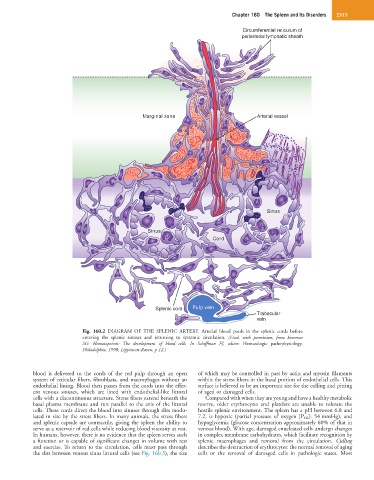
                                                                                Circumferential reticulum of
                                                                                periarterial lymphatic sheath


                                                Marginal zone                        Arterial vessel


                                                                                        Sinus


                                                 Sinus
                                                                       Cord


                                                    Splenic cord  Pulp vein
                                                                                     Trabecular
                                                                                     vein

                            Fig.  160.2  DIAGRAM  OF  THE  SPLENIC  ARTERY.  Arterial  blood  pools  in  the  splenic  cords  before
                            entering  the  splenic  sinuses  and  returning  to  systemic  circulation.  (Used,  with  permission,  from  Emerson
                            SG:  Hematopoiesis:  The  development  of  blood  cells.  In  Schiffman  FJ,  editor:  Hematologic  pathophysiology,
                            Philadelphia, 1998, Lippincott-Raven, p 12.)


            blood  is  delivered  to  the  cords  of  the  red  pulp  through  an  open   of which may be controlled in part by actin and myosin filaments
            system of reticular fibers, fibroblasts, and macrophages without an   within the stress fibers in the basal portion of endothelial cells. This
            endothelial lining. Blood then passes from the cords into the effer-  surface is believed to be an important site for the culling and pitting
            ent  venous  sinuses,  which  are  lined  with  endothelial-like  littoral   of aged or damaged cells.
            cells with a discontinuous structure. Stress fibers extend beneath the   Compared with when they are young and have a healthy metabolic
            basal plasma membrane and run parallel to the axis of the littoral   reserve,  older  erythrocytes  and  platelets  are  unable  to  tolerate  the
            cells. These cords direct the blood into sinuses through slits modu-  hostile splenic environment. The spleen has a pH between 6.8 and
            lated in size by the stress fibers. In many animals, the stress fibers   7.2,  is  hypoxic  (partial  pressure  of  oxygen  [P O2]:  54 mmHg),  and
            and splenic capsule are contractile, giving the spleen the ability to   hypoglycemic (glucose concentration approximately 60% of that in
            serve as a reservoir of red cells while reducing blood viscosity at rest.   venous blood). With age, damaged enucleated cells undergo changes
            In humans, however, there is no evidence that the spleen serves such   in complex membrane carbohydrates, which facilitate recognition by
            a function or is capable of significant changes in volume with rest   splenic  macrophages  and  removal  from  the  circulation.  Culling
            and exercise. To return to the circulation, cells must pass through   describes the destruction of erythrocytes: the normal removal of aging
            the slits between venous sinus littoral cells (see Fig. 160.3), the size   cells  or  the  removal  of  damaged  cells  in  pathologic  states.  Most

