


Page 2607 - Hematology_ Basic Principles and Practice ( PDFDrive )
P. 2607
2320   Part XIII  Consultative Hematology


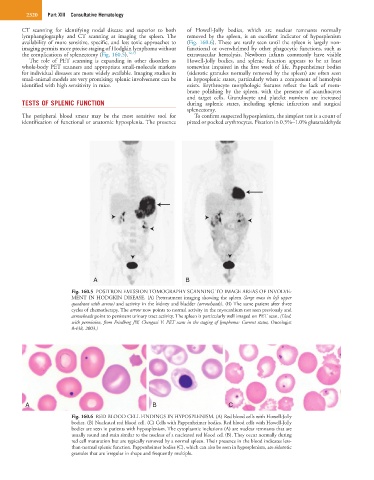
        CT  scanning  for  identifying  nodal  disease  and  superior  to  both   of  Howell-Jolly  bodies,  which  are  nuclear  remnants  normally
        lymphangiography  and  CT  scanning  at  imaging  the  spleen.  The   removed  by  the  spleen,  is  an  excellent  indicator  of  hyposplenism
        availability of more sensitive, specific, and less toxic approaches to   (Fig. 160.6). These are rarely seen until the spleen is largely non-
        imaging permits more precise staging of Hodgkin lymphoma without   functional or overwhelmed by other phagocytic functions, such as
        the complications of splenectomy (Fig. 160.5). 12,13  extravascular  hemolysis.  Newborn  infants  commonly  have  visible
           The  role  of  PET  scanning  is  expanding  in  other  disorders  as   Howell-Jolly  bodies,  and  splenic  function  appears  to  be  at  least
        whole-body PET scanners and appropriate small-molecule markers   somewhat impaired in the first week of life. Pappenheimer bodies
        for individual diseases are more widely available. Imaging studies in   (siderotic granules normally removed by the spleen) are often seen
        small-animal models are very promising; splenic involvement can be   in hyposplenic states, particularly when a component of hemolysis
        identified with high sensitivity in mice.             exists.  Erythrocyte  morphologic  features  reflect  the  lack  of  mem-
                                                              brane  polishing  by  the  spleen,  with  the  presence  of  acanthocytes
                                                              and  target  cells.  Granulocyte  and  platelet  numbers  are  increased
        TESTS OF SPLENIC FUNCTION                             during  asplenic  states,  including  splenic  infarction  and  surgical
                                                              splenectomy.
        The  peripheral  blood  smear  may  be  the  most  sensitive  tool  for   To confirm suspected hyposplenism, the simplest test is a count of
        identification of functional or anatomic hyposplenia. The presence   pitted or pocked erythrocytes. Fixation in 0.5%–1.0% glutaraldehyde


                                A                             B

                        Fig. 160.5  POSITRON EMISSION TOMOGRAPHY SCANNING TO IMAGE AREAS OF INVOLVE-
                        MENT IN HODGKIN DISEASE. (A) Pretreatment imaging showing the spleen (large mass in left upper
                        quadrant with arrow) and activity in the kidney and bladder (arrowheads). (B) The same patient after three
                        cycles of chemotherapy. The arrow now points to normal activity in the myocardium not seen previously and
                        arrowheads point to persistent urinary tract activity. The spleen is particularly well imaged on PET scan. (Used,
                        with permission, from Friedberg JW, Chengazi V: PET scans in the staging of lymphoma: Current status, Oncologist
                        8:438, 2003.)


         A                                         B                        C
                        Fig. 160.6  RED BLOOD CELL FINDINGS IN HYPOSPLENISM. (A) Red blood cells with Howell-Jolly
                        bodies. (B) Nucleated red blood cell. (C) Cells with Pappenheimer bodies. Red blood cells with Howell-Jolly
                        bodies are seen in patients with hyposplenism. The cytoplasmic inclusions (A) are nuclear remnants that are
                        usually round and stain similar to the nucleus of a nucleated red blood cell (B). They occur normally during
                        red cell maturation but are typically removed by a normal spleen. Their presence in the blood indicates less-
                        than-normal splenic function. Pappenheimer bodies (C), which can also be seen in hyposplenism, are siderotic
                        granules that are irregular in shape and frequently multiple.

