


Page 2605 - Hematology_ Basic Principles and Practice ( PDFDrive )
P. 2605
2318   Part XIII  Consultative Hematology


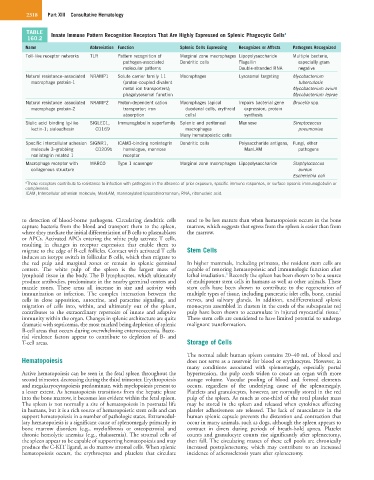
          TABLE   Innate Immune Pattern Recognition Receptors That Are Highly Expressed on Splenic Phagocytic Cells a
          160.2
         Name                 Abbreviation Function         Splenic Cells Expressing  Recognizes or Affects  Pathogens Recognized
         Toll-like receptor networks  TLR  Pattern recognition of   Marginal zone macrophages Lipopolysaccharide  Multiple bacteria,
                                         pathogen-associated   Dendritic cells  Flagellin          especially gram
                                         molecular patterns                    Double-stranded RNA  negative
         Natural resistance–associated  NRAMP1  Solute carrier family 11   Macrophages  Lysosomal targeting  Mycobacterium
           macrophage protein-1          (proton-coupled divalent                                  tuberculosis
                                         metal ion transporters);                                Mycobacterium avium
                                         phagolysosomal function                                 Mycobacterium leprae
         Natural resistance–associated  NRAMP2  Proton-dependent cation   Macrophages (apical   Impairs bacterial gene   Brucella spp.
           macrophage protein-2          transporter; iron    duodenal cells, erythroid   expression, protein
                                         absorption           cells)             synthesis
         Sialic acid–binding Ig-like   SIGLEC1,   Immunoglobulin superfamily  Splenic and peritoneal   Mannose  Streptococcus
           lectin-1; sialoadhesin  CD169                      macrophages                          pneumoniae
                                                            Many hematopoietic cells
         Specific intercellular adhesion  SIGNR1,   ICAM3-binding nonintegrin   Dendritic cells  Polysaccharide antigens,  Fungi, other
           molecule 3–grabbing   CD209b  homologue, mannose                      ManLAM            pathogens
           nonintegrin related 1         receptor
         Macrophage receptor with   MARCO  Type 1 scavenger  Marginal zone macrophages Lipopolysaccharide  Staphylococcus
           collagenous structure                                                                   aureus
                                                                                                 Escherichia coli
         a These receptors contribute to resistance to infection with pathogens in the absence of prior exposure, specific immune responses, or surface opsonic immunoglobulin or
         complement.
         ICAM, Intercellular adhesion molecule; ManLAM, mannosylated lipoarabinomannan; RNA, ribonucleic acid.


        to  detection  of  blood-borne  pathogens.  Circulating  dendritic  cells   tend to be less mature than when hematopoiesis occurs in the bone
        capture bacteria from the blood and transport them to the spleen,   marrow, which suggests that egress from the spleen is easier than from
        where they mediate the initial differentiation of B cells to plasmablasts   the marrow.
        or APCs. Activated APCs entering the white pulp activate T cells,
        resulting  in  changes  in  receptor  expression  that  enable  them  to
        migrate to the edge of B-cell follicles. Contact with activated T cells   Stem Cells
        induces an isotype switch in follicular B cells, which then migrate to
        the  red  pulp  and  marginal  zones  or  remain  in  splenic  germinal   In higher mammals, including primates, the resident stem cells are
        centers.  The  white  pulp  of  the  spleen  is  the  largest  mass  of    capable of restoring hematopoietic and immunologic function after
                                                                           6
        lymphoid tissue in the body. The B lymphocytes, which ultimately   lethal irradiation.  Recently the spleen has been shown to be a source
        produce antibodies, predominate in the nearby germinal centers and   of multipotent stem cells in humans as well as other animals. These
        mantle  zones.  These  areas  all  increase  in  size  and  activity  with     stem  cells  have  been  shown  to  contribute  to  the  regeneration  of
        immunization  or  infection.  The  complex  interaction  between  the   multiple types of tissue, including pancreatic islet cells, bone, cranial
        cells  in  close  apposition,  autocrine,  and  paracrine  signaling,  and   nerves,  and  salivary  glands.  In  addition,  undifferentiated  splenic
        migration  of  cells  into,  within,  and  ultimately  out  of  the  spleen,   monocytes assembled in clusters in the cords of the subcapsular red
                                                                                                                7
        contributes  to  the  extraordinary  repertoire  of  innate  and  adaptive   pulp have been shown to accumulate in injured myocardial tissue.
        immunity within the organ. Changes in splenic architecture are quite   These stem cells are considered to have limited potential to undergo
        dramatic with septicemia, the most marked being depletion of splenic   malignant transformation.
        B-cell areas that occurs during overwhelming enterococcemia. Bacte-
        rial  virulence  factors  appear  to  contribute  to  depletion  of  B-  and
        T-cell areas.                                         Storage of Cells

                                                              The normal adult human spleen contains 20–40 mL of blood and
        Hematopoiesis                                         does not serve as a reservoir for blood or erythrocytes. However, in
                                                              many  conditions  associated  with  splenomegaly,  especially  portal
        Active hematopoiesis can be seen in the fetal spleen throughout the   hypertension,  the  pulp  cords  widen  to  create  an  organ  with  more
        second trimester, decreasing during the third trimester. Erythropoiesis   storage  volume.  Vascular  pooling  of  blood  and  formed  elements
        and megakaryocytopoiesis predominate, with myelopoiesis present to   occurs,  regardless  of  the  underlying  cause  of  the  splenomegaly.
        a lesser extent. As hematopoiesis transitions from the hepatic phase   Platelets and granulocytes, however, are normally stored in the red
        into the bone marrow, it becomes less evident within the fetal spleen.   pulp of the spleen. As much as one-third of the total platelet mass
        The spleen is not normally a site of hematopoiesis in postnatal life   may be stored in the spleen and released when cytokines affecting
        in humans, but it is a rich source of hematopoietic stem cells and can   platelet  adhesiveness  are  released. The  lack  of  musculature  in  the
        support hematopoiesis in a number of pathologic states. Extramedul-  human splenic capsule prevents the distention and contraction that
        lary hematopoiesis is a significant cause of splenomegaly primarily in   occur in many animals, such as dogs, although the spleen appears to
        bone  marrow  disorders  (e.g.,  myelofibrosis  or  osteopetrosis)  and   contract  in  divers  during  periods  of  breath-hold  apnea.  Platelet
        chronic hemolytic anemias (e.g., thalassemia). The stromal cells of   counts  and  granulocyte  counts  rise  significantly  after  splenectomy,
        the spleen appear to be capable of supporting hematopoiesis and may   then fall. The circulating masses of these cell pools are chronically
        produce the C-KIT ligand, as do marrow stromal cells. When splenic   increased  postsplenectomy,  which  may  contribute  to  an  increased
        hematopoiesis  occurs,  the  erythrocytes  and  platelets  that  circulate   incidence of atherosclerosis years after splenectomy.

