


Page 262 - Hematology_ Basic Principles and Practice ( PDFDrive )
P. 262
Chapter 20  B-Cell Development  213


                                                  Heavy chain (chromosome 14)
            5                                                                                                    3
              V 1 V 2 V n           D n               J 1-6         Enhancer  µ   δ  γ3  γ1  ε2  α1 γ2  γ4  ε1 α2
               H
                       H
                   H
                                                       H
                                     H
                                                                                      Constant region
                               D                          J
                       9  12  7    7  12  9     9  23  7
                                                                 Signal joint
                                                                 (degraded)
                             D        J                     D   J
                     9  12  7                      9  12  7    Coding joint
                                              DJ  rearrangement
                                                H
              5                                                                                             3
                V 1 V 2 V n           DJ 1  J 2-6         Enhancer        Constant region
                          H
                 H
                      H
                                        H
                                             H
            V n                                    D   J
             H
                     7  23   9            9  12  7
                                                           Signal joint
                                                           (degraded)
                   V n           D   J
                    H
                                                V n  D   J H  Coding joint
                                                 H
                                            V -DJ  rearrangement
                                                 H
                                             H
                         5                                                                          3
                                  V DJ 1  J 2-6        Enhancer   µ   δ     Constant region
                                          H
                                   H
                                     H
                                            Transcription
                              5                                                 3
                                       V DJ 1  J 2-6         Enhancer  µ   δ
                                               H
                                           H
                                        H
                                               RNA processing
                                AAA                                                     AAA
                   V D J H1  µ                                             V D J H  δ
                                                                            H
                    H
                        Translation and glycosylation                           Translation and glycosylation
                                µ  Heavy chain protein                                  δ  Heavy chain protein
                   V D J H1  µ                                             V D J H  δ
                    H
                                                                            H
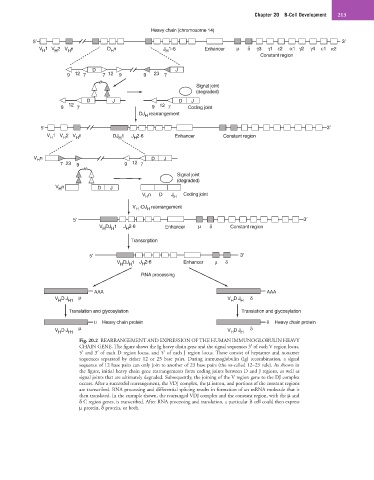
                           Fig. 20.2  REARRANGEMENT AND EXPRESSION OF THE HUMAN IMMUNOGLOBULIN HEAVY
                           CHAIN GENE. The figure shows the Ig heavy chain gene and the signal sequences 3′ of each V region locus,
                           5′ and 3′ of each D region locus, and 5′ of each J region locus. These consist of heptamer and nonamer
                           sequences  separated  by  either  12  or  23  base  pairs.  During  immunoglobulin  (Ig)  recombination,  a  signal
                           sequence of 12 base pairs can only join to another of 23 base pairs (the so-called 12–23 rule). As shown in
                           the figure, initial heavy chain gene rearrangements form coding joints between D and J regions, as well as
                           signal joints that are ultimately degraded. Subsequently, the joining of the V region gene to the DJ complex
                           occurs. After a successful rearrangement, the VDJ complex, the µ intron, and portions of the constant regions
                           are transcribed. RNA processing and differential splicing results in formation of an mRNA molecule that is
                           then translated. In the example shown, the rearranged VDJ complex and the constant region, with the µ and
                           δ C region genes, is transcribed. After RNA processing and translation, a particular B cell could then express
                           µ protein, δ protein, or both.

