


Page 267 - Hematology_ Basic Principles and Practice ( PDFDrive )
P. 267
218    Part III  Immunologic Basis of Hematology


        CD5 and sIgM. These reports must be viewed with caution because   Bone marrow
        CD5 is not a B-1–restricted determinant. Thus the identification of
                                                          +
                                                    +
        B-1 B cells in humans has proven elusive. However, a CD20  CD27    Lymph nodes  Spleen  Splenic artery
             +
                   −
        CD43  CD70  population of cord blood B cells that has properties                    and vein
        consistent with their being classified as human B-1 cells was recently   Peyer patches
                24
        described.  The further characterization of human B-1 B cells and
        studies to define their origin remain areas of active investigation.
        SECONDARY LYMPHOID COMPARTMENTS
        Newly produced B cells are functionally immature, and they com-
        plete  their  final  differentiation  steps  in  peripheral,  also  referred  to                  White
        as secondary, lymphoid tissues. These events in the mouse occur in                                pulp
                                                     +
        the spleen. During this process, the BM-derived surface IgM  B cells
        transit through transitional stages of development before generating
        marginal  zone  (MZ)  or  follicular  (FO)  B  cells  (Fig.  20.1).  MZ  B
        cells are rapidly recruited in the immune response and play a critical
        role in the response to T-independent antigens. FO B cells are poised   Primary follicle         Central
        to respond to T-dependent antigens, which, as their name implies,     (T2, mature                artery
        require help from T cells. The localization of MZ and FO B cells         B cells)
        in distinct anatomic sites and their intraorgan migration during the                             Periarterial
        response to antigenic stimulation is governed by a variety of cytokines   Marginal zone          lymphoid
        and chemokines. 25,26                                                 (MZ B cells)               sheath
                                                                                                         (T cells;
                                                                                 Mantle                  T1 B cells)
        Transitional B Cells                                        Secondary     zone
                                                                          follicle  Germinal
        Two stages of transitional B-cell development have been defined. The     center
        most immature transitional cells, referred to as transitional 1 (T1) B
        cells, localize at the outer edge of the periarterial lymphoid sheath
        (PALS; see Figs. 20.1 and 20.5). The PALS in mice is occupied by a
        considerable number of T cells, but in humans few T cells are present
        in this region. T1 B cells give rise to a more mature population of
        splenic B cells, referred to as transitional 2 (T2) cells. Each of these
        transitional cell stages can be phenotypically distinguished.         Germinal
           The T1 and T2 populations respond differentially to developmen-      center                 Light zone
        tal stimuli, and a considerable degree of selection occurs during the                          (proliferating
        T1 to T2 transition. For example, T1 cells with BCR specificities for                          B cells)
        blood-borne self-antigens are deleted by negative selection. Positive
        selection via BCR signaling must occur, and if it does not, the T2                             Dark zone
        cells will die by neglect. The survival of T2 cells, but not T1 cells, is                       Mantle zone
        also dependent on the B-cell growth factor BAFF (BLyS, TALL-1,                     Secondary
        THANK, zTNF4), which is produced by the splenic microenviron-                       follicle
        ment. A fraction of T2 cells are no longer in the G0 phase of the
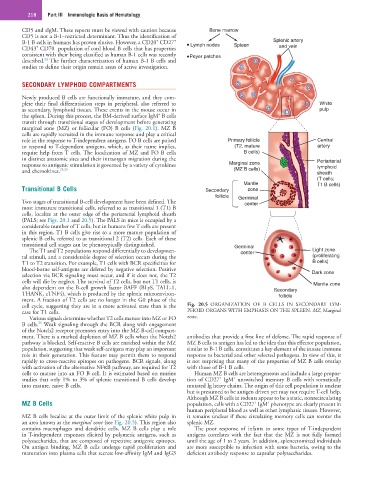
        cell cycle, suggesting they are in a more activated state than is the   Fig.  20.5  ORGANIZATION  OF  B  CELLS  IN  SECONDARY  LYM-
        case for T1 cells.                                    PHOID ORGANS WITH EMPHASIS ON THE SPLEEN. MZ, Marginal
           Various signals determine whether T2 cells mature into MZ or FO   zone.
              26
        B cells.  Weak signaling through the BCR along with engagement
        of the Notch2 receptor promotes entry into the MZ B-cell compart-
        ment. There is a marked depletion of MZ B cells when the Notch2   antibodies that provide a first line of defense. The rapid response of
        pathway is blocked. Self-reactive B cells are enriched within the MZ   MZ B cells to antigen has led to the idea that this effector population,
        population, suggesting that weak self-antigens may play an important   similar to B-1 B cells, constitutes a key element of the innate immune
        role in their generation. This feature may permit them to respond   response to bacterial and other selected pathogens. In view of this, it
        rapidly to cross-reactive epitopes on pathogens. BCR signals, along   is not surprising that many of the properties of MZ B cells overlap
        with activation of the alternative NFκB pathway, are required for T2   with those of B-1 B cells.
        cells to mature into an FO B cell. It is estimated based on murine   Human MZ B cells are heterogeneous and include a large propor-
                                                                             +
                                                                         +
        studies that only 1% to 3% of splenic transitional B cells develop   tion of CD27  IgM  unswitched memory B cells with somatically
        into mature, naive B cells.                           mutated Ig heavy chains. The origin of this cell population is unclear
                                                              but is presumed to be antigen driven yet may not require T-cell help.
                                                              Although MZ B cells in rodents appear to be a static, nonrecirculating
        MZ B Cells                                            population, cells with a CD27  IgM  phenotype are clearly present in
                                                                                         +
                                                                                    +
                                                              human peripheral blood as well as other lymphatic tissues. However,
        MZ B cells localize at the outer limit of the splenic white pulp in   it remains unclear if these circulating memory cells can reenter the
        an area known as the marginal zone (see Fig. 20.5). This region also   splenic MZ.
        contains  macrophages  and  dendritic  cells.  MZ  B  cells  play  a  role   The  poor  response  of  infants  to  some  types  of T-independent
        in T-independent responses elicited by polymeric antigens, such as   antigens  correlates  with  the  fact  that  the  MZ  is  not  fully  formed
        polysaccharides, that are composed of repetitive antigenic epitopes.   until the age of 1 to 2 years. In addition, splenectomized individuals
        On  antigen  binding,  MZ  B  cells  undergo  rapid  proliferation  and   are more susceptible to infection with some bacteria, owing to the
        maturation into plasma cells that secrete low-affinity IgM and IgG3   deficient antibody response to capsular polysaccharides.

