


Page 260 - Hematology_ Basic Principles and Practice ( PDFDrive )
P. 260
Chapter 20  B-Cell Development  211


                                 Myeloid and
                                  Erythroid
                 Bone Marrow

                                 CMP

                                        Lin  CD34     Lin  CD34          CD43 CD19


                                      CD45RA  CD38    CD10  CD19         CD10  IL-7R


                                       CD10  CD62L     IL-7R                CD79a
                                          LMPP/                      Pre-
                   HSC       MPP           ELP          CLP          proB          ProB
                                        Lin  Sca-1    Lin  Sca-1 lo  Lin  CD43    Lin  CD43


                                         CD117 high    CD117 lo  CD45R  CD19    CD45R  CD19    Human


                                           Flt3        CD127        CD127      CD24 CD127

                                                                          Mouse
                                                                             CD45R  CD19


                                                                             c  CD43 Pre-  PreB     CD34 CD19

                  Marginal zone                                                  BCR              CD10  pre-BCR
                     B cells
                                          Notch2
                                          Notch2
                                MZ                                               CD45R              CD19 CD10


                                                 T2                             CD19 IgM
                                                               T1                   BCR      B         BCR
                                            BAFF
                                            BAFF   Transitional
                                                   Transitional
                                                     B cells
                                                     B cells
                                    FO
                        Follicular B
                        Follicular B
                           cells
                           cells
                                                          Spleen
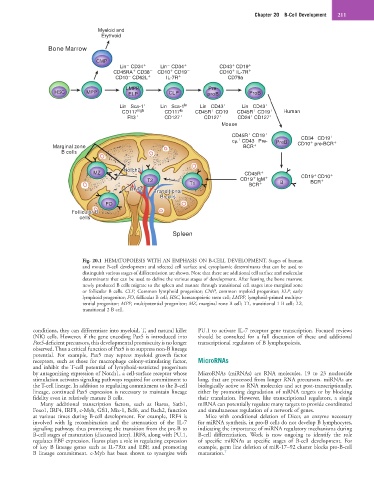
                            Fig. 20.1  HEMATOPOIESIS WITH AN EMPHASIS ON B-CELL DEVELOPMENT. Stages of human
                            and mouse B-cell development and selected cell surface and cytoplasmic determinants that can be used to
                            distinguish various stages of differentiation are shown. Note that there are additional cell surface and molecular
                            determinants that can be used to define the various stages of development. After leaving the bone marrow,
                            newly produced B cells migrate to the spleen and mature through transitional cell stages into marginal zone
                            or follicular B cells. CLP, Common lymphoid progenitor; CMP, common myeloid progenitor; ELP, early
                            lymphoid progenitor; FO, follicular B cell; HSC, hematopoietic stem cell; LMPP, lymphoid-primed multipo-
                            tential progenitor; MPP, multipotential progenitor; MZ, marginal zone B cell; T1, transitional 1 B cell; T2,
                            transitional 2 B cell.
            conditions, they can differentiate into myeloid, T, and natural killer   PU.1 to activate IL-7 receptor gene transcription. Focused reviews
            (NK) cells. However, if the gene encoding Pax5 is introduced into   should  be  consulted  for  a  full  discussion  of  these  and  additional
            Pax5-deficient precursors, this developmental promiscuity is no longer   transcriptional regulators of B lymphopoiesis.
            observed. Thus a critical function of Pax5 is to suppress non-B lineage
            potential.  For  example,  Pax5  may  repress  myeloid  growth  factor
            receptors,  such  as  those  for  macrophage  colony-stimulating  factor,   MicroRNAs
            and  inhibit  the T-cell  potential  of  lymphoid-restricted  progenitors
            by antagonizing expression of Notch1, a cell-surface receptor whose   MicroRNAs  (miRNAs)  are  RNA  molecules,  19  to  23  nucleotide
            stimulation activates signaling pathways required for commitment to   long, that are processed from longer RNA precursors. miRNAs are
            the T-cell lineage. In addition to regulating commitment to the B-cell   biologically active as RNA molecules and act post-transcriptionally,
            lineage, continued Pax5 expression is necessary to maintain lineage   either by promoting degradation of mRNA targets or by blocking
            fidelity even in relatively mature B cells.           their  translation.  However,  like  transcriptional  regulators,  a  single
              Many  additional  transcription  factors,  such  as  Ikaros,  Satb1,   miRNA can potentially regulate many targets to provide coordinated
            Foxo1, IRF4, IRF8, c-Myb, Gfi1, Miz-1, Bcl6, and Bach2, function   and simultaneous regulation of a network of genes.
            at  various  times  during  B-cell  development.  For  example,  IRF4  is   Mice  with  conditional  deletion  of  Dicer,  an  enzyme  necessary
            involved  with  Ig  recombination  and  the  attenuation  of  the  IL-7   for miRNA synthesis, in pro-B cells do not develop B lymphocytes,
            signaling pathway, thus promoting the transition from the pre-B to   indicating the importance of miRNA regulatory mechanisms during
            B-cell stages of maturation (discussed later). IRF8, along with PU.1,   B-cell  differentiation.  Work  is  now  ongoing  to  identify  the  role
            regulates EBF expression. Ikaros plays a role in regulating expression   of  specific  miRNAs  at  specific  stages  of  B-cell  development.  For
            of  key  B  lineage  genes  such  as  IL-7Rα  and  EBF,  and  promoting   example, germ line deletion of miR-17–92 cluster blocks pro-B-cell
            B  lineage  commitment.  c-Myb  has  been  shown  to  synergize  with   maturation. 7

