


Page 265 - Hematology_ Basic Principles and Practice ( PDFDrive )
P. 265
216    Part III  Immunologic Basis of Hematology


                                                           Periosteal
                                                           arteriole
                                                           and vein


                                        Periosteal
                                        capillaries
                                                                               Sinus


                                     Radial
                                     artery


                                  Emissary
                                     vein
                                   Nutrient                             Intersinusoidal
                                    artery            Medullary  Central  space
                                                        artery  sinus
                             B lineage  receptor  CXCR4

                                 IL-7R
                            Plasma     Pre-
                              cell     proB             ProB            PreB              B


                                    CXCL12 rich       IL-7 rich      IL-7 deficient     Exit BM
                                     environment    environment       environment
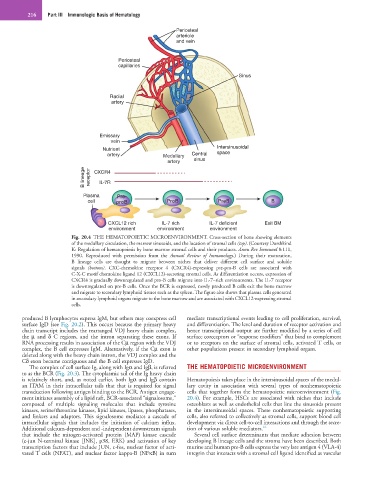
                        Fig. 20.4  THE HEMATOPOIETIC MICROENVIRONMENT. Cross-section of bone showing elements
                        of the medullary circulation, the marrow sinusoids, and the location of stromal cells (top). (Courtesy Dorshkind
                        K: Regulation of hematopoiesis by bone marrow stromal cells and their products. Annu Rev Immunol 8:111,
                        1990.  Reproduced  with  permission  from  the  Annual  Review  of  Immunology.)  During  their  maturation,
                        B  lineage  cells  are  thought  to  migrate  between  niches  that  deliver  different  cell  surface  and  soluble
                        signals  (bottom).  CXC-chemokine  receptor  4  (CXCR4)-expressing  pre-pro-B  cells  are  associated  with
                        C-X-C motif chemokine ligand 12 (CXCL12)-secreting stromal cells. As differentiation occurs, expression of
                        CXCR4 is gradually downregulated and pro-B cells migrate into IL-7–rich environments. The IL-7 receptor
                        is downregulated on pre-B cells. Once the BCR is expressed, newly produced B cells exit the bone marrow
                        and migrate to secondary lymphoid tissues such as the spleen. The figure also shows that plasma cells generated
                        in secondary lymphoid organs migrate to the bone marrow and are associated with CXCL12-expressing stromal
                        cells.
        produced B lymphocytes express IgM, but others may coexpress cell   mediate transcriptional events leading to cell proliferation, survival,
        surface IgD (see Fig. 20.2). This occurs because the primary heavy   and differentiation. The level and duration of receptor activation and
        chain transcript includes the rearranged VDJ heavy chain complex,   hence transcriptional output are further modified by a series of cell
        the  µ  and  δ  C  regions,  and  the  intron  separating  these  exons.  If   surface coreceptors or “response modifiers” that bind to complement
        RNA processing results in association of the Cµ region with the VDJ   or to receptors on the surface of stromal cells, activated T cells, or
        complex, the B cell expresses IgM. Alternatively, if the Cµ exon is   other populations present in secondary lymphoid organs.
        deleted along with the heavy chain intron, the VDJ complex and the
        Cδ exon become contiguous and the B cell expresses IgD.
           The complex of cell surface Ig, along with Igα and Igβ, is referred   THE HEMATOPOIETIC MICROENVIRONMENT
        to as the BCR (Fig. 20.3). The cytoplasmic tail of the Ig heavy chain
        is relatively short, and, as noted earlier, both Igα and Igβ contain   Hematopoiesis takes place in the intersinusoidal spaces of the medul-
        an ITAM in their intracellular tails that that is required for signal   lary  cavity  in  association  with  several  types  of  nonhematopoietic
        transduction following antigen binding to the BCR. Antigen engage-  cells that together form the hematopoietic microenvironment (Fig.
        ment initiates assembly of a lipid raft, BCR-associated “signalosome,”   20.4).  For  example,  HSCs  are  associated  with  niches  that  include
        composed  of  multiple  signaling  molecules  that  include  tyrosine   osteoblasts as well as endothelial cells that line the sinusoids present
        kinases, serine/threonine kinases, lipid kinases, lipases, phosphatases,   in  the  intersinusoidal  spaces.  These  nonhematopoietic  supporting
        and  linkers  and  adaptors. This  signalosome  mediates  a  cascade  of   cells, also referred to collectively as stromal cells, support blood cell
        intracellular  signals  that  includes  the  initiation  of  calcium  influx.   development via direct cell-to-cell interactions and through the secre-
        Additional calcium-dependent and -independent downstream signals   tion of various soluble mediators. 16
        that  include  the  mitogen-activated  protein  (MAP)  kinase  cascade   Several cell surface determinants that mediate adhesion between
        (c-jun N-terminal kinase [JNK], p38, ERK) and activation of key   developing B lineage cells and the stroma have been described. Both
        transcription factors that include JUN, c-fos, nuclear factor of acti-  murine and human pre-B cells express the very late antigen 4 (VLA-4)
        vated T cells (NFAT), and nuclear factor kappa-B (NFκB) in turn   integrin that interacts with a stromal cell ligand identified as vascular

