


Page 264 - Hematology_ Basic Principles and Practice ( PDFDrive )
P. 264
Chapter 20  B-Cell Development  215


                             Pre-BCR     µ heavy                      BCR         µ heavy
                                           chain                                    chain
                                                 VH                                      VH
                                                    Vpre                                     VL
                                                     B
                                             CH1                                      CH1
                                                 λ5     Surrogate                        CL     κ or λ
                                           CH2          light chain                CH2          light chain
                                                        (ΨL C)
                                           CH3                                     CH3

                                                           Cell membrane
                                           CH4                                     CH4
                                              Igα Igβ                                  Igα Igβ


                                               Y  Y                                     Y  Y
                                                       ITAMS                                   ITAMS
                                               Y  Y                                     Y  Y


                                                    Signals
                                                    Pre-BCR: Constitutive vs. stromal ligand
                                                    BCR: Antigen
                                         Signal
                                                         Receptor with: ITAM containing subunits
                                                              Pre-BCR and mature BCR
                                   Receptor
                                            Response
                                             modifier       Response modifiers / co-receptors:
                                                            Positive: CD19/21; CD38; CD40; CD45
                              Lipid raft                    Negative: CD22; FcγRIIB; PIR; CD72


                                                          Lipid Raft-associated signalosome;
                                      Signalosome         Tyrosine kinases (src, syk, Btk family), lipid kinases
                                                          (PI-3-K; SHIP), phosphatases (SHP1, SHP-2), lipases
                                                          (PLCγ), serene/threonine kinases (PKC isoforms),
                                                          linkers/adaptors (BLNK,CARMA1)
                                        Signals
                                                   JNK, p38
                                                   NF-kB     Ca2+ dependent
                                                 NF-AT
                                         ERK

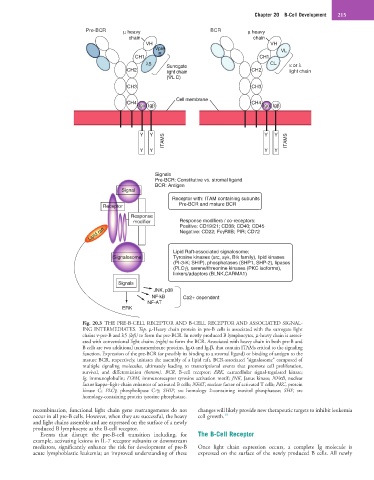
                            Fig. 20.3  THE PRE-B-CELL RECEPTOR AND B-CELL RECEPTOR AND ASSOCIATED SIGNAL-
                            ING INTERMEDIATES. Top, µ-Heavy chain protein in pre-B cells is associated with the surrogate light
                            chains v-pre-B and λ5 (left) to form the pre-BCR. In newly produced B lymphocytes, µ-heavy chain is associ-
                            ated with conventional light chains (right) to form the BCR. Associated with heavy chain in both pre-B and
                            B cells are two additional transmembrane proteins, Ig-α and Ig-β, that contain ITAMs critical to the signaling
                            function. Expression of the pre-BCR (or possibly its binding to a stromal ligand) or binding of antigen to the
                            mature BCR, respectively, initiates the assembly of a lipid raft, BCR-associated “signalosome” composed of
                            multiple  signaling  molecules,  ultimately  leading  to  transcriptional  events  that  promote  cell  proliferation,
                            survival,  and  differentiation  (bottom).  BCR,  B-cell  receptor;  ERK,  extracellular  signal-regulated  kinase;
                            Ig, immunoglobulin; ITAM, immunoreceptor tyrosine activation motif; JNK, Janus kinase; NFκB, nuclear
                            factor kappa–light-chain enhancer of activated B cells; NFAT, nuclear factor of activated T cells; PKC, protein
                            kinase  C;  PLCγ,  phospholipase  C-γ;  SHIP,  src  homology  2-containing  inositol  phosphatase;  SHP,  src
                            homology-containing protein tyrosine phosphatase.

            recombination,  functional  light  chain  gene  rearrangements  do  not   changes will likely provide new therapeutic targets to inhibit leukemia
            occur in all pre-B cells. However, when they are successful, the heavy   cell growth. 15
            and light chains assemble and are expressed on the surface of a newly
            produced B lymphocyte as the B-cell receptor.
              Events  that  disrupt  the  pre-B-cell  transition  including,  for   The B-Cell Receptor
            example, activating lesions in IL-7 receptor subunits or downstream
            mediators, significantly enhance the risk for development of pre-B   Once  light  chain  expression  occurs,  a  complete  Ig  molecule  is
            acute lymphoblastic leukemia; an improved understanding of these   expressed on the surface of the newly produced B cells. All newly

