


Page 2632 - Hematology_ Basic Principles and Practice ( PDFDrive )
P. 2632
Chapter 162  Resources for the Hematologist  e13


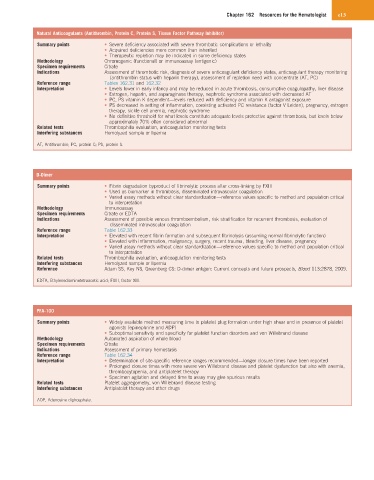
             Natural Anticoagulants (Antithrombin, Protein C, Protein S, Tissue Factor Pathway Inhibitor)
             Summary points        •  Severe deficiency associated with severe thrombotic complications or lethality
                                   •  Acquired deficiencies more common than inherited
                                   •  Therapeutic repletion may be indicated in some deficiency states
             Methodology           Chromogenic (functional) or immunoassay (antigenic)
             Specimen requirements  Citrate
             Indications           Assessment of thrombotic risk, diagnosis of severe anticoagulant deficiency states, anticoagulant therapy monitoring
                                     (antithrombin status with heparin therapy), assessment of repletion need with concentrate (AT, PC)
             Reference range       Tables 162.31 and 162.32
             Interpretation        •  Levels lower in early infancy and may be reduced in acute thrombosis, consumptive coagulopathy, liver disease
                                   •  Estrogen, heparin, and asparaginase therapy, nephrotic syndrome associated with decreased AT
                                   •  PC, PS vitamin K dependent—levels reduced with deficiency and vitamin K antagonist exposure
                                   •  PS decreased in setting of inflammation, coexisting activated PC resistance (factor V Leiden), pregnancy, estrogen
                                     therapy, sickle cell anemia, nephrotic syndrome
                                   •  No definitive threshold for what levels constitute adequate levels protective against thrombosis, but levels below
                                     approximately 70% often considered abnormal
             Related tests         Thrombophilia evaluation, anticoagulation monitoring tests
             Interfering substances  Hemolyzed sample or lipemia

             AT, Antithrombin; PC, protein C; PS, protein S.


             D-Dimer
             Summary points        •  Fibrin degradation byproduct of fibrinolytic process after cross-linking by FXIII
                                   •  Used as biomarker in thrombosis, disseminated intravascular coagulation
                                   •  Varied assay methods without clear standardization—reference values specific to method and population critical
                                     to interpretation
             Methodology           Immunoassay
             Specimen requirements  Citrate or EDTA
             Indications           Assessment of possible venous thromboembolism, risk stratification for recurrent thrombosis, evaluation of
                                     disseminated intravascular coagulation
             Reference range       Table 162.33
             Interpretation        •  Elevated with recent fibrin formation and subsequent fibrinolysis (assuming normal fibrinolytic function)
                                   •  Elevated with inflammation, malignancy, surgery, recent trauma, bleeding, liver disease, pregnancy
                                   •  Varied assay methods without clear standardization—reference values specific to method and population critical
                                     to interpretation
             Related tests         Thrombophilia evaluation, anticoagulation monitoring tests
             Interfering substances  Hemolyzed sample or lipemia
             Reference             Adam SS, Key NS, Greenberg CS: D-dimer antigen: Current concepts and future prospects, Blood 113:2878, 2009.

             EDTA, Ethylenediaminetetraacetic acid; FXIII, factor XIII.


             PFA-100
             Summary points        •  Widely available method measuring time to platelet plug formation under high shear and in presence of platelet
                                     agonists (epinephrine and ADP)
                                   •  Suboptimal sensitivity and specificity for platelet function disorders and von Willebrand disease
             Methodology           Automated aspiration of whole blood
             Specimen requirements  Citrate
             Indications           Assessment of primary hemostasis
             Reference range       Table 162.34
             Interpretation        •  Determination of site-specific reference ranges recommended—longer closure times have been reported
                                   •  Prolonged closure times with more severe von Willebrand disease and platelet dysfunction but also with anemia,
                                     thrombocytopenia, and antiplatelet therapy
                                   •  Specimen agitation and delayed time to assay may give spurious results
             Related tests         Platelet aggregometry, von Willebrand disease testing
             Interfering substances  Antiplatelet therapy and other drugs

             ADP, Adenosine diphosphate.

