


Page 2629 - Hematology_ Basic Principles and Practice ( PDFDrive )
P. 2629
e10    Part XIII  Consultative Hematology


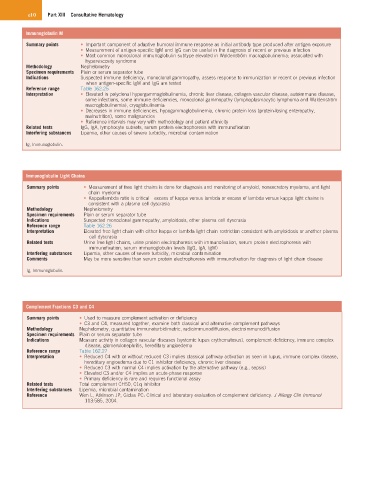
         Immunoglobulin M
          Summary points   •  Important component of adaptive humoral immune response as initial antibody type produced after antigen exposure
                           •  Measurement of antigen-specific IgM and IgG can be useful in the diagnosis of recent or previous infection
                           •  Most common monoclonal immunoglobulin subtype elevated in Waldenström macroglobulinemia; associated with
                             hyperviscosity syndrome
          Methodology      Nephelometry
          Specimen requirements  Plain or serum separator tube
          Indications      Suspected immune deficiency, monoclonal gammopathy, assess response to immunization or recent or previous infection
                             when antigen-specific IgM and IgG are tested
          Reference range  Table 162.25
          Interpretation   •  Elevated in polyclonal hypergammaglobulinemia, chronic liver disease, collagen vascular disease, autoimmune disease,
                             some infections, some immune deficiencies, monoclonal gammopathy (lymphoplasmacytic lymphoma and Waldenström
                             macroglobulinemia), cryoglobulinemia
                           •  Decreases in immune deficiencies, hypogammaglobulinemia, chronic protein loss (protein-losing enteropathy,
                             malnutrition), some malignancies
                           •  Reference intervals may vary with methodology and patient ethnicity
          Related tests    IgG, IgA, lymphocyte subsets, serum protein electrophoresis with immunofixation
          Interfering substances  Lipemia, other causes of severe turbidity, microbial contamination

          Ig, Immunoglobulin.


          Immunoglobulin Light Chains

          Summary points    •  Measurement of free light chains is done for diagnosis and monitoring of amyloid, nonsecretory myeloma, and light
                              chain myeloma
                            •  Kappa/lambda ratio is critical—excess of kappa versus lambda or excess of lambda versus kappa light chains is
                              consistent with a plasma cell dyscrasia
          Methodology       Nephelometry
          Specimen requirements  Plain or serum separator tube
          Indications       Suspected monoclonal gammopathy, amyloidosis, other plasma cell dyscrasia
          Reference range   Table 162.26
          Interpretation    Elevated free light chain with either kappa or lambda light chain restriction consistent with amyloidosis or another plasma
                              cell dyscrasia
          Related tests     Urine free light chains, urine protein electrophoresis with immunofixation, serum protein electrophoresis with
                              immunofixation, serum immunoglobulin levels (IgG, IgA, IgM)
          Interfering substances  Lipemia, other causes of severe turbidity, microbial contamination
          Comments          May be more sensitive than serum protein electrophoresis with immunofixation for diagnosis of light chain disease

          Ig, Immunoglobulin.


          Complement Fractions C3 and C4
          Summary points   •  Used to measure complement activation or deficiency
                           •  C3 and C4, measured together, examine both classical and alternative complement pathways
          Methodology      Nephelometry, quantitative immunoturbidimetric, radioimmunodiffusion, electroimmunodiffusion
          Specimen requirements  Plain or serum separator tube
          Indications      Measure activity in collagen vascular diseases (systemic lupus erythematosus), complement deficiency, immune complex
                             disease, glomerulonephritis, hereditary angioedema
          Reference range  Table 162.27
          Interpretation   •  Reduced C4 with or without reduced C3 implies classical pathway activation as seen in lupus, immune complex disease,
                             hereditary angioedema due to C1 inhibitor deficiency, chronic liver disease
                           •  Reduced C3 with normal C4 implies activation by the alternative pathway (e.g., sepsis)
                           •  Elevated C3 and/or C4 implies an acute-phase response
                           •  Primary deficiency is rare and requires functional assay
          Related tests    Total complement CH50, C1q inhibitor
          Interfering substances  Lipemia, microbial contamination
          Reference        Wen L, Atkinson JP, Giclas PC: Clinical and laboratory evaluation of complement deficiency. J Allergy Clin Immunol
                             113:585, 2004.

