


Page 2634 - Hematology_ Basic Principles and Practice ( PDFDrive )
P. 2634
Chapter 162  Resources for the Hematologist  e15


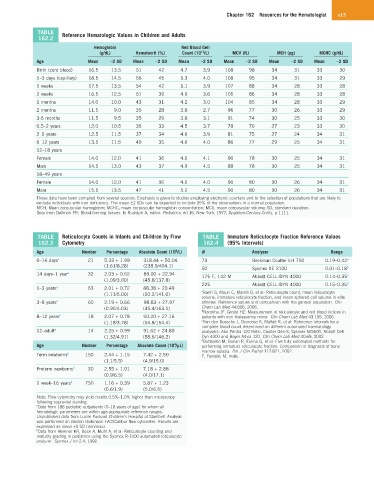
             TABLE   Reference Hematologic Values in Children and Adults
              162.2
                                Hemoglobin                  Red Blood Cell
                                                                   12
                                  (g/dL)     Hematocrit (%)  Count (10 /L)   MCV (fL)       MCH (pg)     MCHC (g/dL)
             Age              Mean   −2 SD   Mean   −2 SD  Mean    −2 SD  Mean   −2 SD   Mean   −2 SD   Mean   −2 SD
             Birth (cord blood)  16.5  13.5  51      42     4.7    3.9     108    98      34     31      33     30
             1–3 days (capillary)  18.5  14.5  56    45     5.3    4.0     108    95      34     31      33     29
             1 weeks          17.5   13.5    54      42     5.1    3.9     107    88      34     28      33     28
             2 weeks          16.5   12.5    51      39     4.9    3.6     105    86      34     28      33     28
             1 months         14.0   10.0    43      31     4.2    3.0     104    85      34     28      33     29
             2 months         11.5    9.0    35      28     3.8    2.7      96    77      30     26      33     29
             3-6 months       11.5    9.5    35      29     3.8    3.1      91    74      30     25      33     30
             0.5–2 years      12.0   10.5    36      33     4.5    3.7      78    70      27     23      33     30
             2–6 years        12.5   11.5    37      34     4.6    3.9      81    75      27     24      34     31
             6–12 years       13.5   11.5    40      35     4.6    4.0      86    77      29     25      34     31
             12–18 years
             Female           14.0   12.0    41      36     4.6    4.1      90    78      30     25      34     31
             Male             14.5   13.0    43      37     4.9    4.5      88    78      30     25      34     31
             18–49 years
             Female           14.0   12.0    41      36     4.6    4.0      90    80      30     26      34     31
             Male             15.5   13.5    47      41     5.2    4.5      90    80      30     26      34     31
             These data have been compiled from several sources. Emphasis is given to studies employing electronic counters and to the selection of populations that are likely to
             exclude individuals with iron deficiency. The mean ±2 SDs can be expected to include 95% of the observations in a normal population.
             MCH, Mean corpuscular hemoglobin; MCHC, mean corpuscular hemoglobin concentration; MCV, mean corpuscular volume; SD, standard deviation.
             Data from Dallman PR: Blood-forming tissues. In Rudolph A, editor: Pediatrics, ed 16, New York, 1977, Appleton-Century-Crofts, p 1111.


             TABLE   Reticulocyte Counts in Infants and Children by Flow   TABLE   Immature Reticulocyte Fraction Reference Values
              162.3  Cytometry                                      162.4  (95% Intervals)
             Age            Number  Percentage  Absolute Count (10 /L)  N           Analyzer                 Range
                                                          9
             0–14 days a      21   5.33 + 1.99  318.44 + 50.04     73               Beckman Coulter LH 750  0.19–0.42 a
                                   (1.61/8.28)  (238.9/404.1)                                                      b
                                                                   50               Sysmex XE 2100         0.01–0.18
             14 days–1 year a  32  2.03 + 0.52  89.00 + 22.94      175 F, 142 M     Abbott CELL-DYN 4000   0.14–0.35 c
                                   (1.09/3.00)  (45.8/137.8)
                                                                   225              Abbott CELL-DYN 4000   0.15–0.35 d
             1–3 years a      63   2.01 + 0.72  88.38 + 20.49      a
                                   (1.11/5.00)  (50.2/141.0)       Banfi G, Mauri C, Morelli B, et al: Reticulocyte count, mean reticulocyte
                                                                   volume, immature reticulocyte fraction, and mean sphered cell volume in elite
             3–8 years a      60   2.19 + 0.66  98.83 + 27.97      athletes: Reference values and comparison with the general population. Clin
                                   (0.95/4.03)  (45.4/163.1)       Chem Lab Med 44:616, 2006.
                                                                   b
                                                                   Noronha JF, Grotto HZ: Measurement of reticulocyte and red blood indices in
             8–12 years a     18   2.07 + 0.78  90.20 + 27.16      patients with iron thalassemia minor. Clin Chem Lab Med 43:195, 2005.
                                   (1.18/3.78)  (54.8/154.4)       c Van den Bossche J, Devreese K, Malfait R, et al: Reference intervals for a
                                                                   complete blood count determined on different automated haematology
             12–adult a       14   2.25 + 0.99  91.62 + 24.80      analysers: Abx Pentra 120 Retic, Coulter Gen-S, Sysmex SE9500, Abbott Cell
                                   (1.32/4.91)  (58.6/146.2)       Dyn 4000 and Bayer Advia 120. Clin Chem Lab Med 40:69, 2002.
                                                                   d Buttarello M, Bulian P, Farina G, et al: Five fully automated methods for
             Age            Number  Percentage  Absolute Count (10 /µL)  performing immature reticulocyte fraction: Comparison in diagnosis of bone
                                                          4
                                                                   marrow aplasia. Am J Clin Pathol 117:871, 2002.
             Term newborns b  150  2.44 + 1.15  7.42 + 2.50        F, Female; M, male.
                                   (1.1/5.5)    (4.9/15.0)
             Preterm newborns b  30  2.55 + 1.01  7.18 + 2.88
                                   (0.9/6.5)    (4.0/17.1)
             1 week–16 years b  750  1.16 + 0.39  5.87 + 1.23
                                   (0.6/1.9)    (5.0/6.5)
             Note: Flow cytometry may yield results 0.5%–1.0% higher than microscopy
             following supravital staining.
             a Data from 188 pediatric outpatients (0–18 years of age) for whom all
             hematologic parameters are within age-appropriate reference ranges.
             Unpublished data from Lucile Packard Children’s Hospital at Stanford. Analysis
             was performed on Becton Dickinson FACSCalibur flow cytometer. Results are
             expressed as mean +1 SD (min/max).
             b Data from Herkner KR, Bock A, Muhl A, et al: Reticulocyte counting and
             maturity grading in pediatrics using the Sysmex R-1000 automated reticulocyte
             analyzer. Sysmex J Int 2:4, 1992.

