


Page 301 - Hematology_ Basic Principles and Practice ( PDFDrive )
P. 301
Chapter 23  Dendritic Cell Biology  249

                                                                                                 +
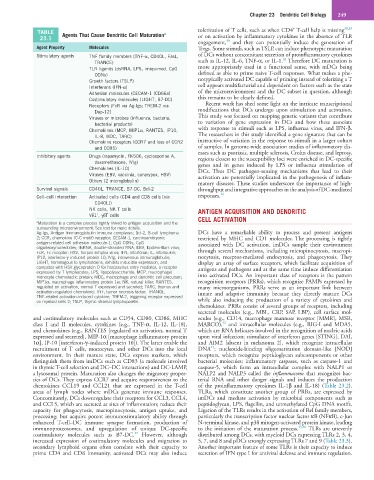
             TABLE   Agents That Cause Dendritic Cell Maturation a  tolerization of T cells, such as when CD4  T-cell help is missing 38,39
              23.1                                                or on activation by inflammatory cytokines in the absence of TLR
                                                                           40
                                                                  engagement,   and  they  can  potentially  induce  the  generation  of
             Agent Property   Molecules                           Tregs. Some stimuli, such as TSLP, can induce phenotypic maturation
             Stimulatory agents  TNF family members (TNF-α, CD40L, FasL,   of DCs without concomitant secretion of proinflammatory cytokines
                                                                                              41
                                TRANCE)                           such as IL-12, IL-6, TNF-α, or IL-1.  Therefore DC maturation is
                              TLR ligands (dsRNA, LPS, imiquimod, CpG   more  appropriately  used  in  a  functional  sense,  with  mDCs  being
                                ODNs)                             defined as able to prime naive T-cell responses. What makes a phe-
                              Growth factors (TSLP)               notypically activated DC capable of priming instead of tolerizing a T
                              Interferons (IFN-α)                 cell appears multifactorial and dependent on factors such as the state
                              Adhesion molecules (CECAM-1 (CD66a)  of the microenvironment and the DC subset in question, although
                              Costimulatory molecules (LIGHT, B7-DC)  this remains to be clearly defined.
                              Receptors (FcR via Ag-Igs; TREM-2 via   Recent work has shed some light on the intricate transcriptional
                                Dap-12)                           modifications  that  DCs  undergo  upon  stimulation  and  activation.
                              Viruses or microbes (influenza, bacteria,   This study was focused on mapping genetic variants that contribute
                                bacterial products)               to  variation  of  gene  expression  in  DCs  and  how  these  associate
                              Chemokines (MCP, MIP1α, RANTES, IP10,   with response to stimuli such as LPS, influenza virus, and IFN-β.
                                IL-8, MDC, TARC)                  The researchers in this study identified a gene signature that can be
                              Chemokine receptors (CCR7 and loss of CCR2   instructive of variation in the response to stimuli in a larger cohort
                                and CCR5)                         of samples. In genome-wide association studies of inflammatory dis-
                                                                  eases such as psoriasis, multiple sclerosis, Crohn disease, and leprosy,
             Inhibitory agents  Drugs (rapamycin, FK506, cyclosporine A,   regions closest to the susceptibility loci were enriched in DC-specific
                                dexamethasone, IVIg)              genes  and  in  genes  induced  by  LPS  or  influenza  stimulation  of
                              Chemokines (IL-10)                  DCs.  Thus  DC  pathogen-sensing  mechanisms  that  lead  to  their
                              Viruses (EBV, vaccinia, canarypox, HSV)  activation are potentially implicated in the pathogenesis of inflam-
                              Others (2 microglobulin)            matory diseases. These studies underscore the importance of high-
             Survival signals  CD40L, TRANCE, B7-DC, Bcl-2        throughput and integrative approaches in the analysis of DC-mediated
             Cell–cell interaction  Activated cells (CD4 and CD8 cells [via   responses. 42
                                CD40L])
                              NK cells, NK T cells                ANTIGEN ACQUISITION AND DENDRITIC
                                 +
                              Vδ1 , γδT cells
             a Maturation is a complex process tightly linked to antigen acquisition and the   CELL ACTIVATION
             surrounding microenvironment. See text for more details.
             Ag-Igs, Antigen–immunoglobulin immune complexes; Bcl-2, B-cell lymphoma   DCs  have  a  remarkable  ability  to  process  and  present  antigens
             2; CCR, chemokine (C-C motif) receptor; CECAM-1, carcinoembryonic   restricted by MHC and CD1 molecules. The processing is tightly
             antigen-related cell adhesion molecule-1; CpG ODNs, CpG   associated  with  DC  activation.  imDCs  sample  their  environment
             oligodeoxynucleotides; dsRNA, double-stranded RNA; EBV, Epstein-Barr virus;
             FcR, Fc receptor; HSV, herpes simplex virus; IFN, interferon; IL, interleukin;   through several mechanisms, including micropinocytosis, macropi-
             IP10, interferon-γ–induced protein 10; IVIg, intravenous immunoglobulin;   nocytosis,  receptor-mediated  endocytosis,  and  phagocytosis.  They
             LIGHT, homologous to lymphotoxins, exhibits inducible expression, and   display an array of surface receptors, which facilitate acquisition of
             competes with HSV glycoprotein D for herpesvirus entry mediator, a receptor   antigens and pathogens and at the same time induce differentiation
             expressed by T lymphocytes; LPS, lipopolysaccharide; MCP, macrophage/
             monocyte chemotactic protein; MDC, macrophage and dendritic cell precursor;   into activated DCs. An important class of receptors is the pattern
             MIP1α, macrophage inflammatory protein 1α; NK, natural killer; RANTES,   recognition receptors (PRRs), which recognize PAMPs expressed by
             regulated on activation, normal T expressed and secreted; TARC, thymus and   many  microorganisms.  PRRs  serve  as  an  important  link  between
             activation-regulated chemokine; TNF, tumor necrosis factor; TRANCE,   innate  and  adaptive  immunity  because  they  directly  mature  DCs
             TNF-related activation-induced cytokine; TREM-2, triggering receptor expressed
             on myeloid cells 2; TSLP, thymic stromal lymphopoietin.  while  also  inducing  the  production  of  a  variety  of  cytokines  and
                                                                  chemokines. PRRs consist of several groups of receptors, including
                                                                  secreted  molecules  (e.g.,  MBL,  CRP,  SAP,  LBP),  cell  surface  mol-
            and costimulatory molecules such as CD54, CD80, CD86, MHC   ecules (e.g., CD14, macrophage mannose receptor [MMR], MSR,
                                                                          43
            class  I  and  II  molecules,  cytokines  (e.g.,  TNF-α,  IL-12,  IL-18),   MARCO),   and  intracellular  molecules  (e.g.,  RIG-I  and  MDA5,
            and chemokines (e.g., RANTES [regulated on activation, normal T   which are RNA helicases involved in the recognition of nucleic acids
            expressed and secreted], MIP-1α [macrophage inflammatory protein   upon viral infection; stimulator of interferon genes [STING], DAI,
            1α], IP-10 [interferon-γ–induced protein 10]). The latter enable the   and  AIM2  [absent  in  melanoma  2],  which  recognize  intracellular
                                                                      44
            recruitment  of  T  cells,  monocytes,  and  other  DCs  into  the  local   DNA ;  nucleotide-binding  oligomerization  domain-like  [NOD]
            environment.  In  their  mature  state,  DCs  express  markers,  which   receptors,  which  recognize  peptidoglycan  subcomponents  or  other
            distinguish them from imDCs such as CD83 (a molecule involved   bacterial  molecules;  inflammatory  caspases,  such  as  caspase-1  and
            in thymic T-cell selection and DC–DC interactions) and DC-LAMP,   caspase-5,  which  form  an  intracellular  complex  with  NALP1  or
            a lysosomal protein. Maturation also changes the migratory proper-  NALP2  and  NALP3  called  the  inflammasome  that  recognizes  bac-
            ties of DCs. They express CCR7 and acquire responsiveness to the   terial  RNA  and  other  danger  signals  and  induces  the  production
            chemokines  CCL19  and  CCL21  that  are  expressed  in  the  T-cell   of  the  proinflammatory  cytokines  IL-1β  and  IL-18)  (Table  23.2).
            areas  of  lymph  nodes  where  mDCs  generate  immune  responses.   TLRs,  which  constitute  another  group  of  PRRs,  are  expressed  by
            Concomitantly, DCs downregulate their receptors for CCL3, CCL4,   imDCs  and  mediate  activation  by  microbial  components  such  as
            and CCL5, which are secreted at sites of inflammation; reduce their   peptidoglycan, LPS, flagellin, and unmethylated CpG DNA motifs.
            capacity  for  phagocytosis,  macropinocytosis,  antigen  uptake,  and   Ligation of the TLRs results in the activation of Rel family members,
            processing; but acquire potent immunostimulatory ability through   particularly the transcription factor nuclear factor κB (NFκB), c-Jun
            enhanced  T-cell–DC  immune  synapse  formation,  production  of   N-terminal kinase, and p38 mitogen-activated protein kinase, leading
            immunoproteosomes,  and  upregulation  of  unique  DC-specific   to the initiation of the maturation process. 45,46  TLRs are unevenly
                                             37
            costimulatory  molecules  such  as  B7-DC.   However,  although   distributed among DCs, with myeloid DCs expressing TLRs 2, 3, 4,
            increased  expression  of  costimulatory  molecules  and  migration  to   5, 7, and 8 and pDCs strongly expressing TLRs 7 and 9 (Table 23.3).
            secondary  lymphoid  organs  often  correlate  with  their  capacity  to   Another important feature of some TLRs is their capacity to induce
            prime  CD4  and  CD8  immunity,  activated  DCs  may  also  induce   secretion of IFN type I for antiviral defense and immune regulation.

