


Page 303 - Hematology_ Basic Principles and Practice ( PDFDrive )
P. 303
Chapter 23  Dendritic Cell Biology  251


            as the generation of tolerogenic signals; and MMR, involved in the   cells such as CD4 and CD8 T cells. Depending on the antigens the
            processing of microbial organisms.                    DCs encounter, the presentation pathway will differ, as described in
              Other receptors expressed by DCs include FcR, which is involved   detail later.
            in cross-presentation of immune complexes and antibody-opsonized
            dead  cells;  integrins  such  as  α vβ 5,  scavenger  receptor  CD36,  and
            Mer family tyrosine kinases for phagocytosis of apoptotic cells and   Major Histocompatibility Complex Class I Antigen
            lipoxygenase-1 or CD91 for uptake of HSPs; complement receptors   Presentation (Endogenous Route)
            that play a role in uptake of opsonized microbes and apoptotic cells;
                                                                                                              +
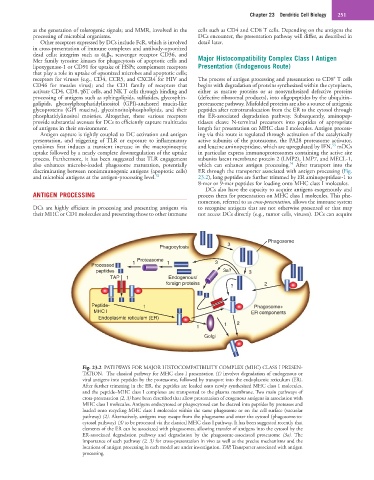
            receptors for viruses (e.g., CD4, CCR5, and CXCR4 for HIV and   The process of antigen processing and presentation to CD8  T cells
            CD46  for  measles  virus);  and  the  CD1  family  of  receptors  that   begins with degradation of proteins synthesized within the cytoplasm,
            activate CD4, CD8, γδT cells, and NK T cells through binding and   either  as  mature  proteins  or  as  neosynthesized  defective  proteins
            processing of antigens such as sphingolipids, sulfatides, glycosphin-  (defective ribosomal products), into oligopeptides by the ubiquitin–
            golipids,  glycosylphosphatidylinositol  (GPI)-anchored  mucin-like   proteasome pathway. Misfolded proteins are also a source of antigenic
            glycoproteins  (GPI  mucins),  glycoinositolphospholipids,  and  their   peptides after retrotranslocation from the ER to the cytosol through
            phosphatidylinositol  moieties.  Altogether,  these  various  receptors   the  ER-associated  degradation  pathway.  Subsequently,  aminopep-
            provide substantial avenues for DCs to efficiently capture multitudes   tidases  cleave  N-terminal  precursors  into  peptides  of  appropriate
            of antigens in their environment.                     length for presentation on MHC class I molecules. Antigen process-
              Antigen capture is tightly coupled to DC activation and antigen   ing via this route is regulated through activation of the catalytically
            presentation,  and  triggering  of TLR  or  exposure  to  inflammatory   active subunits of the proteasome, the PA28 proteasome activator,
                                                                                                              53
            cytokines  first  induces  a  transient  increase  in  the  macropinocytic   and leucine aminopeptidase, which are upregulated by IFN.  mDCs
            uptake followed by a nearly complete downregulation of the uptake   in particular express immunoproteosomes containing the active site
            process. Furthermore, it has been suggested that TLR engagement   subunits latent membrane protein 2 (LMP2), LMP7, and MECL-1,
                                                                                                54
            also  enhances  microbe-loaded  phagosome  maturation,  potentially   which  can  enhance  antigen  processing.   After  transport  into  the
            discriminating between nonimmunogenic antigens (apoptotic cells)   ER through the transporter associated with antigen processing (Fig.
            and microbial antigens at the antigen-processing level. 52  23.2), long peptides are further trimmed by ER aminopeptidase-1 to
                                                                  8-mer or 9-mer peptides for loading onto MHC class I molecules.
                                                                    DCs also have the capacity to acquire antigens exogenously and
            ANTIGEN PROCESSING                                    process them for presentation on MHC class I molecules. This phe-
                                                                  nomenon, referred to as cross-presentation, allows the immune system
            DCs  are  highly  efficient  in  processing  and  presenting  antigens  via   to recognize antigens that are not otherwise presented or that may
            their MHC or CD1 molecules and presenting those to other immune   not access DCs directly (e.g., tumor cells, viruses). DCs can acquire


                                                                                         Phagosome
                                                                           3
                                                     Phagocytosis
                                              Proteasome
                                            1           1              3
                               Processed
                                peptides                                  3a?     3
                                     TAP  1             Endogenous/
                                                       foreign proteins                 2
                                                                             ?


                               Peptide-         1                                   Phagosome+
                                MHC I                                              ER components
                                 Endoplasmic reticulum (ER)
                                                                 1        1    2
                                                                    Golgi


                            Fig. 23.2  PATHWAYS FOR MAJOR HISTOCOMPATIBILITY COMPLEX (MHC) CLASS I PRESEN-
                            TATION.  The classical pathway for MHC class I presentation (1) involves degradation of endogenous or
                            viral antigens into peptides by the proteasome, followed by transport into the endoplasmic reticulum (ER).
                            After further trimming in the ER, the peptides are loaded onto newly synthesized MHC class I molecules,
                            and the peptide–MHC class I complexes are transported to the plasma membrane. Two main pathways of
                            cross-presentation (2, 3) have been described that allow presentation of exogenous antigens in association with
                            MHC class I molecules. Antigens endocytosed or phagocytosed can be cleaved into peptides by proteases and
                            loaded onto recycling MHC class I molecules within the same phagosome or on the cell surface (vacuolar
                            pathway) (2). Alternatively, antigens may escape from the phagosome and enter the cytosol (phagosome-to-
                            cytosol pathway) (3) to be processed via the classical MHC class I pathway. It has been suggested recently that
                            elements of the ER can be associated with phagosomes, allowing transfer of antigens into the cytosol by the
                            ER-associated  degradation  pathway  and  degradation  by  the  phagosome-associated  proteasome  (3a).  The
                            importance of each pathway (2, 3) for cross-presentation in vivo as well as the precise mechanisms and the
                            locations of antigen processing in each model are under investigation. TAP, Transporter associated with antigen
                            processing.

