


Page 305 - Hematology_ Basic Principles and Practice ( PDFDrive )
P. 305
Chapter 23  Dendritic Cell Biology  253


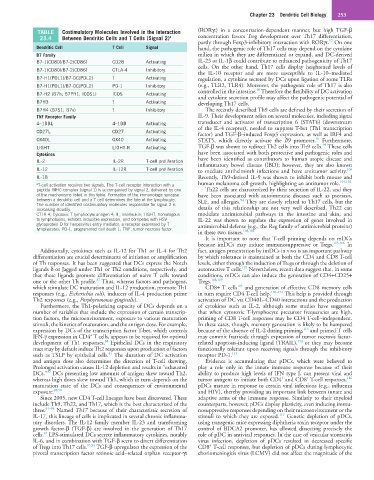
             TABLE   Costimulatory Molecules Involved in the Interaction   (RORγt)  in  a  concentration-dependent  manner,  but  high  TGF-β
              23.4   Between Dendritic Cells and T Cells (Signal 2) a  concentration  favors  Treg  development  over  Th17  differentiation,
                                                                                                             97
                                                                  partly through Foxp3-inhibitory interaction with RORγt.  On one
             Dendritic Cell           T Cell     Signal           hand, the pathogenic role of Th17 cells may depend on the cytokine
             B7 Family                                            milieu in which they are differentiated or expand, and DC-derived
             B7-1(CD80)/B7-2(CD86)    CD28       Activating       IL-23 or IL-1β could contribute to enhanced pathogenicity of Th17
                                                                  cells.  On  the  other  hand, Th17  cells  display  heightened  levels  of
             B7-1(CD80)/B7-2(CD86)    CTLA-4     Inhibitory
                                                                  the  IL-10  receptor  and  are  more  susceptible  to  IL-10–mediated
             B7-H1(PDL1)/B7-DC(PDL2)  ?          Activating       regulation, a cytokine secreted by DCs upon ligation of some TLRs
             B7-H1(PDL1)/B7-DC(PDL2)  PD-1       Inhibitory       (e.g., TLR2, TLR4). Moreover, the pathogenic role of Th17 is also
                                                                                     98
                                                                  controlled in the intestine.  Therefore the flexibility of DC activation
             B7-H2 (B7h; B7PR1; ICOSL)  ICOS     Activating
                                                                  and cytokine secretion profile may affect the pathogenic potential of
             B7H3                     ?          Activating       developing Th17 cells.
             B7H4 (B7S1; B7x)         ?          Inhibitory         The recently described Th9 cells are defined by their secretion of
             TNF Receptor Family                                  IL-9. Their development relies on several molecules, including signal
             4–1BBL                   4–1BB      Activating       transducer  and  activator  of  transcription  6  (STAT6)  (downstream
                                                                  of the IL-4 receptor), needed to suppress T-bet (Th1 transcription
             CD27L                    CD27       Activating
                                                                  factor) and TGF-β–induced Foxp3 expression, as well as IRF4 and
                                                                                                        92
             OX40L                    OX40       Activating       STAT5,  which  directly  activate  the  Il9  promoter.   Furthermore,
                                                                                                           99
             LIGHT                    LIGHT-R    Activating       TGF-β was shown to redirect Th2 cells into Th9 cells.  These cells
             Cytokines                                            have been associated with both protective and pathogenic roles and
             IL-2                     IL-2R      T-cell proliferation  have  been  identified  as  contributors  to  human  atopic  disease  and
                                                                  inflammatory  bowel  disease  (IBD);  however,  they  are  also  known
             IL-12                    IL-12R     T-cell proliferation  to  mediate  antihelminth  infections  and  have  antitumor  activity.
                                                                                                                  100
             IL-18                                                Recently, Th9-derived IL-9 was shown to inhibit both mouse and
             a T-cell activation requires two signals. The T-cell receptor interaction with a   human melanoma cell growth, highlighting an antitumor role. 101,102
             peptide–MHC complex (signal 1) is accompanied by signal 2, delivered by one   Th22 cells are characterized by their secretion of IL-22, and they
             of the mechanisms listed in this table. Formation of the immunologic synapse   have  been  associated  with  autoimmune  diseases  such  as  psoriasis,
             between a dendritic cell and a T cell determines the fate of the lymphocyte.   SLE, and allergies.  They are closely related to Th17 cells, but the
                                                                                94
             The number of identified costimulatory molecules responsible for signal 2 is
             increasing steadily.                                 details  of  this  relationship  are  not  very  well  described. Th22  can
             CTLA-4, Cytotoxic T-lymphocyte antigen 4; IL, interleukin; LIGHT, homologous   modulate  antimicrobial  pathways  in  the  intestine  and  skin,  and
             to lymphotoxins, exhibits inducible expression, and competes with HSV   IL-22  was  shown  to  regulate  the  expression  of  genes  involved  in
             glycoprotein D for herpesvirus entry mediator, a receptor expressed by T   antimicrobial defense (e.g., the Reg family of antimicrobial proteins)
             lymphocytes; PD-1, programmed cell death 1; TNF, tumor necrosis factor.  103,104
                                                                  in these two tissues.
                                                                    It  is  important  to  note  that T-cell  priming  depends  on  mDCs
                                                                  because  imDCs  may  induce  immunosuppressive  or Tregs. 105,106   In
              Additionally, cytokines such as IL-12 for Th1 or IL-4 for Th2   fact, antigen presentation by imDCs in vivo is an important pathway
            differentiation are crucial determinants of initiation or amplification   by which tolerance is maintained at both the CD4 and CD8 T-cell
            of Th responses. It has been suggested that DCs express the Notch   levels, either through the induction of Tregs or through the deletion of
                                                                                107
            ligands δ or Jagged under Th1 or Th2 conditions, respectively, and   autoreactive T cells.  Nevertheless, recent data suggest that, in some
            that  these  ligands  promote  differentiation  of  naive T  cells  toward   conditions, mDCs can also induce the generation of CD4+CD25+
                                 87
            one or the other Th profile.  Thus, whereas factors and pathogens,   Tregs. 108,109
                                                                               105
            which stimulate DC maturation and IL-12 production, promote Th1   CD8+ T cells  and generation of effective CD8 memory cells
            responses (e.g., Escherichia coli), inducers of IL-4 production prime   in turn require CD4 T-cell help. 110–112  This help is provided through
            Th2 responses (e.g., Porphyromonas gingivalis).       activation of DC via CD40L–CD40 interactions and the production
              Furthermore, the Th1-polarizing capacity of DCs depends on a   of  cytokines  such  as  IL-2,  although  some  studies  have  suggested
            number of variables that include the expression of certain transcrip-  that  when  cytotoxic T-lymphocyte  precursor  frequencies  are  high,
            tion factors, the microenvironment, exposure to various maturation   priming of CD8 T-cell responses may be CD4 T-cell–independent.
            stimuli, the kinetics of maturation, and the antigen dose. For example,   In these cases, though, memory generation is likely to be hampered
                                                                                                    113
            expression by DCs of the transcription factor T-bet, which controls   because of the absence of IL-2 during priming,  and primed T cells
                               +
            IFN-γ expression in CD4  T cells, appears to be required for optimal   may commit fratricide through expression of tumor necrosis factor-
                                   88
                                                                                                  114
            development of Th1 responses.  Epithelial DCs in the respiratory   related apoptosis-inducing ligand (TRAIL),  or they may become
            tract may by default induce Th2 responses upon production of factors   functionally tolerant upon receiving signals through the inhibitory
                                     41
            such  as TSLP  by  epithelial  cells.  The  duration  of  DC  activation   receptor PD-1. 115
            and  antigen  dose  also  determines  the  direction  of T-cell  skewing.   Evidence  is  accumulating  that  pDCs,  which  were  believed  to
            Prolonged activation causes IL-12 depletion and results in “exhausted   play  a  role  only  in  the  innate  immune  response  because  of  their
                37
            DCs.”  DCs presenting low amounts of antigen skew toward Th2,   ability to produce high levels of IFN type I, can present viral and
                                                                                                     +
                                                                                             +
                                                                                                                  116
            whereas high doses skew toward Th1, which in turn depends on the   tumor antigens to initiate both CD4  and CD8  T-cell responses.
            maturation  state  of  the  DCs  and  consequences  of  environmental   pDCs mature in response to certain viral infections (e.g., influenza
            exposure. 89,90                                       and HIV), thereby providing an important link between innate and
              Since 2005, new CD4 T-cell lineages have been discovered. These   adaptive arms of the immune response. Similarly to their myeloid
            include Th9, Th22, and Th17, which is the best characterized of the   counterparts, however, pDCs display plasticity, even inducing immu-
            three. 91–94  Named Th17 because of their characteristic secretion of   nosuppressive responses depending on their microenvironment or the
                                                                                            117
            IL-17, this lineage of cells is implicated in several chronic inflamma-  stimuli  to  which  they  are  exposed.   Genetic  depletion  of  pDCs,
            tory  disorders. The  IL-12  family  member  IL-23  and  transforming   using transgenic mice expressing diphtheria toxin receptor under the
            growth  factor-β  (TGF-β)  are  involved  in  the  generation  of Th17   control  of  BDCA2  promoter,  has  allowed  dissecting  precisely  the
               91
            cells.  LPS-stimulated DCs secrete inflammatory cytokines, notably   role of pDC in antiviral responses. In the case of vesicular stomatitis
            IL-6, and in combination with TGF-β seem to divert differentiation   virus  infection,  depletion  of  pDCs  resulted  in  decreased  specific
                                                                      +
            of Tregs into Th17 cells. 95,96  TGF-β upregulates the expression of the   CD8  T-cell responses, but depletion of pDCs during lymphocytic
            pivotal transcription factor retinoic acid–related orphan receptor-γt   choriomeningitis virus (LCMV) did not affect the magnitude of the

