


Page 302 - Hematology_ Basic Principles and Practice ( PDFDrive )
P. 302
250    Part III  Immunologic Basis of Hematology


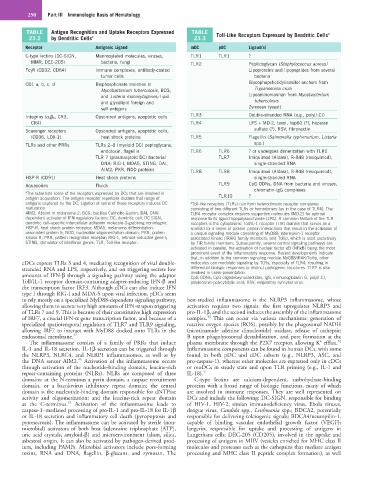
          TABLE   Antigen Recognition and Uptake Receptors Expressed   TABLE   Toll-Like Receptors Expressed by Dendritic Cells a
          23.2    by Dendritic Cells a                          23.3
         Receptor               Antigenic Ligand               mDC       pDC      Ligand(s)
         C-type lectins (DC-SIGN,   Mannosylated molecules, viruses,   TLR1  TLR1  ?
           MMR, DEC-205)          bacteria, fungi              TLR2               Peptidoglycan (Staphylococcus aureus)
         FcγR (CD32, CD64)      Immune complexes, antibody-coated                 Lipoproteins and lipopeptides from several
                                  tumor cells                                       bacteria
         CD1 a, b, c, d         Bisphosphonate moieties in                        Glycophopshotidylinositol anchors from
                                  Mycobacterium tuberculosis, BCG,                  Trypanosoma cruzi
                                  and Listeria monocytogenes; lipid               Lipoaminomannan from Mycobacterium
                                  and glycolipid foreign and                        tuberculosis
                                  self-antigens                                   Zymosan (yeast)
         Integrins (α v β 5 , CR3,   Opsonized antigens, apoptotic cells  TLR3    Double-stranded RNA (e.g., poly[I:C])
           CR4)                                                TLR4               LPS + MD-2, taxol, hsp60 (?), heparan
         Scavenger receptors    Opsonized antigens, apoptotic cells,                sulfate (?), RSV, fibronectin
           (CD36, LOX-1)          heat shock proteins          TLR5               Flagellin (Salmonella typhimurium, Listeria
         TLRs and other PRRs    TLRs 2–8 (myeloid DC) peptoglycans,                 spp.)
                                  endotoxin, flagellin         TLR6      TLR6     ? or undergoes dimerization with TLR2
                                TLR 7 (plasmacytoid DC) bacterial        TLR7     Imiquimod (Aldara), R-848 (resiquimod),
                                  DNA; RIG-I, MDA5, STING, DAI,                     single-stranded RNA
                                  AIM2, PKR, NOD proteins      TLR8      TLR8     Imiquimod (Aldara), R-848 (resiquimod),
         HSP-R (CD91)           Heat shock proteins                                 single-stranded RNA
         Aquaporins             Fluids                                   TLR9     CpG ODNs, DNA from bacteria and viruses,
                                                                                    chromatin-IgG complexes
         a The table lists some of the receptors expressed by DCs that are involved in
         antigen acquisition. The antigen receptor repertoire dictates that range of   TLR10  ?
         antigens captured by the DC. Ligation of some of these receptors induces DC   a Toll-like receptors (TLRs) can form heterodimeric receptor complexes
         maturation.                                           consisting of two different TLRs or homodimers (as in the case of TLR4). The
         AIM2, Absent in melanoma 2; BCG, bacillus Calmette-Guérin; DAI, DNA-  TLR4 receptor complex requires supportive molecules (MD-2) for optimal
         dependent activator of IFN-regulatory factors; DC, dendritic cell; DC-SIGN,   response to its ligand lipopolysaccharide (LPS). A common feature of the TLR
         dendritic cell–specific intercellular adhesion molecule-3-grabbing nonintegrin;   receptors is the cytoplasmic Toll/IL-1 receptor (TIR) domain that serves as a
         HSP-R, heat shock protein receptor; MDA5, melanoma differentiation-  scaffold for a series of protein–protein interactions that result in the activation of
         associated protein 5; NOD, nucleotide oligomerization domain; PKR, protein   a unique signaling module consisting of MyD88; interleukin-1 receptor
         kinase R; PRR, pattern recognition receptor; RIG-1, retinoid-inducible gene I;   associated kinase (IRAK) family members; and Tollip, which is used exclusively
         STING, stimulator of interferon genes; TLR, Toll-like receptor.  by TIR family members. Subsequently, several central signaling pathways are
                                                               activated in parallel, the activation of nuclear factor κB (NFκB) being the most
                                                               prominent event of the inflammatory response. Recent developments indicate
                                                               that, in addition to the common signaling module MyD88/IRAK/Tollip, other
        cDCs express TLRs 3 and 4, mediating recognition of viral double-  molecules can modulate signaling by TLRs, especially of TLR4, resulting in
        stranded RNA and LPS, respectively, and on triggering secrete low   differential biologic responses to distinct pathogenic structures. TLR2 is also
        amounts of IFN-β through a signaling pathway using the adaptor   involved in cross-presentation.
                                                               CpG ODNs, CpG oligodeoxynucleotides; IgG, immunoglobulin G; poly(I:C),
        Toll/IL-1 receptor domain-containing adapter-inducing IFN-β and   polyinosinic-polycytidylic acid; RSV, respiratory syncytial virus.
        the transcription factor IRF3. Although cDCs can also induce IFN
        type I through RIG-I and MDA-5 upon viral infection, pDCs seem
        to rely mostly on a specialized MyD88-dependent signaling pathway,   best-studied  inflammasome  is  the  NLRP3  inflammasome,  whose
        allowing them to secrete very high amounts of IFN-α upon triggering   activation  requires  two  signals:  the  first  upregulates  NLRP3  and
        of TLRs 7 and 9. This is because of their constitutive high expression   pro-IL-1β, and the second induces the assembly of the inflammasome
                                                                     48
        of IRF7, a crucial IFN-α gene transcription factor, and because of a   complex.   This  can  occur  via  various  mechanisms:  generation  of
        specialized spatiotemporal regulation of TLR7 and TLR9 signaling,   reactive oxygen species (ROS), possibly by the phagosomal NADH
        allowing IRF7 to interact with MyD88 docked onto TLRs in the   (nicotinamide  adenine  dinucleotide)  oxidase,  release  of  cathepsin
        endosomal membrane. 47                                B upon phagolysosomal destabilization, and pore formation at the
                                                                                                          +
                                                                                                               50
           The  inflammasome  consists  of  a  family  of  PRRs  that  induce   plasma membrane through the P2X7 receptor, allowing K  efflux.
        IL-1 and IL-18 secretion. IL-1β secretion can be triggered through   Inflammasome components can be found in human DCs, with some
        the  NLRP3,  NLRC4,  and  NLRP1  inflammasomes,  as  well  as  by   found  in  both  pDC  and  cDC  subsets  (e.g.,  NLRP3,  ASC,  and
                           48
        the  DNA  sensor  AIM2.   Activation  of  the  inflammasome  occurs   pro-caspase-1), whereas other molecules are expressed only in cDCs
        through  activation  of  the  nucleotide-binding  domain,  leucine-rich   or moDCs in steady state and upon TLR priming (e.g., IL-1 and
        repeat-containing  proteins  (NLRs).  NLRs  are  composed  of  three   IL-18). 51
        domains: at the N-terminus a pyrin domain, a caspase recruitment   C-type  lectins  are  calcium-dependent,  carbohydrate-binding
        domain,  or  a  baculovirus  inhibitory  repeat  domain;  the  central   proteins with a broad range of biologic functions, many of which
        domain is the nucleotide-binding domain responsible for dNTPase   are  involved  in  immune  responses.  They  are  well  represented  on
        activity  and  oligomerization;  and  the  leucine-rich  repeat  domain   DCs and include the following: DC-SIGN, responsible for binding
                       49
        at  the  C-terminus.   Activation  of  the  inflammasome  leads  to   of  HIV-1,  HIV-2,  simian  immunodeficiency  virus,  Ebola  viruses,
        caspase-1–mediated processing of pro-IL-1 and pro-IL-18 for IL-1β   dengue  virus,  Candida  spp.,  Leishmania  spp.;  BDCA2,  potentially
        or  IL-18  secretion  and  inflammatory  cell  death  (pyropoptosis  and   responsible for delivering tolerogenic signals; BDCA4/neuropilin-1,
        pyronecrosis). The inflammasome can be activated by sterile (non-  capable  of  binding  vascular  endothelial  growth  factor  (VEGF);
        microbial)  activators  of  both  host  (adenosine  triphosphate  [ATP],   langerin,  responsible  for  uptake  and  processing  of  antigens  in
        uric acid crystals, amyloid-β) and microenvironment (alum, silica,   Langerhans cells; DEC-205 (CD205), involved in the uptake and
        asbestos) origin. It can also be activated by pathogen-derived prod-  processing of antigens in MIIV (vesicles enriched for MHC class II
        ucts,  including  PAMPs.  Microbial  activators  include  pore-forming   molecules and proteases such as the cathepsins that mediate antigen
        toxins,  RNA  and  DNA,  flagellin,  β-glucans,  and  zymosan.  The   processing and MHC class II peptide complex formation), as well

