


Page 322 - Hematology_ Basic Principles and Practice ( PDFDrive )
P. 322
264    Part III  Immunologic Basis of Hematology


        factor  B  by  C3(H 2O)  allows  factor  D,  another  protease,  to  cleave   from  membrane  surface  glycoproteins)  found  on  host  surfaces  in
        factor B to form Ba and Bb. Bb remains associated with C3(H 2O) to   contact with blood plasma. Although these polyanion binding sites
        form the C3(H 2O)Bb complex. Factor D appears to function as a   are not required for FH to regulate fluid phase AP C3 convertase,
        serine protease in its native state but can cleave factor B only when   they are required for its activity on surface-bound C3bBb. In fact,
        bound  to  C3.  Recently,  there  has  been  an  interesting  connection   this is the basis for FH being able to discriminate between AP C3
        found between factor D and MASP-1, a component of the LP. It was   convertase adventitiously deposited on host tissue versus that depos-
        found  that  a  MASP-1/MASP-3  knockout  mouse  (the  proteins   ited on a microbial surface because the latter do not possess either
        MASP-1  and  MASP-3  are  alternative  splice  products  of  the  same   the sulfated glycosaminoglycans or the sialic acid arrays. 30,31
        gene) completely lacked AP functionality. Upon further investigation,   Pathogen  surfaces  are  normally  not  afforded  the  protection
        it was determined that the secreted factor D in this mouse possessed   offered by these regulators. Persistence of the C3bBb convertase on
        a  five-residue  propeptide  at  its  amino  terminus.  Removal  of  this   microbial surfaces may additionally be favored by the positive regula-
        propeptide  from  factor  D  by  the  addition  of  MASP-1  resulted  in   tor  properdin  (factor  P).  This  positive  modulation  of  the  AP  by
        restoration of AP functionality. 26                   properdin  has  traditionally  been  thought  to  be  attributable  to  its
           C3(H 2O)Bb is an enzymatic complex capable of cleaving native   ability to prolong the lifetime of the AP C3 convertase by forming a
        C3.  This  complex  is  a  fluid-phase  C3  convertase.  Although  it  is   C3bBbP  complex. This  mechanism is still  valid,  but  recently, evi-
        formed  only  in  small  amounts,  it  can  cleave  many  molecules  of   dence has been presented that properdin, which circulates predomi-
        C3.  Much  of  the  C3b  produced  in  this  process  is  inactivated  by   nantly  as  a  homotrimer,  may  also  be  able  to  recognize  AP  targets
        hydrolysis, but some attaches covalently to the surface of host cells   directly. Specifically, it has been shown to bind to microbial surfaces,
        or  pathogens.  C3b  bound  in  this  way  is  able  to  bind  factor  B,   such as to Neisseria gonorrhoeae or yeast cell walls, that are known AP
        allowing its cleavage by factor D to yield Ba and Bb. The result is   activators, but not to strains of Escherichia coli that are known to be
        the formation of C3bBb, a C3 convertase akin to C4b2a found in   nonactivators of the AP of complement. Because it is a homotrimer,
        the classical and MBL pathways, with the capability of initiating an   even  if  factor  P  uses  two  of  its  subunits  to  bind  to  the  microbial
        amplification cascade.                                surface, one is still left that can recruit C3b, or C3(H 2 O), from the
           In light of the nonspecific nature of C3b binding in the AP, it is   fluid  phase  to  the  microbial  surface.  The  properdin-bound  C3b/
        not surprising that a number of complement regulators exist both in   C3(H2O) can then act as a platform for recruiting factors B and D,
                                                                                                       32
        the  plasma  and  on  host  cell  membranes  to  prevent  complement   thereby  forming  a  surface-bound  AP  C3  convertase.   Consistent
        activation on self-tissues. Some of these regulatory components are   with this target recognition model for properdin functionality, indi-
        mentioned  now  for  the  sake  of  clarity;  more  detailed  attention  is   viduals with deficiencies in factor P have a heightened susceptibility
        provided later in this chapter (Table 24.1). CR1 and DAF (CD55)   to infection with Neisseria. 33
        compete with factor B for binding to C3b on the cell surface and can   After  forming,  the  C3bBb  convertase  rapidly  cleaves  more  C3
                                                28
        displace Bb from a convertase that has already formed.  Factor I (FI),   to C3b, which can participate in the formation of more molecules
        a serum protease, in concert with CR1 or MCP (CD46) can prevent   of  C3bBb  convertase.  The  AP  thereby  activates  an  amplification
        convertase formation by converting C3b into its inactive derivative,   loop  that  can  proceed  on  the  surface of  a pathogen  but  not  on  a
            29
        iC3b.   CR1  is  unique  among  the  FI  cofactors  in  facilitating  an   host  cell.  An  additional  point  regarding  amplification  by  the  AP
        additional proteolytic cleavage of iC3b to yield C3c and C3dg (see   is that C3b deposited on a target as a result of activation of either
        Fig.  24.2B). Trimming  of  the  latter  by  noncomplement  proteases   the CP or the LP can act as a nidus for the formation of an AP C3
        yields the proteolytic limit fragment C3d, which structurally corre-  convertase.
        sponds to the TED domain (see Fig. 24.2B). Another complement   Although specific antibody is not required for AP activation, many
                                                                                                      34
        regulatory protein found in the plasma is FH. FH binds C3b and is   classes of immunoglobulin can facilitate AP activation.  The mecha-
        able to compete with factor B and displace Bb from the convertase.   nism by which this occurs remains elusive, although some evidence
        In addition, FH acts as a cofactor for FI to convert C3b to iC3b. In   indicates that C3b covalently bound to IgG displays a reduced rate
                                                                                              35
        addition  to  interaction  sites  for  C3b,  FH  possesses  two  distinct   of inactivation to iC3b by factors H and I.  However, in contrast to
        binding sites for polyanionic molecules, particularly various sulfated   CP  activation,  which  requires  Fc,  AP  activation  can  occur  with
        glycosaminoglycans (e.g., heparan sulfate) or arrays of sialic acid (e.g.,   F(ab)′ 2  fragments.
                                                                 An instructive demonstration for the role of antibody in continu-
                                                              ing the AP cascade, with possible ramifications for human disease,
                                                              comes from a murine model of rheumatoid arthritis. Mice do not
                                                                                                36
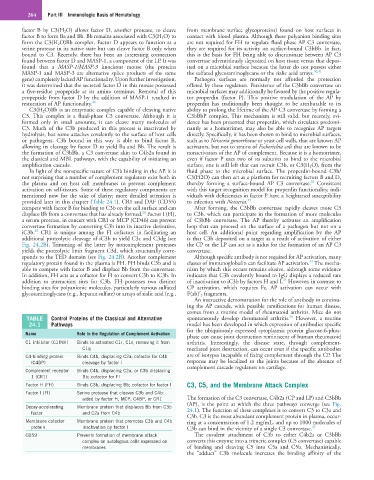
          TABLE   Control Proteins of the Classical and Alternative   spontaneously  develop  rheumatoid  arthritis.   However,  a  murine
          24.1    Pathways                                    model has been developed in which expression of antibodies specific
                                                              for the ubiquitously expressed cytoplasmic protein glucose-6-phos-
         Name             Role in the Regulation of Complement Activation
                                                              phate can cause joint destruction reminiscent of human rheumatoid
         C1 inhibitor (C1INH)  Binds to activated C1r, C1s, removing it from   arthritis.  Interestingly,  the  disease  state,  through  complement-
                            C1q                               mediated joint destruction, can occur even if the specific antibodies
         C4-binding protein   Binds C4b, displacing C2a; cofactor for C4b   are of isotypes incapable of fixing complement through the CP. The
           (C4BP)           cleavage by factor I              response  may  be  localized  to  the  joints  because  of  the  absence  of
                                                              complement cascade regulators on cartilage.
         Complement receptor   Binds C4b, displacing C2a, or C3b displacing
           1 (CR1)          Bb; cofactor for FI
         Factor H (FH)    Binds C3b, displacing Bb; cofactor for factor I  C3, C5, and the Membrane Attack Complex
         Factor I (FI)    Serine protease that cleaves C3b and C4b:
                            aided by factor H, MCP, C4BP, or CR1  The formation of the C3 convertase, C4b2a (CP and LP) and C3bBb
                                                              (AP),  is  the  point  at  which  the  three  pathways  converge  (see  Fig.
         Decay-accelerating   Membrane protein that displaces Bb from C3b   24.1). The function of these complexes is to convert C3 to C3a and
           factor           and C2a from C4b
                                                              C3b. C3 is the most abundant complement protein in plasma, occur-
         Membrane cofactor   Membrane protein that promotes C3b and C4b   ring at a concentration of 1.2 mg/mL, and up to 1000 molecules of
           protein          inactivation by factor I          C3b can bind in the vicinity of a single C3 convertase. 37
         CD59             Prevents formation of membrane attack   The  covalent  attachment  of  C3b  to  either  C4b2a  or  C3bBb
                            complex on autologous cells expressed on   converts this enzyme into a trimeric complex (C5 convertase) capable
                            membranes                         of  binding  and  cleaving  C5  into  C5a  and  C5b.  Mechanistically,
                                                              the  “adduct”  C3b  molecule  increases  the  binding  affinity  of  the

