


Page 320 - Hematology_ Basic Principles and Practice ( PDFDrive )
P. 320
262    Part III  Immunologic Basis of Hematology


                           Classical pathway
                            Ig      Clq, r, s  C4      C2                                  C3


                      Ag                                                         Convertase
                                                          C4a        C2b         (classical or  C3a
                                                            Classical C3         alternative)
                                                            convertase
                           Lectin pathway
                                                                                              C5
                         MBL         MASP      C4        C2
                                                                             *
                                                                                   C5
                                                                                convertase   C5a
                                                          C4a        C2b
                                                             Classical C3                     C6  Lytic pathway
                                                             convertase                       C7
                            Alternative pathway                                               C8
                             C3      Factor B   Factor D
                                                                                              C9


                                                                                         Out
                                  *     C3a                    Ba
                                                      Alternative                         In
                                                     C3 convertase

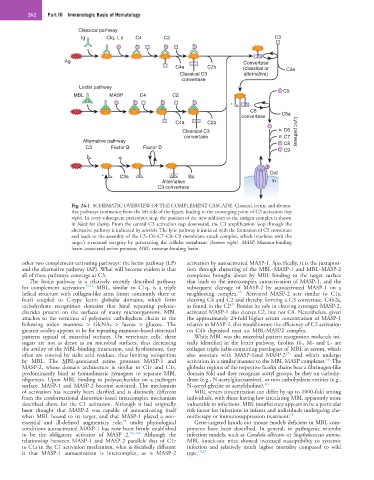
                        Fig. 24.1  SCHEMATIC OVERVIEW OF THE COMPLEMENT CASCADE. Classical, lectin, and alterna-
                        tive pathways commence from the left side of the figure, leading to the converging point of C3 activation (top
                        right). In every subsequent proteolytic step, the position of the new addition to the antigen complex is shown
                        in black for clarity. From the central C3 activation step downward, the C3 amplification loop through the
                        alternative pathway is indicated by asterisks. The lytic pathway is initiated with the formation of C5 convertase
                        and leads to the assembly of the C5–C6–C7–C8–C9 membrane attack complex, which interferes with the
                        target’s  structural  integrity  by  penetrating  the  cellular  membrane  (bottom  right).  MASP,  Mannan-binding
                        lectin–associated serine protease; MBL, mannan-binding lectin.

        other two complement-activating pathways: the lectin pathway (LP)   activation by autoactivated MASP-1. Specifically, it is the juxtaposi-
        and the alternative pathway (AP). What will become evident is that   tion through clustering of the MBL–MASP-1 and MBL–MASP-2
        all of these pathways converge at C3.                 complexes  brought  about  by  MBL  binding  to  the  target  surface
           The  lectin  pathway  is  a  relatively  recently  described  pathway   that leads to the intercomplex autoactivation of MASP-1, and the
        for  complement  activation. 15,16   MBL,  similar  to  C1q,  is  a  triple   subsequent  cleavage  of  MASP-2  by  autoactivated  MASP-1  on  a
                                                                               16c
        helical structure with collagen-like arms (most commonly three or   neighboring  complex.   Activated  MASP-2  acts  similar  to  C1s,
        four)  coupled  to  C-type  lectin  globular  domains,  which  form   cleaving C4 and C2 and thereby forming a C3 convertase, C4b2a,
                                                                             17
        carbohydrate  recognition  domains  that  bind  repeating  polysac-  as found in the CP.  Besides its role in cleaving zymogen MASP-2,
        charides  present  on  the  surfaces  of  many  microorganisms.  MBL   activated MASP-1 also cleaves C2, but not C4. Nevertheless, given
        attaches  to  the  terminus  of  polymeric  carbohydrate  chains  in  the   the approximately 24-fold higher serum concentration of MASP-1
        following  order:  mannose  >  GlcNAc  >  fucose  >  glucose.  The   relative to MASP-2, this would ensure the efficiency of C2 activation
        greatest avidity appears to be for repeating mannose-based structural   on  C4b  deposited  near  an  MBL-MASP2  complex.
        patterns  typical  of  microbial  surfaces.  On  vertebrate  cells,  these   While MBL was the microbial pattern recognition molecule ini-
        sugars  are  not  as  dense  as  on  microbial  surfaces,  thus  decreasing   tially  identified  in  the  lectin  pathway,  ficolins  H-,  M-  and  L-  are
        the avidity of the MBL-binding interaction, and furthermore, they   collagen triple helix-containing paralogues of MBL in serum, which
                                                                                              17a
        often  are  covered  by  sialic  acid  residues,  thus  limiting  recognition   also  associate  with  MASP-1and  MASP-2   and  which  undergo
                                                                                                            16c
        by  MBL.  The  MBL-associated  serine  proteases  MASP-1  and   activation in a similar manner to the MBL-MASP complexes.  The
        MASP-2,  whose  domain  architecture  is  similar  to  C1r  and  C1s,   globular regions of the respective ficolin chains bear a fibrinogen-like
        predominantly  bind  as  homodimeric  zymogens  to  separate  MBL   domain fold and they recognize acetyl groups, be they on carbohy-
        oligomers.  Upon  MBL  binding  to  polysaccharides  on  a  pathogen   drate (e.g., N-acetylglucosamine), or non carbohydrate entities (e.g.,
        surface,  MASP-1  and  MASP-2  become  activated. The  mechanism   N-acetyl-glycine or acetylcholine). 17a
        of  activation  has  recently  been  clarified  and  is  distinctly  different   MBL serum concentration can differ by up to 1000-fold among
        from the conformational distortion-based intracomplex mechanism   individuals, with those having low circulating MBL apparently more
        described  above  for  the  C1  activation.  Although  it  had  originally   vulnerable to infections. MBL insufficiency appears to be a particular
        been  thought  that  MASP-2  was  capable  of  autoactivating  itself   risk factor for infections in infants and individuals undergoing che-
        when  MBL  bound  to  its  target,  and  that  MASP-1  played  a  non-  motherapy or immunosuppression treatment. 18
                                         14
        essential  and  ill-defined  augmentary  role,   under  physiological   Gene-targeted knock-out mouse models deficient in MBL com-
        conditions autoactivated MASP-1 has now been firmly established   ponents  have  been  described.  In  general,  in  pathogenic  microbe
        to  be  the  obligatory  activator  of  MASP  2. 16a,16b   Although  the   infection models, such as Candida albicans or Staphylococcus aureus,
        relationship  between  MASP-1  and  MASP-2  parallels  that  of  C1r   MBL  knock-out  mice  showed  increased  susceptibility  to  systemic
        to C1s in the C1 activation mechanism, what is decidedly different   infection  and  relatively  much  higher  mortality  compared  to  wild
        is  that  MASP-1  autoactivation  is  intercomplex,  as  is  MASP-2   type. 19,20

