


Page 321 - Hematology_ Basic Principles and Practice ( PDFDrive )
P. 321
Chapter 24  Complement and Immunoglobulin Biology Leading to Clinical Translation  263

            Alternative Pathway                                   MG8 domains, which is nevertheless close to the protein’s surface.
                                                                  The subsequent determination of the atomic structure of the activated
            The AP may represent one of the earliest forms of innate immunity.   form of C3 (i.e., C3b) demonstrated a dramatic shift in the location
            Unlike the CP or LP pathway, the AP can be fully activated in the   of the TED. 24,25  Proteolytic cleavage releases the C3a anaphylatoxin
            absence of specific pathogen binding by a “recognition” equivalent to   peptide,  and  the TED  becomes  fully  exposed  to  engage  potential
                       21
            C1q  or  MBL.   In  fact,  the  AP  is  always  “on”  at  a  low  level.  In   targets (see structure-based depiction of C3b in Fig. 24.2B). Thus the
            addition, the AP forms and uses the distinct C3 convertase C3bBb. 22  dramatic  shift  in  structure  also  exposes  potential  binding  sites  for
              Complement C3 is a two-chain protein with an apparent molecu-  factor B of the AP and competing sites for regulators of C3b, such
            lar weight of approximately 200 kDa. The crystal structure of native   as factor H (FH), membrane cofactor protein (MCP), complement
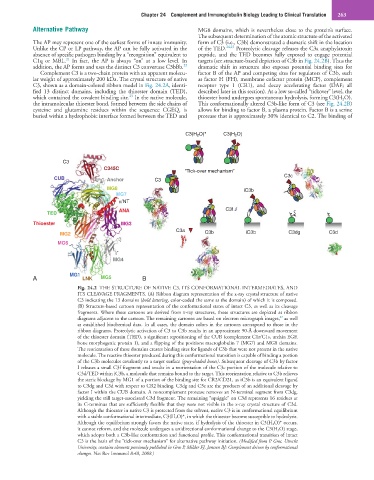
            C3, shown as a domain-colored ribbon model in Fig. 24.2A, identi-  receptor  type  1  (CR1),  and  decay  accelerating  factor  (DAF;  all
            fied  13  distinct  domains,  including  the  thioester  domain  (TED),   described later in this section). At a low so-called “tickover” level, the
                                           23
            which contained the covalent binding site.  In the native molecule,   thioester bond undergoes spontaneous hydrolysis, forming C3(H 2O).
            the intramolecular thioester bond, formed between the side chains of   This conformationally altered C3b-like form of C3 (see Fig. 24.2B)
            cysteine  and  glutamine  residues  within  the  sequence  CGEQ,  is   allows for binding to factor B, a plasma protein. Factor B is a serine
            buried within a hydrophobic interface formed between the TED and   protease that is approximately 30% identical to C2. The binding of


                                                              C3(H 2 O)*  C3(H 2 O)


                      C3
                                   C345C
                                                             “Tick-over mechanism”
                   CUB              Anchor          C3                                        C3c
                                    MG8                                          iC3b
                                       MG7
                                        α’NT
                                        ANA                                C3f
                TED
            Thioester                    MG3
                                                           C3a
                     MG2                                            C3b          iC3b          C3dg          C3d
                    MG6

                                      MG4

                        MG1
            A               LNK   MG5           B
                          Fig. 24.2  THE STRUCTURE OF NATIVE C3, ITS CONFORMATIONAL INTERMEDIATES, AND
                          ITS CLEAVAGE FRAGMENTS. (A) Ribbon diagram representation of the x-ray crystal structure of native
                          C3 indicating the 13 domains (bold lettering, color-coded the same as the domain) of which it is composed.
                          (B) Structure-based cartoon representation of the conformational states of intact C3, as well as its cleavage
                          fragments. Where these cartoons are derived from x-ray structures, those structures are depicted as ribbon
                                                                                             27
                          diagrams adjacent to the cartoon. The remaining cartoons are based on electron micrograph images,  as well
                          as established biochemical data. In all cases, the domain colors in the cartoons correspond to those in the
                          ribbon diagrams. Proteolytic activation of C3 to C3b results in an approximate 90-Å downward movement
                          of the thioester domain (TED), a significant repositioning of the CUB (complement C1r/C1s, urchin EGF,
                          bone morphogenic protein 1), and a flipping of the positions macroglobulin 7 (MG7) and MG8 domains.
                          The reorientation of these domains creates binding sites for ligands of C3b that were not present in the native
                          molecule. The reactive thioester produced during this conformational transition is capable of binding a portion
                          of the C3b molecules covalently to a target surface (gray-shaded boxes). Subsequent cleavage of C3b by factor
                          I releases a small C3f fragment and results in a reorientation of the C3c portion of the molecule relative to
                          C3d/TED within iC3b, a molecule that remains bound to the target. This reorientation relative to C3b relieves
                          the steric blockage by MG1 of a portion of the binding site for CR2/CD21, as iC3b is an equivalent ligand
                          to C3dg and C3d with respect to CR2 binding. C3dg and C3c are the products of an additional cleavage by
                          factor I within the CUB domain. A noncomplement protease removes an N-terminal segment from C3dg,
                          yielding the still target-associated C3d fragment. The remaining “squiggle” on C3d represents 16 residues at
                          its C-terminus that are sufficiently flexible that they were not visible in the x-ray crystal structure of C3d.
                          Although the thioester in native C3 is protected from the solvent, native C3 is in conformational equilibrium
                          with a stable conformational intermediate, C3(H 2 O)*, in which the thioester become susceptible to hydrolysis.
                          Although the equilibrium strongly favors the native state, if hydrolysis of the thioester in C3(H 2 O)* occurs,
                          it cannot reform, and the molecule undergoes a unidirectional conformational change to the C3(H 2 O) stage,
                          which adopts both a C3b-like conformation and functional profile. This conformational transition of intact
                          C3 is the basis of the “tick-over mechanism” for alternative pathway initiation. (Modified from P. Gros, Utrecht
                          University; contains elements previously published in Gros P, Milder FJ, Janssen BJ: Complement driven by conformational
                          changes. Nat Rev Immunol 8:48, 2008.)

