


Page 325 - Hematology_ Basic Principles and Practice ( PDFDrive )
P. 325
Chapter 24  Complement and Immunoglobulin Biology Leading to Clinical Translation  267


            FI cleaves C3b, producing iC3b, the inactive form of C3b. iC3b is   function—results in disease pathology. In addition, gain-of-function
            incapable of reacting with factor B to form the AP C3 convertase,   variants of factor B have been described that either form the AP C3
            thereby preventing uncontrolled AP activation. In the absence of FI,   convertase  more  efficiently  than  wild-type  factor  B  or  are  more
            unrestrained C3 consumption occurs secondary to accelerated spon-  resistant  to  decay-dissociation  by  FH  or  DAF.  Finally,  several  C3
            taneous  AP  turnover.  Patients  with  FI  deficiency  have  recurrent   variants have been described in aHUS patients that are gain of func-
            infections caused by pyogenic organisms, including meningococcal   tion in the sense that as C3b there is decreased binding affinity for
            meningitis.                                           MCP and FH and thus AP C3 convertases formed with this C3b as
              Likewise, mice deficient in the central protein FH exhibit unre-  subunit would have a prolonged lifetime relative to wild-type C3b. 64,65
            strained C3 activation via the AP, leading to near depletion of serum   Because FH mutations account for at least 30% of reported aHUS
            C3. An important outcome of the failure to regulate C3 activation   cases and approximately 70% of these are caused by missense muta-
            is  glomerulonephritis.  Strikingly,  mice  deficient  in  FH  develop  a   tions in SCR domains 19 and 20, the molecular basis of this disease
            disease resembling the human disorder membrane glomerulonephri-  association has been intensively investigated, and the findings of these
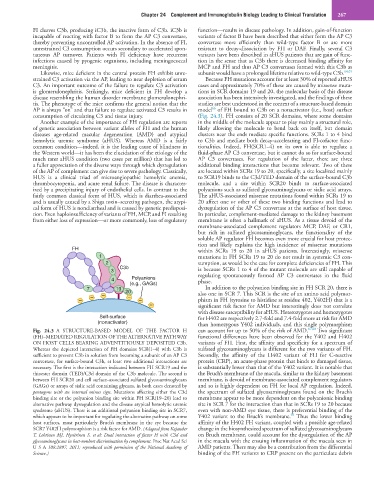
            tis. The phenotype of the mice confirms the general notion that the   studies are best understood in the context of a structure-based domain
                                                                      66
            AP is always “on” and that failure to regulate activated C3 results in   model  of FH bound to C3b on a nonactivator (i.e., host) surface
            consumption of circulating C3 and tissue injury.      (Fig. 24.3). FH consists of 20 SCR domains, where some domains
              Another example of the importance of FH regulation are reports   in the middle of the molecule appear to play mainly a structural role,
            of genetic association between variant alleles of FH and the human   likely  allowing  the  molecule  to  bend  back  on  itself,  but  domain
            diseases  age-related  macular  degeneration  (AMD)  and  atypical   clusters near the ends mediate specific functions. SCRs 1 to 4 bind
            hemolytic  uremic  syndrome  (aHUS).  Whereas  AMD  is  a  fairly   to C3b and mediate both decay-accelerating and FI-cofactor func-
            common condition—indeed, it is the leading cause of blindness in   tionalities.  Indeed,  FH(SCR1–4)  on  its  own  is  able  to  regulate  a
            the Western world—it has been the elucidation of the etiology of the   fluid-phase AP C3 convertase, but it cannot do so for surface-bound
            much rarer aHUS condition (two cases per million) that has led to   AP  C3  convertases.  For  regulation  of  the  latter,  there  are  three
            a fuller appreciation of the diverse ways through which dysregulation   additional binding interactions that become relevant. Two of these
            of the AP of complement can give rise to severe pathology. Classically,   are located within SCRs 19 to 20, specifically, a site localized mainly
            HUS  is  a  clinical  triad  of  microangiopathic  hemolytic  anemia,   to SCR19 binds to the C3d/TED domain of the surface-bound C3b
            thrombocytopenia, and acute renal failure. The disease is character-  molecule,  and  a  site  within  SCR20  binds  to  surface-associated
            ized by a precipitating injury of endothelial cells. In contrast to the   polyanions such as sulfated glycosaminoglycans or sialic acid arrays.
            fairly common classical form of HUS, which is diarrhea-associated   The aHUS-associated missense mutations found within SCRs 19 to
            and is usually caused by a Shiga toxin–secreting pathogen, the atypi-  20 affect one or other of these two binding functions and lead to
            cal form of HUS is nondiarrheal and is caused by genetic predisposi-  dysregulation of the AP C3 convertase at the surface of host tissue.
            tion. Even haploinsufficiency of variants of FH, MCP, and FI resulting   In particular, complement-mediated damage to the kidney basement
            from either loss of expression—or more commonly, loss of regulatory   membrane is often a hallmark of aHUS. As a tissue devoid of the
                                                                  membrane-associated  complement  regulators  MCP,  DAF,  or  CR1,
                                                                  but  rich  in  sulfated  glycosaminoglycans,  the  functionality  of  the
                                                                  soluble AP regulator FH becomes even more crucial for host protec-
                                                                  tion  and  likely  explains  the  high  incidence  of  missense  mutations
                         FH                                       within  SCRs  19  to  20  in  aHUS  patients.  Interestingly,  missense
                                 1                                mutations in FH SCRs 19 to 20 do not result in systemic C3 con-
                                    2                             sumption, as would be the case for complete deficiencies of FH. This
                                        C3b                       is because SCRs 1 to 4 of the mutant molecule are still capable of
                                     3                            regulating  spontaneously  formed  AP  C3  convertases  in  the  fluid
                                     4      Polyanions            phase.
                                           (e.g., GAGs)
                             7         19  20                       In addition to the polyanion binding site in FH SCR 20, there is
                               –  –        –                      also one in SCR 7. This SCR is the site of an amino acid polymor-
                           –                   –                  phism in FH (tyrosine to histidine at residue 402, Y402H) that is a
                                                  –               significant risk factor for AMD but interestingly does not correlate
                                                                  with disease susceptibility for aHUS. Heterozygotes and homozygotes
                                  Self-surface                    for H402 are respectively 2.7-fold and 7.4-fold more at risk for AMD
                                 (nonactivator)                   than homozygous Y402 individuals, and this single polymorphism
            Fig.  24.3  A  STRUCTURE-BASED  MODEL  OF  THE  FACTOR  H   can account for up to 50% of the risk of AMD. 67,68  Two significant
            (FH)–MEDIATED REGULATION OF THE ALTERNATIVE PATHWAY   functional differences have been observed for the Y402 and H402
            ON HOST CELLS BEARING ADVENTITIOUSLY DEPOSITED C3b.   variants of FH. First, the affinity and specificity for a spectrum of
            Whereas  the  depicted  interaction  of  FH  domains  SCR(1–4)  with  C3b  is   sulfated glycosaminoglycans is different for the two variants of FH.
            sufficient to prevent C3b in solution from becoming a subunit of an AP C3   Secondly,  the  affinity  of  the  H402  variant  of  FH  for  C-reactive
            convertase, for surface-bound C3b, at least two additional interactions are   protein (CRP), an acute-phase protein that binds to damaged tissue,
            necessary. The first is the interaction indicated between FH SCR19 and the   is substantially lower than that of the Y402 variant. It is notable that
            thioester domain (TED)/C3d domain of the C3b molecule. The second is   the Bruch’s membrane of the macula, similar to the kidney basement
            between FH SCR20 and cell surface–associated sulfated glycosaminoglycans   membrane, is devoid of membrane-associated complement regulators
            (GAGs) or arrays of sialic acid containing glycans, in both cases denoted by   and so is highly dependent on FH for local AP regulation. Indeed,
            pentagons  with  an  internal  minus  sign.  Mutations  affecting  either  the  C3d   the spectrum of sulfated glycosaminoglycans found on the Bruch’s
            binding site or the polyanion binding site within FH SCR(19–20) lead to   membrane appear to be more dependent on the polyanionic binding
            alternative pathway dysregulation and the disease atypical hemolytic uremic   site in SCR 7 for the interaction than that in SCRs 19 to 20 because
            syndrome (aHUS). There is an additional polyanion binding site in SCR7,   even with non-AMD eye tissue, there is preferential binding of the
                                                                                                69
            which appears to be important for regulating the alternative pathway on some   Y402  variant  to  the  Bruch’s  membrane.  Thus  the  lower  binding
            host  surfaces,  most  particularly  Bruch’s  membrane  in  the  eye  because  the   affinity of the H402 FH variant, coupled with a possible age-related
            SCR7 Y402H polymorphism is a risk factor for AMD. (Adapted from Kajander   change in the biosynthesized spectrum of sulfated glycosaminoglycans
            T,  Lehtinen  MJ,  Hyvärinen  S,  et al:  Dual  interaction  of  factor  H  with  C3d  and   on Bruch membrane, could account for the dysregulation of the AP
            glycosaminoglycans in host-nonhost discrimination by complement. Proc Nat Acad Sci   in the macula with the ensuing inflammation of the macula seen in
            U  S  A  108:2897,  2011;  reproduced  with  permission  of  the  National  Academy  of   AMD patients. There may also be a contribution from the differential
            Science.)                                             binding of the FH variants to CRP present on the particulate debris

