


Page 33 - Hematology_ Basic Principles and Practice ( PDFDrive )
P. 33
Chapter 1  Anatomy and Physiology of the Gene  5


                               A                                 B
                                             3′
                          5′       3′                                                    5′
                              C:G             C:G
                               A:T      5′                                             G:C
                                T:A           A:T                                      A:T    3′
                                 C:G          T:A                                      T:A
                                              C:G   C:G                               C:G
                                 C:G                 A:T                        A:T
                                                                                 C:G
                                A:T                   T:A G:C  G:C     G:C  G:C T:A
                               T:A
                              G:C                             C:G     C:G
                                                              T:A  3′  5′ T:A   5′        C
                             G:C                                T     A       3′                  3′  5′
                              C:G                                 C G
                               T:A                                                              5′
                               T:A
                               C:G                                G:C                        3′
                                                                   C:G
                                                                    T:A
                               G:C                                   T:A                    5′
                                C:G                                                       3′
                                 T:A
                                  T:A                                C:G
                                                                    A:T
                                 C:G                               T:A
                                A:T                               C:G
                                T:A
                              C:G
                                                                  T:A
                                                                   A:T
                              T:A                                   T:A
                               A:T                               3′     5′             5′    3′
                                 T:A
                              5′     3′
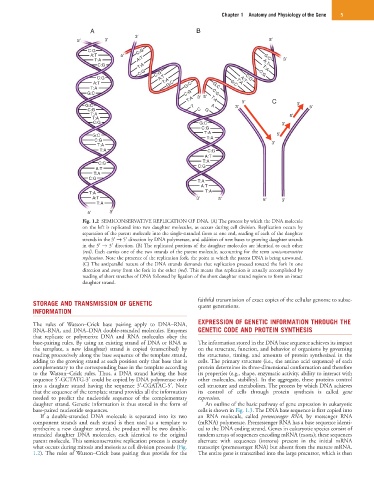
                            Fig. 1.2  SEMICONSERVATIVE REPLICATION OF DNA. (A) The process by which the DNA molecule
                            on the left is replicated into two daughter molecules, as occurs during cell division. Replication occurs by
                            separation of the parent molecule into the single-stranded form at one end, reading of each of the daughter
                            strands in the 3′ → 5′ direction by DNA polymerase, and addition of new bases to growing daughter strands
                            in the 5′ → 3′ direction. (B) The replicated portions of the daughter molecules are identical to each other
                            (red). Each carries one of the two strands of the parent molecule, accounting for the term semiconservative
                            replication. Note the presence of the replication fork, the point at which the parent DNA is being unwound.
                            (C) The antiparallel nature of the DNA strands demands that replication proceed toward the fork in one
                            direction and away from the fork in the other (red). This means that replication is actually accomplished by
                            reading of short stretches of DNA followed by ligation of the short daughter strand regions to form an intact
                            daughter strand.


            STORAGE AND TRANSMISSION OF GENETIC                   faithful transmission of exact copies of the cellular genome to subse-
                                                                  quent generations.
            INFORMATION
                                                                  EXPRESSION OF GENETIC INFORMATION THROUGH THE
            The  rules  of  Watson–Crick  base  pairing  apply  to  DNA–RNA,
            RNA–RNA, and DNA–DNA double-stranded molecules. Enzymes   GENETIC CODE AND PROTEIN SYNTHESIS
            that  replicate  or  polymerize  DNA  and  RNA  molecules  obey  the
            base-pairing rules. By using an existing strand of DNA or RNA as   The information stored in the DNA base sequence achieves its impact
            the  template,  a  new  (daughter)  strand  is  copied  (transcribed)  by   on the structure, function, and behavior of organisms by governing
            reading processively along the base sequence of the template strand,   the  structures,  timing,  and  amounts  of  protein  synthesized  in  the
            adding to the growing strand at each position only that base that is   cells. The primary structure (i.e., the amino acid sequence) of each
            complementary to the corresponding base in the template according   protein determines its three-dimensional conformation and therefore
            to  the  Watson–Crick  rules. Thus,  a  DNA  strand  having  the  base   its properties (e.g., shape, enzymatic activity, ability to interact with
            sequence 5′-GCTATG-3′ could be copied by DNA polymerase only   other molecules, stability). In the aggregate, these proteins control
            into  a  daughter  strand  having  the  sequence  3′-CGATAC-5′.  Note   cell structure and metabolism. The process by which DNA achieves
            that the sequence of the template strand provides all the information   its  control  of  cells  through  protein  synthesis  is  called  gene
            needed  to  predict  the  nucleotide  sequence  of  the  complementary   expression.
            daughter strand. Genetic information is thus stored in the form of   An outline of the basic pathway of gene expression in eukaryotic
            base-paired nucleotide sequences.                     cells is shown in Fig. 1.3. The DNA base sequence is first copied into
              If  a  double-stranded  DNA  molecule  is  separated  into  its  two   an  RNA  molecule,  called  premessenger  RNA,  by  messenger  RNA
            component  strands  and  each  strand  is  then  used  as  a  template  to   (mRNA) polymerase. Premessenger RNA has a base sequence identi-
            synthesize a new daughter strand, the product will be two double-  cal to the DNA coding strand. Genes in eukaryotic species consist of
            stranded  daughter  DNA  molecules,  each  identical  to  the  original   tandem arrays of sequences encoding mRNA (exons); these sequences
            parent molecule. This semiconservative replication process is exactly   alternate  with  sequences  (introns)  present  in  the  initial  mRNA
            what occurs during mitosis and meiosis as cell division proceeds (Fig.   transcript (premessenger RNA) but absent from the mature mRNA.
            1.2). The rules of Watson–Crick base pairing thus provide for the   The entire gene is transcribed into the large precursor, which is then

