


Page 35 - Hematology_ Basic Principles and Practice ( PDFDrive )
P. 35
Chapter 1  Anatomy and Physiology of the Gene  7


                                   a
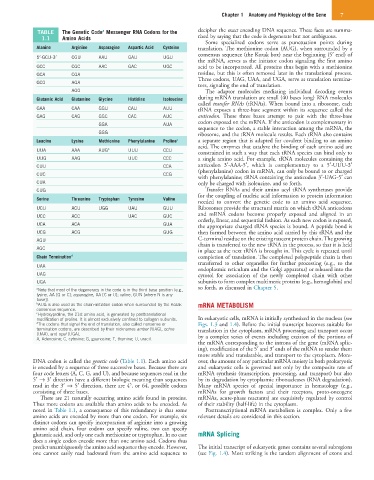
             TABLE   The Genetic Code  Messenger RNA Codons for the   decipher the exact encoding DNA sequence. These facts are summa-
               1.1   Amino Acids                                  rized by saying that the code is degenerate but not ambiguous.
                                                                    Some  specialized  codons  serve  as  punctuation  points  during
             Alanine    Arginine  Asparagine  Aspartic Acid  Cysteine  translation. The methionine codon (AUG), when surrounded by a
             5′-GCU-3′  CGU      AAU       GAU        UGU         consensus sequence (the Kozak box) near the beginning (5′ end) of
                                                                  the mRNA, serves as the initiator codon signaling the first amino
             GCC        CGC      AAC       GAC        UGC         acid to be incorporated. All proteins thus begin with a methionine
             GCA        CGA                                       residue, but this is often removed later in the translational process.
                                                                  Three codons, UAG, UAA, and UGA, serve as translation termina-
             GCG        AGA
                                                                  tors, signaling the end of translation.
                        AGG                                         The  adaptor  molecules  mediating  individual  decoding  events
             Glutamic Acid  Glutamine  Glycine  Histidine  Isoleucine  during mRNA translation are small (40 bases long) RNA molecules
                                                                  called transfer RNAs (tRNAs). When bound into a ribosome, each
             GAA        CAA      GGU       CAU        AUU         tRNA exposes a three-base segment within its sequence called the
             GAG        CAG      GGC       CAC        AUC         anticodon.  These  three  bases  attempt  to  pair  with  the  three-base
                                 GGA                  AUA         codon exposed on the mRNA. If the anticodon is complementary in
                                                                  sequence to the codon, a stable interaction among the mRNA, the
                                 GGG                              ribosome, and the tRNA molecule results. Each tRNA also contains
             Leucine    Lysine   Methionine  Phenylalanine  Proline c  a separate region that is adapted for covalent binding to an amino
                                                                  acid. The enzymes that catalyze the binding of each amino acid are
             UUA        AAA      AUG b     UUU        CCU         constrained in such a way that each tRNA species can bind only to
             UUG        AAG                UUC        CCC         a single amino acid. For example, tRNA molecules containing the
             CUU                                      CCA         anticodon  3′-AAA-5′,  which  is  complementary  to  a  5′-UUU-3′
                                                                  (phenylalanine) codon in mRNA, can only be bound to or charged
             CUC                                      CCG
                                                                  with phenylalanine; tRNA containing the anticodon 3′-UAG-5′ can
             CUA                                                  only be charged with isoleucine, and so forth.
             CUG                                                    Transfer RNAs and their amino acyl tRNA synthetases provide
                                                                  for the coupling of nucleic acid information to protein information
             Serine     Threonine  Tryptophan  Tyrosine  Valine
                                                                  needed  to  convert  the  genetic  code  to  an  amino  acid  sequence.
             UCU        ACU      UGG       UAU        GUU         Ribosomes provide the structural matrix on which tRNA anticodons
             UCC        ACC                UAC        GUC         and  mRNA  codons  become  properly  exposed  and  aligned  in  an
                                                                  orderly, linear, and sequential fashion. As each new codon is exposed,
             UCA        ACA                           GUA         the appropriate charged tRNA species is bound. A peptide bond is
             UCG        ACG                           GUG         then formed between the amino acid carried by this tRNA and the
             AGU                                                  C-terminal residue on the existing nascent protein chain. The growing
                                                                  chain is transferred to the new tRNA in the process, so that it is held
             AGC
                                                                  in place as the next tRNA is brought in. This cycle is repeated until
             Chain Termination d                                  completion of translation. The completed polypeptide chain is then
                                                                  transferred  to  other  organelles  for  further  processing  (e.g.,  to  the
             UAA
                                                                  endoplasmic reticulum and the Golgi apparatus) or released into the
             UAG                                                  cytosol  for  association  of  the  newly  completed  chain  with  other
             UGA                                                  subunits to form complex multimeric proteins (e.g., hemoglobin) and
             a Note that most of the degeneracy in the code is in the third base position (e.g.,   so forth, as discussed in Chapter 5.
             lysine, AA [G or C]; asparagine, AA [C or U]; valine, GUN [where N is any
             base]).
             b AUG is also used as the chain-initiation codon when surrounded by the Kozak   mRNA METABOLISM
             consensus sequence.
             c Hydroxyproline, the 21st amino acid, is generated by posttranslational
             modification of proline. It is almost exclusively confined to collagen subunits.  In eukaryotic cells, mRNA is initially synthesized in the nucleus (see
             d The codons that signal the end of translation, also called nonsense or   Figs. 1.3 and 1.4). Before the initial transcript becomes suitable for
             termination codons, are described by their nicknames amber (UAG), ochre   translation in the cytoplasm, mRNA processing and transport occur
             (UAA), and opal (UGA).                               by a complex series of events including excision of the portions of
             A, Adenosine; C, cytosine; G, guanosine; T, thymine; U, uracil.
                                                                  the mRNA corresponding to the introns of the gene (mRNA splic-
                                                                  ing), modification of the 5′ and 3′ ends of the mRNA to render them
                                                                  more stable and translatable, and transport to the cytoplasm. More-
            DNA codon is called the genetic code (Table 1.1). Each amino acid   over, the amount of any particular mRNA moiety in both prokaryotic
            is encoded by a sequence of three successive bases. Because there are   and eukaryotic cells is governed not only by the composite rate of
            four code letters (A, C, G, and U), and because sequences read in the   mRNA synthesis (transcription, processing, and transport) but also
            5′ → 3′ direction have a different biologic meaning than sequences   by its degradation by cytoplasmic ribonucleases (RNA degradation).
                                           3
            read in the 3′ → 5′ direction, there are 4 , or 64, possible codons   Many  mRNA  species  of  special  importance  in  hematology  (e.g.,
            consisting of three bases.                            mRNAs  for  growth  factors  and  their  receptors,  proto-oncogene
              There are 21 naturally occurring amino acids found in proteins.   mRNAs, acute-phase reactants) are exquisitely regulated by control
            Thus more codons are available than amino acids to be encoded. As   of their stability (half-life) in the cytoplasm.
            noted  in Table  1.1,  a  consequence  of  this  redundancy  is  that  some   Posttranscriptional  mRNA  metabolism  is  complex.  Only  a  few
            amino acids are encoded by more than one codon. For example, six   relevant details are considered in this section.
            distinct codons can specify incorporation of arginine into a growing
            amino  acid  chain,  four  codons  can  specify  valine,  two  can  specify
            glutamic acid, and only one each methionine or tryptophan. In no case   mRNA Splicing
            does a single codon encode more than one amino acid. Codons thus
            predict unambiguously the amino acid sequence they encode. However,   The initial transcript of eukaryotic genes contains several subregions
            one  cannot  easily  read  backward  from  the  amino  acid  sequence  to   (see Fig. 1.4). Most striking is the tandem alignment of exons and

