


Page 36 - Hematology_ Basic Principles and Practice ( PDFDrive )
P. 36
8     Part I  Molecular and Cellular Basis of Hematology


                                                       Intron
                        5  “CAP”            GU   AG    GU     AG     GU     AG         (poly A tail)-3
                               5  UT                                           3  UT
                                          Splice           Splice
                                          donor           acceptor
                                          site  Splicing    site

                                              Protein coding sequence
                                5  “CAP”                                  (poly A tail)-3
                               “CAP” site                               Poly (A) signal:
                               (1st base                                5  - - - AUAA- - -AAAA(A)- - -3
                              transcribed)
                                        Translation    Termination    Elements involved in
                                      start site: AUG  of translation:  control of stability ~20 bp
                                                       UAG, UAA,      (e.g., AU rich = unstable
                                                     or UGA codon     mRNA)
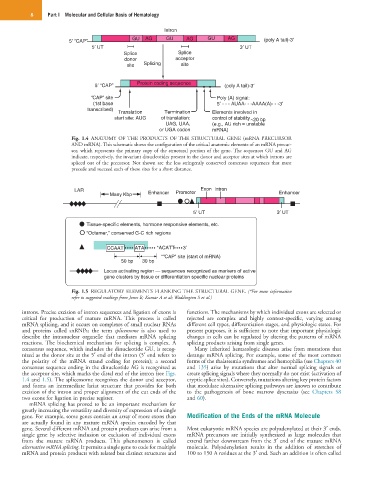
                        Fig.  1.4  ANATOMY  OF THE  PRODUCTS  OF THE  STRUCTURAL  GENE  (mRNA  PRECURSOR
                        AND mRNA). This schematic shows the configuration of the critical anatomic elements of an mRNA precur-
                        sor, which represents the primary copy of the structural portion of the gene. The sequences GU and AG
                        indicate, respectively, the invariant dinucleotides present in the donor and acceptor sites at which introns are
                        spliced out of the precursor. Not shown are the less stringently conserved consensus sequences that must
                        precede and succeed each of these sites for a short distance.


                         LAR                                       Exon Intron
                                     Many Kbp    Enhancer  Promoter                         Enhancer


                                                                5  UT                       3  UT
                             Tissue-specific elements, hormone responsive elements, etc.
                             “Octamer,” conserved G-C rich regions

                                    CCAAT    ATA    *ACATT      3
                                                      *“CAP” site (start of mRNA)
                                         50 bp  30 bp
                                   Locus activating region — sequences recognized as markers of active
                                   gene clusters by tissue or differentiation specific nuclear proteins

                        Fig. 1.5  REGULATORY ELEMENTS FLANKING THE STRUCTURAL GENE. (*For more information
                        refer to suggested readings from Jones B; Kumar A et al; Waddington S et al.)

        introns. Precise excision of intron sequences and ligation of exons is   functions. The mechanisms by which individual exons are selected or
        critical  for  production  of  mature  mRNA.  This  process  is  called   rejected  are  complex  and  highly  context-specific,  varying  among
        mRNA splicing, and it occurs on complexes of small nuclear RNAs   different cell types, differentiation stages, and physiologic states. For
        and  proteins  called  snRNPs;  the  term  spliceosome  is  also  used  to   present purposes, it is sufficient to note that important physiologic
        describe  the  intranuclear  organelle  that  mediates  mRNA  splicing   changes in cells can be regulated by altering the patterns of mRNA
        reactions. The  biochemical  mechanism  for  splicing  is  complex.  A   splicing products arising from single genes.
        consensus sequence, which includes the dinucleotide GU, is recog-  Many  inherited  hematologic  diseases  arise from  mutations  that
        nized as the donor site at the 5′ end of the intron (5′ end refers to   derange mRNA splicing. For example, some of the most common
        the  polarity  of  the  mRNA  strand  coding  for  protein);  a  second   forms of the thalassemia syndromes and hemophilia (see Chapters 40
        consensus sequence ending in the dinucleotide AG is recognized as   and  135)  arise  by  mutations  that  alter  normal  splicing  signals  or
        the acceptor site, which marks the distal end of the intron (see Figs.   create splicing signals where they normally do not exist (activation of
        1.4 and 1.5). The spliceosome recognizes the donor and acceptor,   cryptic splice sites). Conversely, mutations altering key protein factors
        and  forms  an  intermediate  lariat  structure  that  provides  for  both   that modulate alternative splicing pathways are known to contribute
        excision of the intron and proper alignment of the cut ends of the   to  the  pathogenesis  of  bone  marrow  dyscrasias  (see  Chapters  58
        two exons for ligation in precise register.           and 60).
           mRNA splicing has proved to be an important mechanism for
        greatly increasing the versatility and diversity of expression of a single
        gene. For example, some genes contain an array of more exons than   Modification of the Ends of the mRNA Molecule
        are  actually  found  in  any  mature  mRNA  species  encoded  by  that
        gene. Several different mRNA and protein products can arise from a   Most eukaryotic mRNA species are polyadenylated at their 3′ ends.
        single  gene  by  selective  inclusion  or  exclusion  of  individual  exons   mRNA  precursors  are  initially  synthesized  as  large  molecules  that
        from  the  mature  mRNA  products.  This  phenomenon  is  called   extend farther downstream from the 3′ end of the mature mRNA
        alternative mRNA splicing. It permits a single gene to code for multiple   molecule.  Polyadenylation  results  in  the  addition  of  stretches  of
        mRNA and protein products with related but distinct structures and   100 to 150 A residues at the 3′ end. Such an addition is often called

