


Page 350 - Hematology_ Basic Principles and Practice ( PDFDrive )
P. 350
286    Part III  Immunologic Basis of Hematology


                                                                       Clonal        Memory
                                                                      disability       B

                                      T-cell help
                          T-cell tolerance
                                               Auto-antigen
                                                                                     Memory
                                                             Activated                 B
                                                               B
                                                                                 Memory foundation
                       Pre-B     Immature      Virgin
                                    B            B
                       slgM−      slgM +       slgM +  Clonal
                                                    anergy   Activated                      Plasma
                                                               B
                                        Clonal                                               cell
                                       deletion               Clonal
                                                            expansion

                            Bone marrow          Spleen

                                                                                           Plasma
                                                                                             cell
                                                                                 Secretion
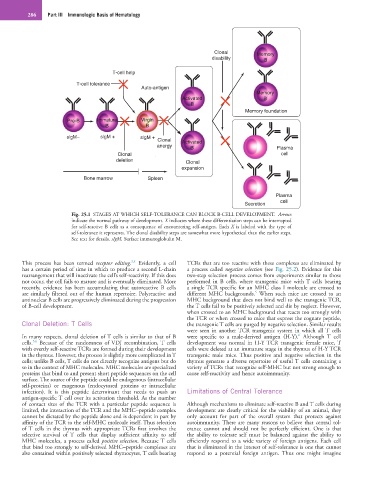
                        Fig. 25.1  STAGES AT WHICH SELF-TOLERANCE CAN BLOCK B-CELL DEVELOPMENT.  Arrows
                        indicate the normal pathway of development. X indicates where these differentiation steps can be interrupted
                        for  self-reactive  B  cells  as  a  consequence  of  encountering  self-antigen.  Each  X  is  labeled  with  the  type  of
                        self-tolerance it represents. The clonal disability steps are somewhat more hypothetical than the earlier steps.
                        See text for details. sIgM, Surface immunoglobulin M.


                                            3,4
        This  process  has  been  termed  receptor  editing.   Evidently,  a  cell   TCRs that are too reactive with these complexes are eliminated by
        has a certain period of time in which to produce a second L-chain   a process called negative selection (see Fig. 25.2). Evidence for this
        rearrangement that will inactivate the cell’s self-reactivity. If this does   two-step selection process comes from experiments similar to those
        not occur, the cell fails to mature and is eventually eliminated. More   performed  in  B  cells,  where  transgenic  mice  with T  cells  bearing
        recently,  evidence  has  been  accumulating  that  autoreactive  B  cells   a single TCR specific for an MHC class I molecule are crossed to
                                                                                    5
        are similarly filtered out of the human repertoire. Polyreactive and   different  MHC  backgrounds.   When  such  mice  are  crossed  to  an
        antinuclear B cells are progressively eliminated during the progression   MHC background that does not bind well to the transgenic TCR,
        of B-cell development.                                the T cells fail to be positively selected and die by neglect. However,
                                                              when crossed to an MHC background that reacts too strongly with
                                                              the TCR or when crossed to mice that express the cognate peptide,
        Clonal Deletion: T Cells                              the transgenic T cells are purged by negative selection. Similar results
                                                              were  seen  in  another TCR  transgenic  system  in  which  all T  cells
                                                                                                   6
        In many respects, clonal deletion of T cells is similar to that of B   were  specific  to  a  male-derived  antigen  (H-Y).   Although  T  cell
            5,6
        cells.  Because of the randomness of VDJ recombination, T cells   development  was  normal  in  H-Y TCR  transgenic  female  mice, T
        with overtly self-reactive TCRs are formed during their development   cells were deleted at an immature stage in the thymus of H-Y TCR
        in the thymus. However, the process is slightly more complicated in T   transgenic  male  mice. Thus  positive  and  negative  selection  in  the
        cells; unlike B cells, T cells do not directly recognize antigens but do   thymus generate a diverse repertoire of useful T cells containing a
        so in the context of MHC molecules. MHC molecules are specialized   variety of TCRs that recognize self-MHC but not strong enough to
        proteins that bind to and present short peptide sequences on the cell   cause self-reactivity and hence autoimmunity.
        surface. The source of the peptide could be endogenous (intracellular
        self-proteins)  or  exogenous  (endocytosed  proteins  or  intracellular
        infection).  It  is  this  peptide  determinant  that  needs  to  push  an   Limitations of Central Tolerance
        antigen-specific T cell over its activation threshold. As the number
        of  contact  sites  of  the TCR  with  a  particular  peptide  sequence  is   Although mechanisms to eliminate self-reactive B and T cells during
        limited, the interaction of the TCR and the MHC−peptide complex   development are clearly critical for the viability of an animal, they
        cannot be dictated by the peptide alone and is dependent in part by   only  account  for  part  of  the  overall  system  that  protects  against
        affinity of the TCR to the self-MHC molecule itself. Thus selection   autoimmunity. There are many reasons to believe that central tol-
        of T  cells  in  the  thymus  with  appropriate TCRs  first  involves  the   erance  cannot  and  should  not  be  perfectly  efficient.  One  is  that
        selective  survival  of  T  cells  that  display  sufficient  affinity  to  self   the  ability  to  tolerate  self  must  be  balanced  against  the  ability  to
        MHC molecules, a process called positive selection. Because T cells   efficiently respond to a wide variety of foreign antigens. Each cell
        that bind too strongly to self-derived MHC−peptide complexes are   that is eliminated in the interest of self-tolerance is one that cannot
        also contained within positively selected thymocytes, T cells bearing   respond  to  a  potential  foreign  antigen.  Thus  one  might  imagine

